For decades, gold has anchored global portfolios as the quintessential safe-haven asset. But in the past ten years, bitcoin has rapidly emerged as its digital counterpart — and, in many cases, its outperformer. New research from Dovile Silenskyte, Director of Digital Assets Research at WisdomTree, suggests that investors may no longer need to choose between the two. Instead, the data increasingly supports a combined approach, where gold provides stability and bitcoin offers asymmetric upside. Gold vs. Bitcoin: A Changing Store-of-Value Hierarchy Gold’s safe-haven characteristics remain structurally intact. Its scarcity, established role in global markets and historical performance during periods of stress have kept it resilient. Since 2013, gold posted annualised returns of 10.4% with 14.5% volatility, delivering a Sharpe ratio of 0.6, according to Silenskyte’s analysis. Bitcoin, however, has shifted the paradigm. Over the same period, it generated annualised returns of 50.5% with 67.0% volatility, resulting in a Sharpe ratio of 0.7 — marginally outperforming gold on a risk-adjusted basis despite its extreme swings. On the Sortino ratio, which focuses on downside risk, the gap is even wider: 1.0 for bitcoin versus 0.3 for gold. In simple terms, bitcoin has historically compensated investors more efficiently for the risk taken. “Even with high volatility, bitcoin has offered superior risk-adjusted returns,” Silenskyte notes. Bitcoin Volatility: From Barrier to Manageable Risk Bitcoin’s volatility is frequently cited as the primary reason some investors remain hesitant. Yet Silenskyte’s research shows that this volatility has declined significantly over the past decade. Its 90-day annualised volatility has compressed from above 150% to under 40%, putting it within range of several commodities. At the same time, liquidity has deepened, with daily spot volumes comparable to major S&P 500 equities. Derivatives markets — particularly futures and options — provide sophisticated hedging tools that make volatility increasingly manageable for institutional allocators. “Volatility is a tax, but a declining one,” Silenskyte says. Macro Conditions Favour a Combined Allocation Rather than competing, bitcoin and gold appear to hedge different types of macro risk. Gold thrives during inflation, geopolitical turmoil and periods of negative real yields. Bitcoin, with its 21-million-supply cap and decentralised issuance, serves as a hedge against fiat debasement and technological disruption. Importantly, bitcoin and gold display a low long-term correlation of just 6%, according to WisdomTree. This gives them powerful diversification properties: gold anchors the defensive side of a portfolio, while bitcoin provides convex upside driven by digital adoption. Portfolio Implications: Not Either-Or, but Both WisdomTree’s modelling shows that adding even 1% bitcoin to a traditional 60/40 portfolio can increase the Sharpe ratio by 0.06, with only a marginal change in maximum drawdowns. The takeaway from Silenskyte’s research is clear: gold remains foundational, but bitcoin enhances the opportunity set. As digital assets mature, the case for treating the two as complementary hedges — not rivals — becomes stronger. Together, they broaden the safe-haven spectrum for the modern investorFor decades, gold has anchored global portfolios as the quintessential safe-haven asset. But in the past ten years, bitcoin has rapidly emerged as its digital counterpart — and, in many cases, its outperformer. New research from Dovile Silenskyte, Director of Digital Assets Research at WisdomTree, suggests that investors may no longer need to choose between the two. Instead, the data increasingly supports a combined approach, where gold provides stability and bitcoin offers asymmetric upside. Gold vs. Bitcoin: A Changing Store-of-Value Hierarchy Gold’s safe-haven characteristics remain structurally intact. Its scarcity, established role in global markets and historical performance during periods of stress have kept it resilient. Since 2013, gold posted annualised returns of 10.4% with 14.5% volatility, delivering a Sharpe ratio of 0.6, according to Silenskyte’s analysis. Bitcoin, however, has shifted the paradigm. Over the same period, it generated annualised returns of 50.5% with 67.0% volatility, resulting in a Sharpe ratio of 0.7 — marginally outperforming gold on a risk-adjusted basis despite its extreme swings. On the Sortino ratio, which focuses on downside risk, the gap is even wider: 1.0 for bitcoin versus 0.3 for gold. In simple terms, bitcoin has historically compensated investors more efficiently for the risk taken. “Even with high volatility, bitcoin has offered superior risk-adjusted returns,” Silenskyte notes. Bitcoin Volatility: From Barrier to Manageable Risk Bitcoin’s volatility is frequently cited as the primary reason some investors remain hesitant. Yet Silenskyte’s research shows that this volatility has declined significantly over the past decade. Its 90-day annualised volatility has compressed from above 150% to under 40%, putting it within range of several commodities. At the same time, liquidity has deepened, with daily spot volumes comparable to major S&P 500 equities. Derivatives markets — particularly futures and options — provide sophisticated hedging tools that make volatility increasingly manageable for institutional allocators. “Volatility is a tax, but a declining one,” Silenskyte says. Macro Conditions Favour a Combined Allocation Rather than competing, bitcoin and gold appear to hedge different types of macro risk. Gold thrives during inflation, geopolitical turmoil and periods of negative real yields. Bitcoin, with its 21-million-supply cap and decentralised issuance, serves as a hedge against fiat debasement and technological disruption. Importantly, bitcoin and gold display a low long-term correlation of just 6%, according to WisdomTree. This gives them powerful diversification properties: gold anchors the defensive side of a portfolio, while bitcoin provides convex upside driven by digital adoption. Portfolio Implications: Not Either-Or, but Both WisdomTree’s modelling shows that adding even 1% bitcoin to a traditional 60/40 portfolio can increase the Sharpe ratio by 0.06, with only a marginal change in maximum drawdowns. The takeaway from Silenskyte’s research is clear: gold remains foundational, but bitcoin enhances the opportunity set. As digital assets mature, the case for treating the two as complementary hedges — not rivals — becomes stronger. Together, they broaden the safe-haven spectrum for the modern investor

Bitcoin and Gold: A New Era of Complementary Safe-Haven Assets, Says WisdomTree Analyst

2025/11/14 22:18
3 min read
For feedback or concerns regarding this content, please contact us at [email protected]

For decades, gold has anchored global portfolios as the quintessential safe-haven asset. But in the past ten years, bitcoin has rapidly emerged as its digital counterpart — and, in many cases, its outperformer.

New research from Dovile Silenskyte, Director of Digital Assets Research at WisdomTree, suggests that investors may no longer need to choose between the two. Instead, the data increasingly supports a combined approach, where gold provides stability and bitcoin offers asymmetric upside.

Gold vs. Bitcoin: A Changing Store-of-Value Hierarchy

Gold’s safe-haven characteristics remain structurally intact. Its scarcity, established role in global markets and historical performance during periods of stress have kept it resilient.

Since 2013, gold posted annualised returns of 10.4% with 14.5% volatility, delivering a Sharpe ratio of 0.6, according to Silenskyte’s analysis.
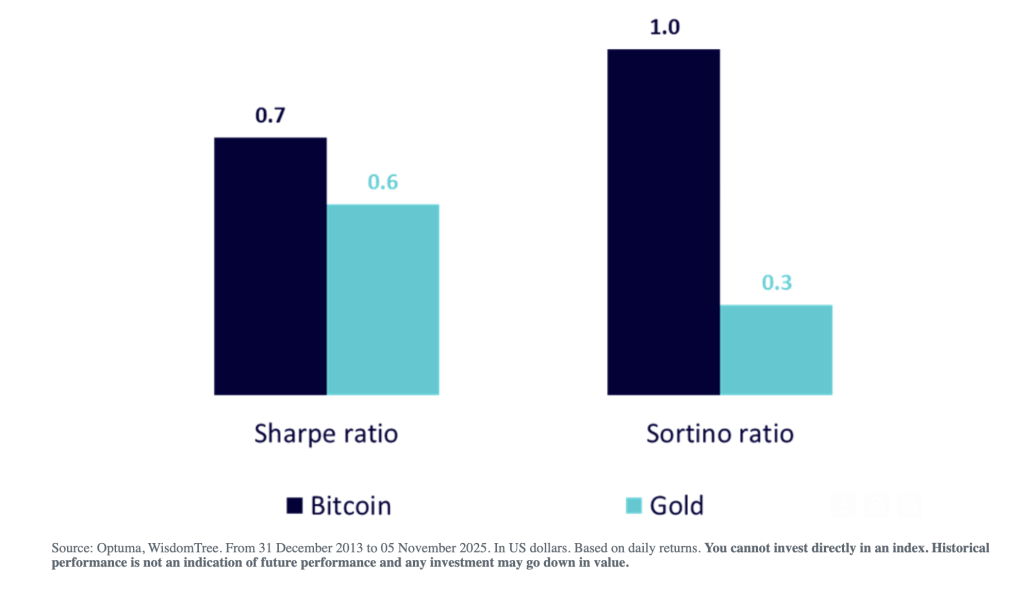
Bitcoin, however, has shifted the paradigm. Over the same period, it generated annualised returns of 50.5% with 67.0% volatility, resulting in a Sharpe ratio of 0.7 — marginally outperforming gold on a risk-adjusted basis despite its extreme swings.

On the Sortino ratio, which focuses on downside risk, the gap is even wider: 1.0 for bitcoin versus 0.3 for gold. In simple terms, bitcoin has historically compensated investors more efficiently for the risk taken.

“Even with high volatility, bitcoin has offered superior risk-adjusted returns,” Silenskyte notes.

Bitcoin Volatility: From Barrier to Manageable Risk

Bitcoin’s volatility is frequently cited as the primary reason some investors remain hesitant. Yet Silenskyte’s research shows that this volatility has declined significantly over the past decade. Its 90-day annualised volatility has compressed from above 150% to under 40%, putting it within range of several commodities.

At the same time, liquidity has deepened, with daily spot volumes comparable to major S&P 500 equities. Derivatives markets — particularly futures and options — provide sophisticated hedging tools that make volatility increasingly manageable for institutional allocators.

“Volatility is a tax, but a declining one,” Silenskyte says.

Macro Conditions Favour a Combined Allocation

Rather than competing, bitcoin and gold appear to hedge different types of macro risk. Gold thrives during inflation, geopolitical turmoil and periods of negative real yields. Bitcoin, with its 21-million-supply cap and decentralised issuance, serves as a hedge against fiat debasement and technological disruption.

Importantly, bitcoin and gold display a low long-term correlation of just 6%, according to WisdomTree. This gives them powerful diversification properties: gold anchors the defensive side of a portfolio, while bitcoin provides convex upside driven by digital adoption.

Portfolio Implications: Not Either-Or, but Both

WisdomTree’s modelling shows that adding even 1% bitcoin to a traditional 60/40 portfolio can increase the Sharpe ratio by 0.06, with only a marginal change in maximum drawdowns.

The takeaway from Silenskyte’s research is clear: gold remains foundational, but bitcoin enhances the opportunity set. As digital assets mature, the case for treating the two as complementary hedges — not rivals — becomes stronger.

Together, they broaden the safe-haven spectrum for the modern investor.

Market Opportunity
ERA Logo
ERA Price(ERA)
$0,1396
$0,1396$0,1396
-0,56%
USD
ERA (ERA) Live Price Chart
Disclaimer: The articles reposted on this site are sourced from public platforms and are provided for informational purposes only. They do not necessarily reflect the views of MEXC. All rights remain with the original authors. If you believe any content infringes on third-party rights, please contact [email protected] for removal. MEXC makes no guarantees regarding the accuracy, completeness, or timeliness of the content and is not responsible for any actions taken based on the information provided. The content does not constitute financial, legal, or other professional advice, nor should it be considered a recommendation or endorsement by MEXC.

You May Also Like

Red state lawmaker warns something ominous hiding behind Supreme Court's 'five alarm fire'

Red state lawmaker warns something ominous hiding behind Supreme Court's 'five alarm fire'

A former lawmaker from a red state warned that something ominous is hiding behind the latest "five-alarm fire" from the Supreme Court, according to a new report
Share
Rawstory2026/05/15 08:07
One Of Frank Sinatra’s Most Famous Albums Is Back In The Spotlight

One Of Frank Sinatra’s Most Famous Albums Is Back In The Spotlight

The post One Of Frank Sinatra’s Most Famous Albums Is Back In The Spotlight appeared on BitcoinEthereumNews.com. Frank Sinatra’s The World We Knew returns to the Jazz Albums and Traditional Jazz Albums charts, showing continued demand for his timeless music. Frank Sinatra performs on his TV special Frank Sinatra: A Man and his Music Bettmann Archive These days on the Billboard charts, Frank Sinatra’s music can always be found on the jazz-specific rankings. While the art he created when he was still working was pop at the time, and later classified as traditional pop, there is no such list for the latter format in America, and so his throwback projects and cuts appear on jazz lists instead. It’s on those charts where Sinatra rebounds this week, and one of his popular projects returns not to one, but two tallies at the same time, helping him increase the total amount of real estate he owns at the moment. Frank Sinatra’s The World We Knew Returns Sinatra’s The World We Knew is a top performer again, if only on the jazz lists. That set rebounds to No. 15 on the Traditional Jazz Albums chart and comes in at No. 20 on the all-encompassing Jazz Albums ranking after not appearing on either roster just last frame. The World We Knew’s All-Time Highs The World We Knew returns close to its all-time peak on both of those rosters. Sinatra’s classic has peaked at No. 11 on the Traditional Jazz Albums chart, just missing out on becoming another top 10 for the crooner. The set climbed all the way to No. 15 on the Jazz Albums tally and has now spent just under two months on the rosters. Frank Sinatra’s Album With Classic Hits Sinatra released The World We Knew in the summer of 1967. The title track, which on the album is actually known as “The World We Knew (Over and…

Share
BitcoinEthereumNews2025/09/18 00:02
Data focus shifts to payrolls – Societe Generale

Data focus shifts to payrolls – Societe Generale

The post Data focus shifts to payrolls – Societe Generale appeared on BitcoinEthereumNews.com. Societe Generale analysts note a quiet data calendar ahead of key
Share
BitcoinEthereumNews2026/04/02 17:52

KAIO Global Debut

KAIO Global DebutKAIO Global Debut

Enjoy 0-fee KAIO trading and tap into the RWA boom


