An analyst has pointed out how a sort of supply “air gap” exists for Solana below $144, with no major on-chain support levels until much lower. Solana URPD Reveals Supply Chasm Below $144 In a new post on X, analyst Ali Martinez has talked about how Solana support is looking from an on-chain lens. In on-chain analysis, the potential of any price level to act as support or resistance lies in the amount of coins that investors last purchased at it. Related Reading: Bitcoin Crashes To $98,000 As HODLer Selling Accelerates The reasoning behind this is that holders look at their cost basis as a special level and are sensitive to retests of it. The more holders that have their cost basis at a particular level, the larger the reaction from a retest could theoretically be. As for what the nature of this reaction is likely to be, it comes down to the direction of the retest, as well as the mood in the market. When the retest occurs from above, holders might decide to accumulate more, thinking that the decline is a temporary dip and they would return in profit again. Retests of major supply levels from above can, for this reason, provide support to the cryptocurrency. Similarly, retests in the opposite direction may be met with resistance, as holders panic exit at their break-even level, fearing going underwater again. To showcase how the supply cost basis distribution on the Solana network is like right now, Martinez has shared the data of the UTXO Realized Price Distribution (URPD) from Glassnode. As is visible in the above graph, the largest Solana supply zones on this indicator are all located above $144. Below this level, the cryptocurrency has relatively thin clusters. “There’s barely any meaningful demand until $24,” noted the analyst. SOL has already started slipping under the last major support level of $144, so it only remains to be seen how the cryptocurrency will develop in the near future, considering the lack of any meaningful on-chain support cushions. Related Reading: Bitcoin Sentiment Most Fearful Since March: Is A Bottom Near? In a separate X post, Martinez has also shared the URPD data for Bitcoin. Unlike Solana, the number one cryptocurrency’s supply distribution is more even, meaning the asset has levels to rely on below the current range. In particular, $82,000 and $67,000 are two levels below $95,000 that hold the cost basis of a significant amount of supply, and thus, could potentially be support barriers on the way down. SOL Price Solana dropped to $135 during its latest plunge, but the coin has since recovered back to $141. Featured image from Dall-E, Glassnode.com, chart from TradingView.comAn analyst has pointed out how a sort of supply “air gap” exists for Solana below $144, with no major on-chain support levels until much lower. Solana URPD Reveals Supply Chasm Below $144 In a new post on X, analyst Ali Martinez has talked about how Solana support is looking from an on-chain lens. In on-chain analysis, the potential of any price level to act as support or resistance lies in the amount of coins that investors last purchased at it. Related Reading: Bitcoin Crashes To $98,000 As HODLer Selling Accelerates The reasoning behind this is that holders look at their cost basis as a special level and are sensitive to retests of it. The more holders that have their cost basis at a particular level, the larger the reaction from a retest could theoretically be. As for what the nature of this reaction is likely to be, it comes down to the direction of the retest, as well as the mood in the market. When the retest occurs from above, holders might decide to accumulate more, thinking that the decline is a temporary dip and they would return in profit again. Retests of major supply levels from above can, for this reason, provide support to the cryptocurrency. Similarly, retests in the opposite direction may be met with resistance, as holders panic exit at their break-even level, fearing going underwater again. To showcase how the supply cost basis distribution on the Solana network is like right now, Martinez has shared the data of the UTXO Realized Price Distribution (URPD) from Glassnode. As is visible in the above graph, the largest Solana supply zones on this indicator are all located above $144. Below this level, the cryptocurrency has relatively thin clusters. “There’s barely any meaningful demand until $24,” noted the analyst. SOL has already started slipping under the last major support level of $144, so it only remains to be seen how the cryptocurrency will develop in the near future, considering the lack of any meaningful on-chain support cushions. Related Reading: Bitcoin Sentiment Most Fearful Since March: Is A Bottom Near? In a separate X post, Martinez has also shared the URPD data for Bitcoin. Unlike Solana, the number one cryptocurrency’s supply distribution is more even, meaning the asset has levels to rely on below the current range. In particular, $82,000 and $67,000 are two levels below $95,000 that hold the cost basis of a significant amount of supply, and thus, could potentially be support barriers on the way down. SOL Price Solana dropped to $135 during its latest plunge, but the coin has since recovered back to $141. Featured image from Dall-E, Glassnode.com, chart from TradingView.com

Solana Air Gap: Analyst Says No Major Support Level Until $24

2025/11/15 08:00

An analyst has pointed out how a sort of supply “air gap” exists for Solana below $144, with no major on-chain support levels until much lower.

Solana URPD Reveals Supply Chasm Below $144

In a new post on X, analyst Ali Martinez has talked about how Solana support is looking from an on-chain lens. In on-chain analysis, the potential of any price level to act as support or resistance lies in the amount of coins that investors last purchased at it.

The reasoning behind this is that holders look at their cost basis as a special level and are sensitive to retests of it. The more holders that have their cost basis at a particular level, the larger the reaction from a retest could theoretically be.

As for what the nature of this reaction is likely to be, it comes down to the direction of the retest, as well as the mood in the market. When the retest occurs from above, holders might decide to accumulate more, thinking that the decline is a temporary dip and they would return in profit again.

Retests of major supply levels from above can, for this reason, provide support to the cryptocurrency. Similarly, retests in the opposite direction may be met with resistance, as holders panic exit at their break-even level, fearing going underwater again.

To showcase how the supply cost basis distribution on the Solana network is like right now, Martinez has shared the data of the UTXO Realized Price Distribution (URPD) from Glassnode.

Solana URPD

As is visible in the above graph, the largest Solana supply zones on this indicator are all located above $144. Below this level, the cryptocurrency has relatively thin clusters. “There’s barely any meaningful demand until $24,” noted the analyst.

SOL has already started slipping under the last major support level of $144, so it only remains to be seen how the cryptocurrency will develop in the near future, considering the lack of any meaningful on-chain support cushions.

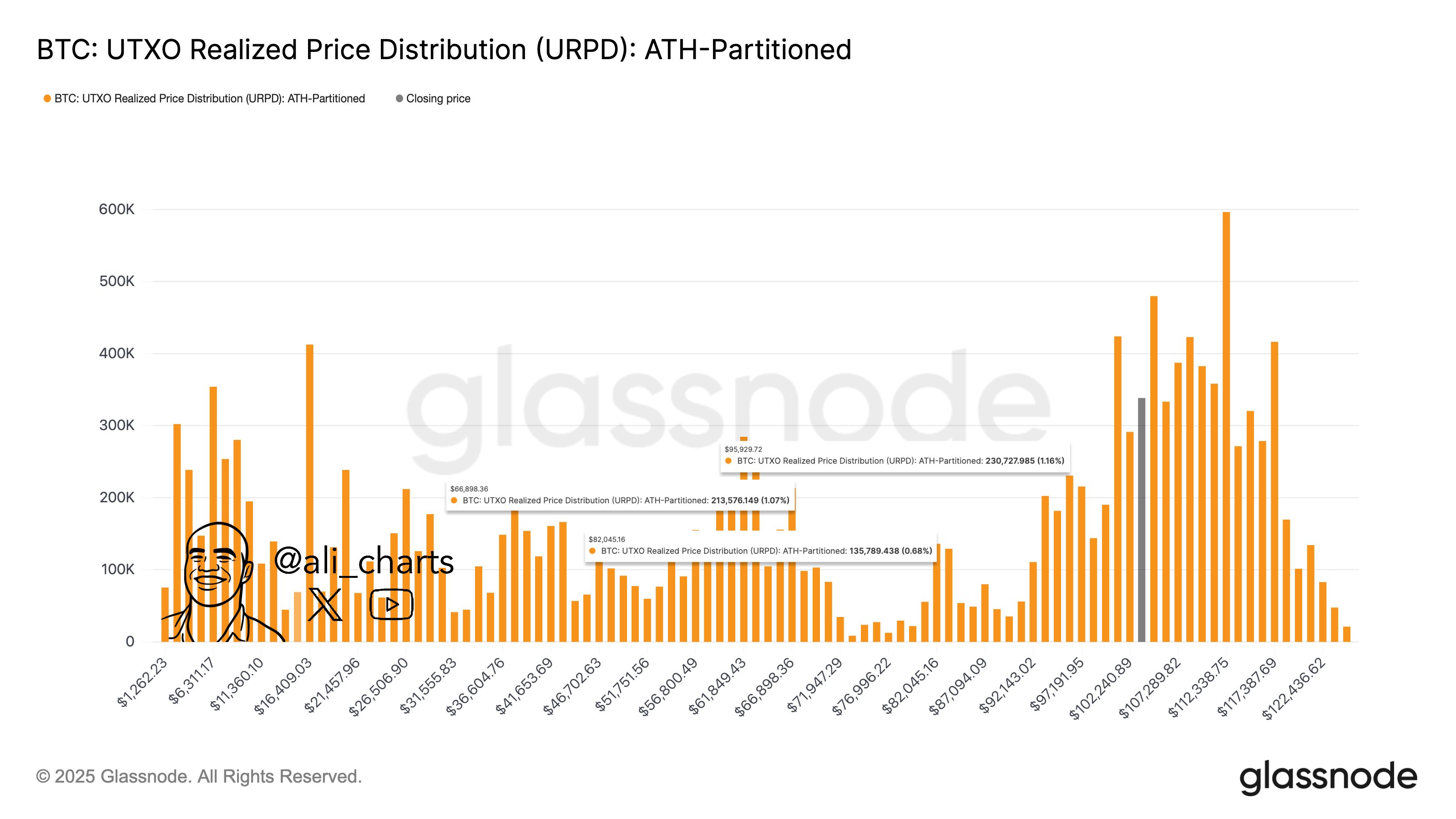
In a separate X post, Martinez has also shared the URPD data for Bitcoin. Unlike Solana, the number one cryptocurrency’s supply distribution is more even, meaning the asset has levels to rely on below the current range.
Bitcoin URPD

In particular, $82,000 and $67,000 are two levels below $95,000 that hold the cost basis of a significant amount of supply, and thus, could potentially be support barriers on the way down.

SOL Price

Solana dropped to $135 during its latest plunge, but the coin has since recovered back to $141.

Solana Price Chart
Market Opportunity
Major Logo
Major Price(MAJOR)
$0.11217
$0.11217$0.11217
-0.21%
USD
Major (MAJOR) Live Price Chart
Disclaimer: The articles reposted on this site are sourced from public platforms and are provided for informational purposes only. They do not necessarily reflect the views of MEXC. All rights remain with the original authors. If you believe any content infringes on third-party rights, please contact [email protected] for removal. MEXC makes no guarantees regarding the accuracy, completeness, or timeliness of the content and is not responsible for any actions taken based on the information provided. The content does not constitute financial, legal, or other professional advice, nor should it be considered a recommendation or endorsement by MEXC.

You May Also Like

Bitcoin Has Taken Gold’s Role In Today’s World, Eric Trump Says

Bitcoin Has Taken Gold’s Role In Today’s World, Eric Trump Says

Eric Trump on Tuesday described Bitcoin as a “modern-day gold,” calling it a liquid store of value that can act as a hedge to real estate and other assets. Related Reading: XRP’s Biggest Rally Yet? Analyst Projects $20+ In October 2025 According to reports, the remark came during a TV appearance on CNBC’s Squawk Box, tied to the launch of American Bitcoin, the mining and treasury firm he helped start. Company Holdings And Strategy Based on public filings and company summaries, American Bitcoin has accumulated 2,443 BTC on its balance sheet. That stash has been valued in the low hundreds of millions of dollars at recent spot prices. The firm mixes large-scale mining with the goal of holding Bitcoin as a strategic reserve, which it says will help it grow both production and asset holdings over time. Eric Trump’s comments were direct. He told viewers that institutions are treating Bitcoin more like a store of value than a fringe idea, and he warned firms that resist blockchain adoption. The tone was strong at times, and the line about Bitcoin being a modern equivalent of gold was used to frame American Bitcoin’s role as both miner and holder.   Eric Trump has said: bitcoin is modern-day gold — unusual_whales (@unusual_whales) September 16, 2025 How The Company Went Public American Bitcoin moved toward a public listing via an all-stock merger with Gryphon Digital Mining earlier this year, a deal that kept most of the original shareholders in control and positioned the new entity for a Nasdaq debut. Reports show that mining partner Hut 8 holds a large ownership stake, leaving the Trump family and other backers with a minority share. The listing brought fresh attention and capital to the firm as it began trading under the ticker ABTC. Market watchers say the firm’s public debut highlights two trends: mining companies are trying to grow by both producing and holding Bitcoin, and political ties are bringing more headlines to crypto firms. Some analysts point out that holding large amounts of Bitcoin on the balance sheet exposes a company to price swings, while supporters argue it aligns incentives between miners and investors. Related Reading: Ethereum Bulls Target $8,500 With Big Money Backing The Move – Details Reaction And Possible Risks Based on coverage of the launch, investors have reacted with both enthusiasm and caution. Supporters praise the prospect of a US-based miner that aims to be transparent and aggressive about building a reserve. Critics point to governance questions, possible conflicts tied to high-profile backers, and the usual risks of a volatile asset being held on corporate balance sheets. Eric Trump’s remark that Bitcoin has taken gold’s role in today’s world reflects both his belief in its value and American Bitcoin’s strategy of mining and holding. Whether that view sticks will depend on how investors and institutions respond in the months ahead. Featured image from Meta, chart from TradingView
Share
NewsBTC2025/09/18 06:00
Fed Makes First Rate Cut of the Year, Lowers Rates by 25 Bps

Fed Makes First Rate Cut of the Year, Lowers Rates by 25 Bps

The post Fed Makes First Rate Cut of the Year, Lowers Rates by 25 Bps appeared on BitcoinEthereumNews.com. The Federal Reserve has made its first Fed rate cut this year following today’s FOMC meeting, lowering interest rates by 25 basis points (bps). This comes in line with expectations, while the crypto market awaits Fed Chair Jerome Powell’s speech for guidance on the committee’s stance moving forward. FOMC Makes First Fed Rate Cut This Year With 25 Bps Cut In a press release, the committee announced that it has decided to lower the target range for the federal funds rate by 25 bps from between 4.25% and 4.5% to 4% and 4.25%. This comes in line with expectations as market participants were pricing in a 25 bps cut, as against a 50 bps cut. This marks the first Fed rate cut this year, with the last cut before this coming last year in December. Notably, the Fed also made the first cut last year in September, although it was a 50 bps cut back then. All Fed officials voted in favor of a 25 bps cut except Stephen Miran, who dissented in favor of a 50 bps cut. This rate cut decision comes amid concerns that the labor market may be softening, with recent U.S. jobs data pointing to a weak labor market. The committee noted in the release that job gains have slowed, and that the unemployment rate has edged up but remains low. They added that inflation has moved up and remains somewhat elevated. Fed Chair Jerome Powell had also already signaled at the Jackson Hole Conference that they were likely to lower interest rates with the downside risk in the labor market rising. The committee reiterated this in the release that downside risks to employment have risen. Before the Fed rate cut decision, experts weighed in on whether the FOMC should make a 25 bps cut or…
Share
BitcoinEthereumNews2025/09/18 04:36
UK Looks to US to Adopt More Crypto-Friendly Approach

UK Looks to US to Adopt More Crypto-Friendly Approach

The post UK Looks to US to Adopt More Crypto-Friendly Approach appeared on BitcoinEthereumNews.com. The UK and US are reportedly preparing to deepen cooperation on digital assets, with Britain looking to copy the Trump administration’s crypto-friendly stance in a bid to boost innovation.  UK Chancellor Rachel Reeves and US Treasury Secretary Scott Bessent discussed on Tuesday how the two nations could strengthen their coordination on crypto, the Financial Times reported on Tuesday, citing people familiar with the matter.  The discussions also involved representatives from crypto companies, including Coinbase, Circle Internet Group and Ripple, with executives from the Bank of America, Barclays and Citi also attending, according to the report. The agreement was made “last-minute” after crypto advocacy groups urged the UK government on Thursday to adopt a more open stance toward the industry, claiming its cautious approach to the sector has left the country lagging in innovation and policy.  Source: Rachel Reeves Deal to include stablecoins, look to unlock adoption Any deal between the countries is likely to include stablecoins, the Financial Times reported, an area of crypto that US President Donald Trump made a policy priority and in which his family has significant business interests. The Financial Times reported on Monday that UK crypto advocacy groups also slammed the Bank of England’s proposal to limit individual stablecoin holdings to between 10,000 British pounds ($13,650) and 20,000 pounds ($27,300), claiming it would be difficult and expensive to implement. UK banks appear to have slowed adoption too, with around 40% of 2,000 recently surveyed crypto investors saying that their banks had either blocked or delayed a payment to a crypto provider.  Many of these actions have been linked to concerns over volatility, fraud and scams. The UK has made some progress on crypto regulation recently, proposing a framework in May that would see crypto exchanges, dealers, and agents treated similarly to traditional finance firms, with…
Share
BitcoinEthereumNews2025/09/18 02:21