

MIVPG and Instance Correlation: Enhanced Multi-Instance Learning

Table of Links
Abstract and 1 Introduction
-
Related Work
2.1. Multimodal Learning
2.2. Multiple Instance Learning
-
Methodology
3.1. Preliminaries and Notations
3.2. Relations between Attention-based VPG and MIL
3.3. MIVPG for Multiple Visual Inputs
3.4. Unveiling Instance Correlation in MIVPG for Enhanced Multi-instance Scenarios
-
Experiments and 4.1. General Setup
4.2. Scenario 1: Samples with Single Image
4.3. Scenario 2: Samples with Multiple Images, with Each Image as a General Embedding
4.4. Scenario 3: Samples with Multiple Images, with Each Image Having Multiple Patches to be Considered and 4.5. Case Study
-
Conclusion and References
\ Supplementary Material
A. Detailed Architecture of QFormer
B. Proof of Proposition
C. More Experiments
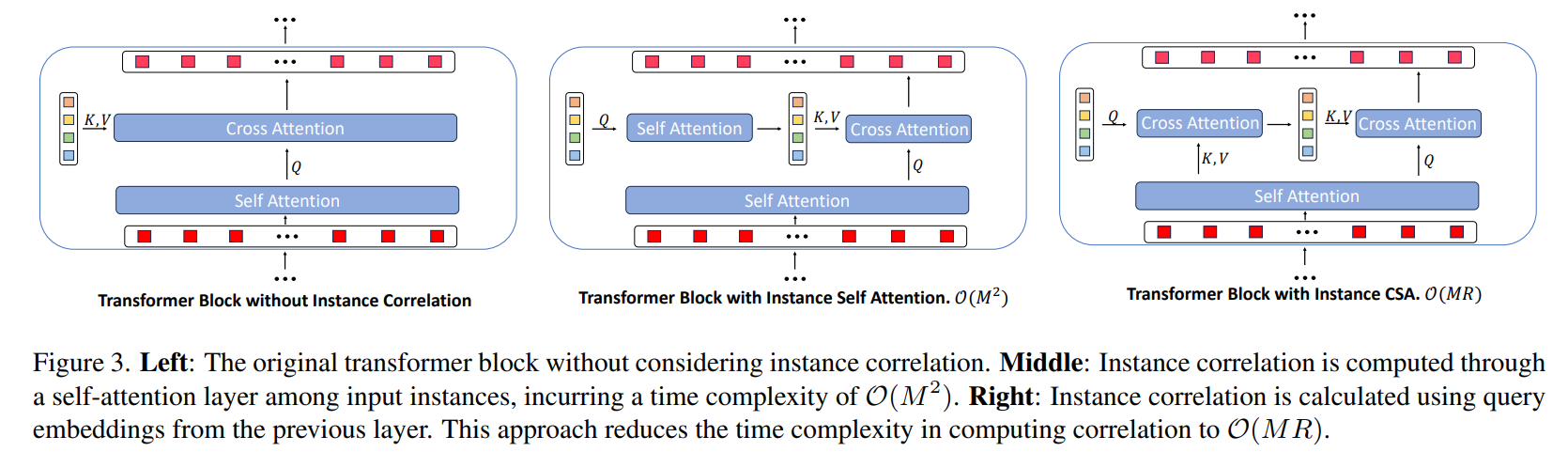
3.4. Unveiling Instance Correlation in MIVPG for Enhanced Multi-instance Scenarios
\ 
\ 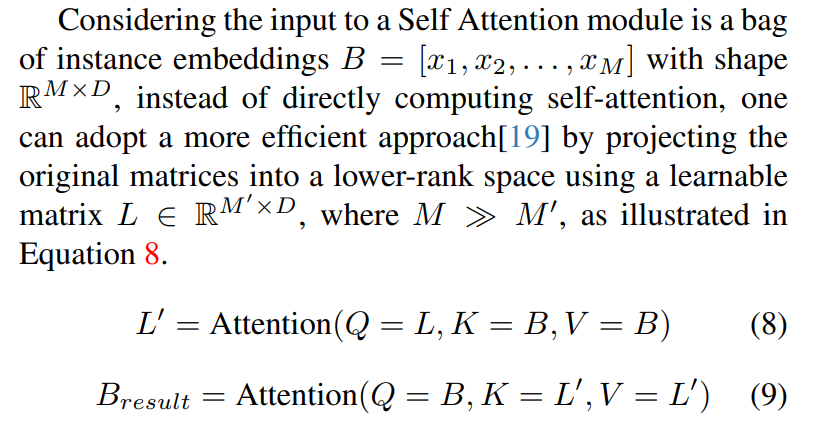
\ Subsequently, the aggregated low-rank matrix can be reintegrated with the original embeddings, as shown in Equation 9. This low-rank projection effectively reduces the time complexity to O(MM′).
\ 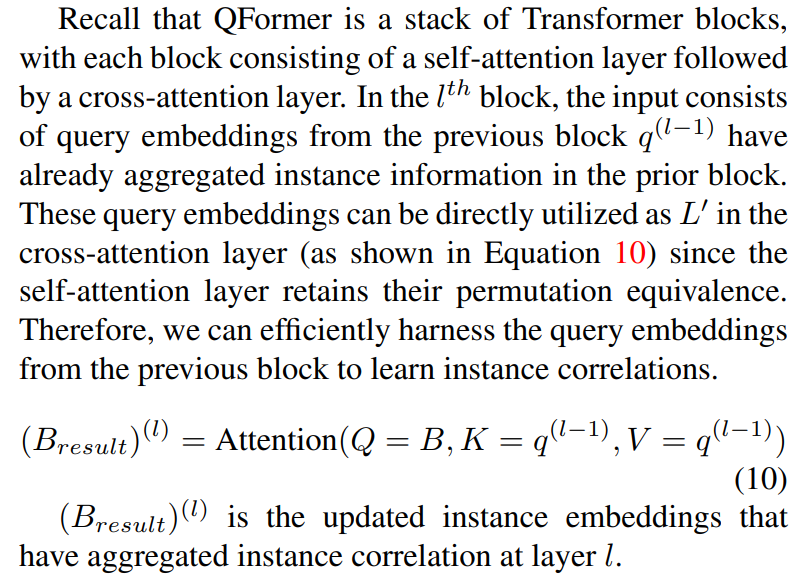
\ Proposition 2. MIVPG, when equipped with the CSA (Correlated Self-Attention) module, continues to fulfill the essential properties of MIL
\ We prove the proposition 2 in the supplementary B.
\ In summary, as depicted in Figure 2a, we establish that QFormer falls under the MIL category and is a specialized instance of our proposed MIVPG. The latter extends to visual inputs with multiple dimensions, accounting for instance correlation.
\
:::info Authors:
(1) Wenliang Zhong, The University of Texas at Arlington ([email protected]);
(2) Wenyi Wu, Amazon ([email protected]);
(3) Qi Li, Amazon ([email protected]);
(4) Rob Barton, Amazon ([email protected]);
(5) Boxin Du, Amazon ([email protected]);
(6) Shioulin Sam, Amazon ([email protected]);
(7) Karim Bouyarmane, Amazon ([email protected]);
(8) Ismail Tutar, Amazon ([email protected]);
(9) Junzhou Huang, The University of Texas at Arlington ([email protected]).
:::
:::info This paper is available on arxiv under CC by 4.0 Deed (Attribution 4.0 International) license.
:::
\
You May Also Like

Vinexpo Paris overtakes ProWein as world’s largest trade show

Federal Reserve expected to slash rates today, here's how it may impact crypto
Market participants are eagerly anticipating at least a 25 basis point (BPS) interest rate cut from the Federal Reserve on Wednesday. The Federal Reserve, the central bank of the United States, is expected to begin slashing interest rates on Wednesday, with analysts expecting a 25 basis point (BPS) cut and a boost to risk asset prices in the long term.Crypto prices are strongly correlated with liquidity cycles, Coin Bureau founder and market analyst Nic Puckrin said. However, while lower interest rates tend to raise asset prices long-term, Puckrin warned of a short-term price correction. “The main risk is that the move is already priced in, Puckrin said, adding, “hope is high and there’s a big chance of a ‘sell the news’ pullback. When that happens, speculative corners, memecoins in particular, are most vulnerable.”Read more

