KuCoin has launched its operations in Australia, opening a regional headquarters in Sydney to tap into one of the world’s fastest-growing crypto markets.KuCoin has launched its operations in Australia, opening a regional headquarters in Sydney to tap into one of the world’s fastest-growing crypto markets.

KuCoin Strengthens Global Presence with Australian Headquarters
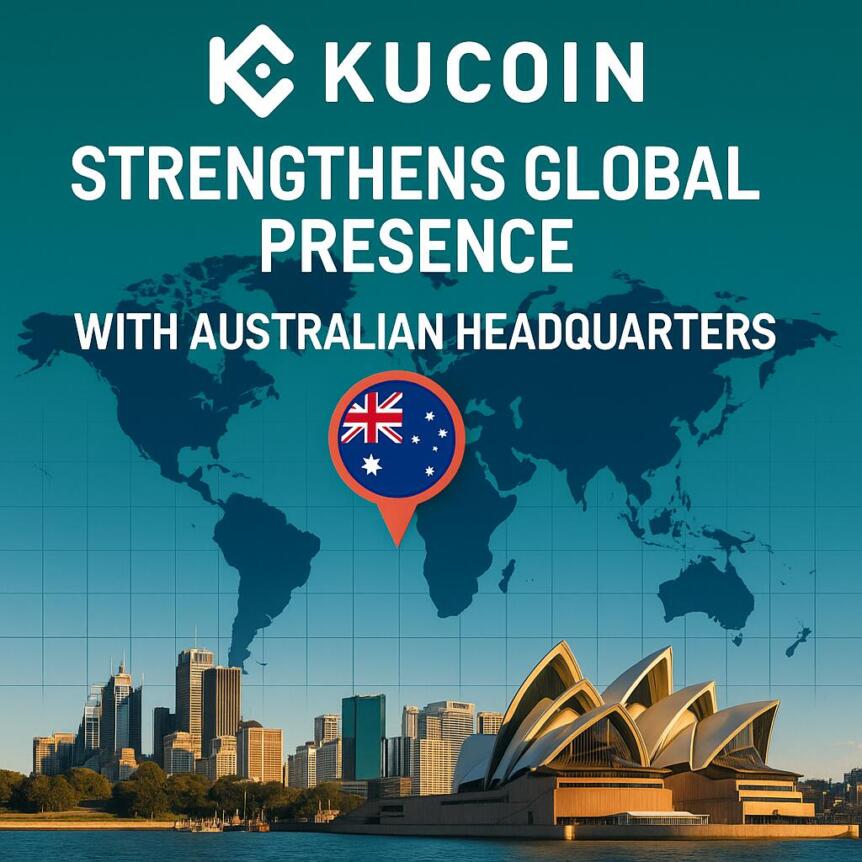
Kucoin Strengthens Global Presence With Australian Headquarters

Crypto exchange KuCoin has launched its operations in Australia, opening a regional headquarters in Sydney to tap into one of the world’s fastest-growing crypto markets. The new office marks a significant step in the exchange’s global expansion, following its earlier entry into Thailand this year.

The Sydney office will serve as the base for KuCoin’s operations in Australia and will focus on strengthening its presence in the local digital asset landscape. The company has appointed James Pinch, a seasoned executive with extensive experience in the Australian financial sector, as the managing director to lead these efforts. Pinch brings a wealth of knowledge from his previous roles at firms such as OKX, CMC Markets, and Vantage.

Targeting Australia’s Growing Crypto Market

Australia’s cryptocurrency market is rapidly growing, with projections indicating a near 20% increase to US$1.2 billion by 2026. KuCoin is positioning itself to capitalize on this growth by offering a combination of transparency, security, and innovation to Australian investors. Pinch emphasized that the Australian market demands stability and robust engagement, qualities that KuCoin aims to deliver.

In the coming months, KuCoin plans to expand its local workforce, hiring for various roles, including positions in compliance, cybersecurity, operations, and product development. The company’s entry into the market also coincides with the Australian government’s ongoing efforts to establish a licensing framework for digital asset platforms.

KuCoin’s Strategy to Engage with the Australian Crypto Community

To foster deeper engagement with local stakeholders, KuCoin will sponsor the upcoming Australian Crypto Convention. This move is aimed at supporting industry growth and building relationships within the local crypto community. As part of its strategy to stay competitive, KuCoin is also keeping an eye on regulatory developments in Australia, particularly the forthcoming licensing requirements for crypto exchanges.

Additionally, KuCoin’s expansion in Australia follows its success in Thailand, where it secured a full license to offer services. In Thailand, the exchange also took the lead in the government’s tokenized bond program. The company’s global strategy includes offering crypto-based services like KuCoin Pay and launching a cloud mining platform, further diversifying its portfolio.

Competition and Regulatory Landscape in Australia

KuCoin’s entry into the Australian market places it in direct competition with other crypto exchanges, including Gemini, which launched in Australia just last month. Gemini has already registered with the Australian Transaction Reports and Analysis Centre (AUSTRAC), complying with anti-money laundering regulations. For KuCoin to fully operate in Australia, it must secure an Australian Financial Services License (AFSL), a crucial step to offer services in Australian Dollars (AUD).

The regulatory environment in Australia remains dynamic, with the country considering a new licensing framework for digital asset platforms under the Corporations Act. Once the framework is established, exchanges operating in Australia must comply, or they could face severe penalties, including hefty fines.

This article was originally published as KuCoin Strengthens Global Presence with Australian Headquarters on Crypto Breaking News – your trusted source for crypto news, Bitcoin news, and blockchain updates.


Market Opportunity
TAP Protocol Logo
TAP Protocol Price(TAP)
$0.1411
$0.1411$0.1411
0.00%
USD
TAP Protocol (TAP) Live Price Chart
Disclaimer: The articles reposted on this site are sourced from public platforms and are provided for informational purposes only. They do not necessarily reflect the views of MEXC. All rights remain with the original authors. If you believe any content infringes on third-party rights, please contact [email protected] for removal. MEXC makes no guarantees regarding the accuracy, completeness, or timeliness of the content and is not responsible for any actions taken based on the information provided. The content does not constitute financial, legal, or other professional advice, nor should it be considered a recommendation or endorsement by MEXC.

You May Also Like

The Channel Factories We’ve Been Waiting For

The Channel Factories We’ve Been Waiting For

The post The Channel Factories We’ve Been Waiting For appeared on BitcoinEthereumNews.com. Visions of future technology are often prescient about the broad strokes while flubbing the details. The tablets in “2001: A Space Odyssey” do indeed look like iPads, but you never see the astronauts paying for subscriptions or wasting hours on Candy Crush.  Channel factories are one vision that arose early in the history of the Lightning Network to address some challenges that Lightning has faced from the beginning. Despite having grown to become Bitcoin’s most successful layer-2 scaling solution, with instant and low-fee payments, Lightning’s scale is limited by its reliance on payment channels. Although Lightning shifts most transactions off-chain, each payment channel still requires an on-chain transaction to open and (usually) another to close. As adoption grows, pressure on the blockchain grows with it. The need for a more scalable approach to managing channels is clear. Channel factories were supposed to meet this need, but where are they? In 2025, subnetworks are emerging that revive the impetus of channel factories with some new details that vastly increase their potential. They are natively interoperable with Lightning and achieve greater scale by allowing a group of participants to open a shared multisig UTXO and create multiple bilateral channels, which reduces the number of on-chain transactions and improves capital efficiency. Achieving greater scale by reducing complexity, Ark and Spark perform the same function as traditional channel factories with new designs and additional capabilities based on shared UTXOs.  Channel Factories 101 Channel factories have been around since the inception of Lightning. A factory is a multiparty contract where multiple users (not just two, as in a Dryja-Poon channel) cooperatively lock funds in a single multisig UTXO. They can open, close and update channels off-chain without updating the blockchain for each operation. Only when participants leave or the factory dissolves is an on-chain transaction…
Share
BitcoinEthereumNews2025/09/18 00:09
Gold Hits $3,700 as Sprott’s Wong Says Dollar’s Store-of-Value Crown May Slip

Gold Hits $3,700 as Sprott’s Wong Says Dollar’s Store-of-Value Crown May Slip

The post Gold Hits $3,700 as Sprott’s Wong Says Dollar’s Store-of-Value Crown May Slip appeared on BitcoinEthereumNews.com. Gold is strutting its way into record territory, smashing through $3,700 an ounce Wednesday morning, as Sprott Asset Management strategist Paul Wong says the yellow metal may finally snatch the dollar’s most coveted role: store of value. Wong Warns: Fiscal Dominance Puts U.S. Dollar on Notice, Gold on Top Gold prices eased slightly to $3,678.9 […] Source: https://news.bitcoin.com/gold-hits-3700-as-sprotts-wong-says-dollars-store-of-value-crown-may-slip/
Share
BitcoinEthereumNews2025/09/18 00:33
DeFi Leaders Raise Alarm Over Market Structure Bill’s Shaky Future

DeFi Leaders Raise Alarm Over Market Structure Bill’s Shaky Future

US Senate Postpones Markup of Digital Asset Market Clarity Act Amid Industry Concerns The proposed Digital Asset Market Clarity Act (CLARITY) in the U.S. Senate
Share
Crypto Breaking News2026/01/17 06:20



