Ethereum (ETH) briefly dropped to near $2,870 on November 19, its lowest point since July, after the release of Federal Reserve minutes raised market uncertainty. Despite the pullback, on-chain indicators and analyst insights suggest that the second-largest cryptocurrency may be forming a potential bottom. Federal Reserve Minutes Ignite Market Volatility The sharp decline in Ethereum was triggered by the Federal Reserve’s October 28–29 meeting minutes. It introduced significant uncertainty about December’s policy outlook. The document showed a slim majority of Fed officials against a December rate cut, while others suggested it “could well be appropriate.” This divided stance sparked volatility across both traditional and cryptocurrency markets. Bitcoin slid to a seven-month low, and Ethereum reached near $2,870. Ethereum (ETH) Price Performance. Source: BeInCrypto Markets At the time of writing, it had recovered to $3,036. It was still down 1.13% over the past day. But the worst may be over for the coin. On-Chain Data Highlights Strong $2,800 Support Insights from an analyst identify the $2,800 area as strong on-chain support. This level aligns with realized price clusters for both retail traders and whales, which have often marked previous market bottoms. “Historically, realized price levels have often marked cycle bottoms, suggesting that this range could once again provide a foundation for a short-term rebound,” an analyst wrote. The analysis also revealed that retail traders are selling, while whales holding more than 10,000 ETH are buying. This usually indicates healthy redistribution. Additionally, the amount of forced long liquidations is shrinking, meaning there’s less forced-selling pressure. At the same time, more traders are opening shorts. This increases the chances of a short squeeze—a rapid upward move if the price bounces and shorts get liquidated in a low-liquidity market. Technical analysts have weighed in on this support level. A trader flagged $2,800 as a critical zone for the formation of a bottom. Analyst Matt Hughes also noted that Ethereum’s drop to roughly $2,870 represents the midpoint between its 2021 market peak and its 2022 bottom. Despite the pullback, he argues the move remains within the bounds of normal crypto-market volatility. “If you remain objective this is still just normal volatility in crypto and yes, it is still a bullish backtest,” Hughes said. Liquidity Reset and Market Bottoming Patterns Altcoin Vector provided further context by examining Ethereum’s liquidity trends. Historical patterns show that when ETH liquidity fully resets, it often precedes a multi-week bottoming period rather than a breakdown. ETH just repeated the same liquidity event that marked the last two major bottoms, almost to the week. Every major ETH reversal started with a full liquidity reset,” Milk Road added. ETH Liquidity Index Indicating Full Reset at Current Levels. Source: X/Altcoin Vector This “correction/bottoming window” is expected to remain open as long as liquidity slowly rebuilds. If it returns in the coming weeks, Ethereum could be positioned for its next expansion leg. However, Altcoin Vector warned that a delayed recovery in liquidity increases the risk of prolonged stagnation, leaving the asset’s market structure more vulnerable. Institutional Accumulation And Network Fundamentals Despite turbulence in price, network fundamentals remain resilient. ETH staking hit a record high in November 2025, with over 33 million tokens now locked. Milk Road observed that although sentiment has been weak, the high level of staked ETH indicates strong long-term confidence in the network. “ETH staking just hit a new all time high… again. Price has been messy, and sentiment has been worse. But the one thing that hasn’t moved is the amount of ETH people are willing to lock away for years,” the post read. At the same time, institutional accumulation is accelerating. Corporate interest now goes beyond simply buying ETH on the open market. BlackRock is also making progress on its iShares Staked Ethereum Trust ETF. This development could amplify long-term demand and signal a deeper institutional commitment to Ethereum’s ecosystem. Furthermore, exchange reserves decreased by over 1 million ETH over the past few months. “This is the kind of silent supply shock that never looks bullish… until the chart violently catches up. ETH is being accumulated aggressively!” an analyst remarked. The convergence of on-chain signals, whale accumulation, shrinking exchange reserves, and record staking paints a positive picture for Ethereum. Whether the coin moves toward a sustained recovery will hinge on any potential macroeconomic drivers and the overall market state.Ethereum (ETH) briefly dropped to near $2,870 on November 19, its lowest point since July, after the release of Federal Reserve minutes raised market uncertainty. Despite the pullback, on-chain indicators and analyst insights suggest that the second-largest cryptocurrency may be forming a potential bottom. Federal Reserve Minutes Ignite Market Volatility The sharp decline in Ethereum was triggered by the Federal Reserve’s October 28–29 meeting minutes. It introduced significant uncertainty about December’s policy outlook. The document showed a slim majority of Fed officials against a December rate cut, while others suggested it “could well be appropriate.” This divided stance sparked volatility across both traditional and cryptocurrency markets. Bitcoin slid to a seven-month low, and Ethereum reached near $2,870. Ethereum (ETH) Price Performance. Source: BeInCrypto Markets At the time of writing, it had recovered to $3,036. It was still down 1.13% over the past day. But the worst may be over for the coin. On-Chain Data Highlights Strong $2,800 Support Insights from an analyst identify the $2,800 area as strong on-chain support. This level aligns with realized price clusters for both retail traders and whales, which have often marked previous market bottoms. “Historically, realized price levels have often marked cycle bottoms, suggesting that this range could once again provide a foundation for a short-term rebound,” an analyst wrote. The analysis also revealed that retail traders are selling, while whales holding more than 10,000 ETH are buying. This usually indicates healthy redistribution. Additionally, the amount of forced long liquidations is shrinking, meaning there’s less forced-selling pressure. At the same time, more traders are opening shorts. This increases the chances of a short squeeze—a rapid upward move if the price bounces and shorts get liquidated in a low-liquidity market. Technical analysts have weighed in on this support level. A trader flagged $2,800 as a critical zone for the formation of a bottom. Analyst Matt Hughes also noted that Ethereum’s drop to roughly $2,870 represents the midpoint between its 2021 market peak and its 2022 bottom. Despite the pullback, he argues the move remains within the bounds of normal crypto-market volatility. “If you remain objective this is still just normal volatility in crypto and yes, it is still a bullish backtest,” Hughes said. Liquidity Reset and Market Bottoming Patterns Altcoin Vector provided further context by examining Ethereum’s liquidity trends. Historical patterns show that when ETH liquidity fully resets, it often precedes a multi-week bottoming period rather than a breakdown. ETH just repeated the same liquidity event that marked the last two major bottoms, almost to the week. Every major ETH reversal started with a full liquidity reset,” Milk Road added. ETH Liquidity Index Indicating Full Reset at Current Levels. Source: X/Altcoin Vector This “correction/bottoming window” is expected to remain open as long as liquidity slowly rebuilds. If it returns in the coming weeks, Ethereum could be positioned for its next expansion leg. However, Altcoin Vector warned that a delayed recovery in liquidity increases the risk of prolonged stagnation, leaving the asset’s market structure more vulnerable. Institutional Accumulation And Network Fundamentals Despite turbulence in price, network fundamentals remain resilient. ETH staking hit a record high in November 2025, with over 33 million tokens now locked. Milk Road observed that although sentiment has been weak, the high level of staked ETH indicates strong long-term confidence in the network. “ETH staking just hit a new all time high… again. Price has been messy, and sentiment has been worse. But the one thing that hasn’t moved is the amount of ETH people are willing to lock away for years,” the post read. At the same time, institutional accumulation is accelerating. Corporate interest now goes beyond simply buying ETH on the open market. BlackRock is also making progress on its iShares Staked Ethereum Trust ETF. This development could amplify long-term demand and signal a deeper institutional commitment to Ethereum’s ecosystem. Furthermore, exchange reserves decreased by over 1 million ETH over the past few months. “This is the kind of silent supply shock that never looks bullish… until the chart violently catches up. ETH is being accumulated aggressively!” an analyst remarked. The convergence of on-chain signals, whale accumulation, shrinking exchange reserves, and record staking paints a positive picture for Ethereum. Whether the coin moves toward a sustained recovery will hinge on any potential macroeconomic drivers and the overall market state.

Why Ethereum May Have Successfully Bottomed at the $2,800 Support Zone

Ethereum (ETH) briefly dropped to near $2,870 on November 19, its lowest point since July, after the release of Federal Reserve minutes raised market uncertainty.

Despite the pullback, on-chain indicators and analyst insights suggest that the second-largest cryptocurrency may be forming a potential bottom.

Federal Reserve Minutes Ignite Market Volatility

The sharp decline in Ethereum was triggered by the Federal Reserve’s October 28–29 meeting minutes. It introduced significant uncertainty about December’s policy outlook.

The document showed a slim majority of Fed officials against a December rate cut, while others suggested it “could well be appropriate.”

This divided stance sparked volatility across both traditional and cryptocurrency markets. Bitcoin slid to a seven-month low, and Ethereum reached near $2,870.
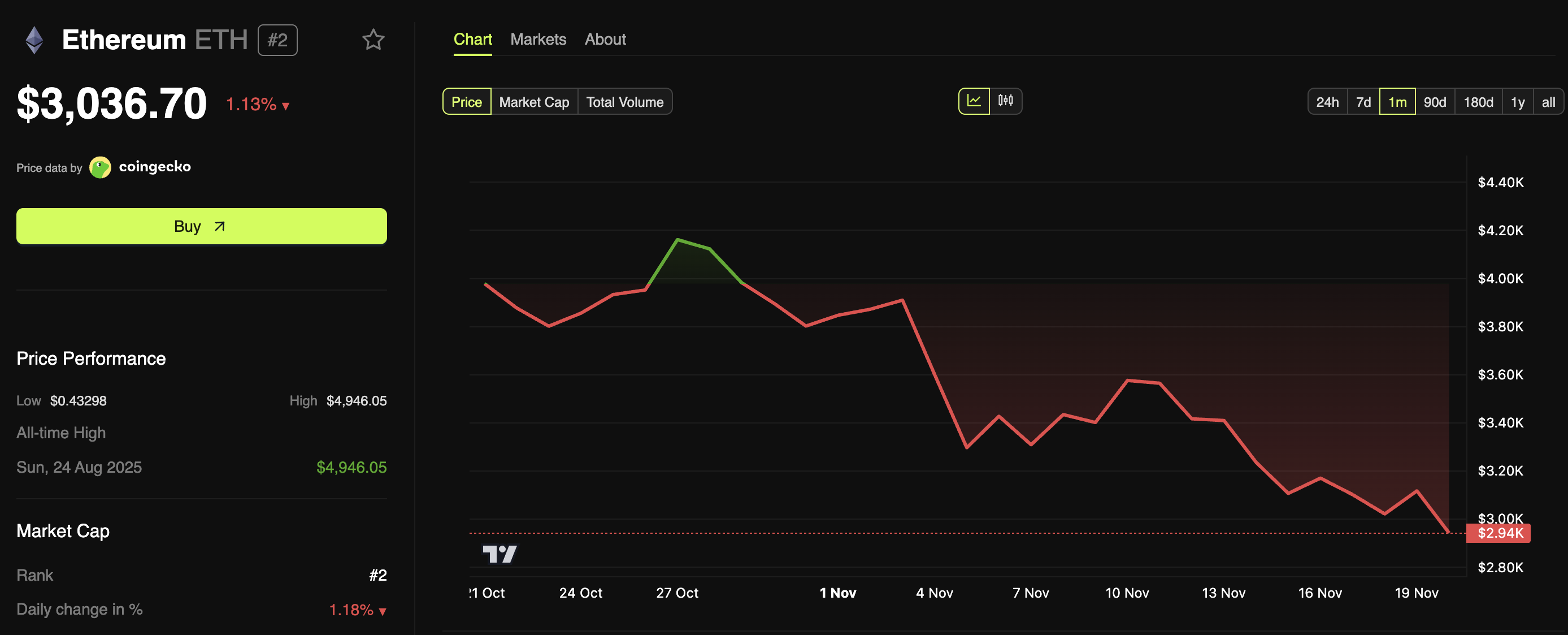
Ethereum (ETH) Price PerformanceEthereum (ETH) Price Performance. Source: BeInCrypto Markets

At the time of writing, it had recovered to $3,036. It was still down 1.13% over the past day. But the worst may be over for the coin.

On-Chain Data Highlights Strong $2,800 Support

Insights from an analyst identify the $2,800 area as strong on-chain support. This level aligns with realized price clusters for both retail traders and whales, which have often marked previous market bottoms.

The analysis also revealed that retail traders are selling, while whales holding more than 10,000 ETH are buying. This usually indicates healthy redistribution.

Additionally, the amount of forced long liquidations is shrinking, meaning there’s less forced-selling pressure. At the same time, more traders are opening shorts.

This increases the chances of a short squeeze—a rapid upward move if the price bounces and shorts get liquidated in a low-liquidity market.

Technical analysts have weighed in on this support level. A trader flagged $2,800 as a critical zone for the formation of a bottom.

Analyst Matt Hughes also noted that Ethereum’s drop to roughly $2,870 represents the midpoint between its 2021 market peak and its 2022 bottom. Despite the pullback, he argues the move remains within the bounds of normal crypto-market volatility.

Liquidity Reset and Market Bottoming Patterns

Altcoin Vector provided further context by examining Ethereum’s liquidity trends. Historical patterns show that when ETH liquidity fully resets, it often precedes a multi-week bottoming period rather than a breakdown.
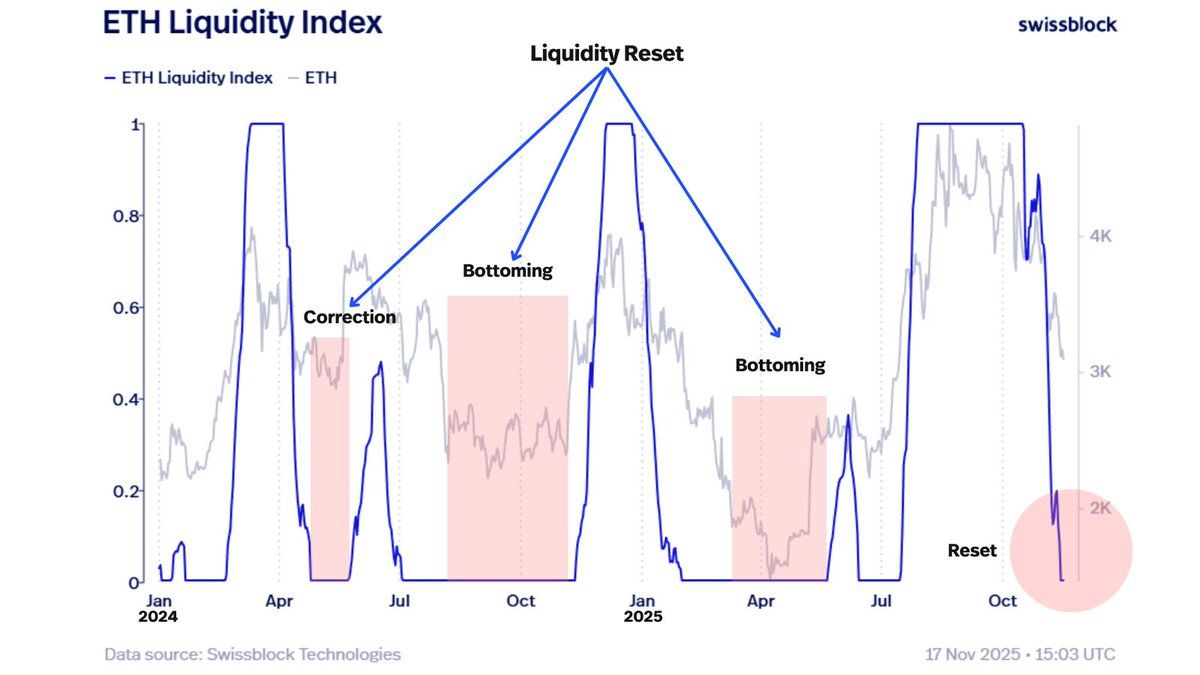
ETH Liquidity Index chart showing reset patternETH Liquidity Index Indicating Full Reset at Current Levels. Source: X/Altcoin Vector

This “correction/bottoming window” is expected to remain open as long as liquidity slowly rebuilds. If it returns in the coming weeks, Ethereum could be positioned for its next expansion leg.

However, Altcoin Vector warned that a delayed recovery in liquidity increases the risk of prolonged stagnation, leaving the asset’s market structure more vulnerable.

Institutional Accumulation And Network Fundamentals

Despite turbulence in price, network fundamentals remain resilient. ETH staking hit a record high in November 2025, with over 33 million tokens now locked.

Milk Road observed that although sentiment has been weak, the high level of staked ETH indicates strong long-term confidence in the network.

At the same time, institutional accumulation is accelerating.

Corporate interest now goes beyond simply buying ETH on the open market. BlackRock is also making progress on its iShares Staked Ethereum Trust ETF.

This development could amplify long-term demand and signal a deeper institutional commitment to Ethereum’s ecosystem. Furthermore, exchange reserves decreased by over 1 million ETH over the past few months.

The convergence of on-chain signals, whale accumulation, shrinking exchange reserves, and record staking paints a positive picture for Ethereum. Whether the coin moves toward a sustained recovery will hinge on any potential macroeconomic drivers and the overall market state.


Market Opportunity
Ethereum Logo
Ethereum Price(ETH)
$3,290.75
$3,290.75$3,290.75
+0.81%
USD
Ethereum (ETH) Live Price Chart
Disclaimer: The articles reposted on this site are sourced from public platforms and are provided for informational purposes only. They do not necessarily reflect the views of MEXC. All rights remain with the original authors. If you believe any content infringes on third-party rights, please contact [email protected] for removal. MEXC makes no guarantees regarding the accuracy, completeness, or timeliness of the content and is not responsible for any actions taken based on the information provided. The content does not constitute financial, legal, or other professional advice, nor should it be considered a recommendation or endorsement by MEXC.

You May Also Like

Crypto Casino Luck.io Pays Influencers Up to $500K Monthly – But Why?

Crypto Casino Luck.io Pays Influencers Up to $500K Monthly – But Why?

Crypto casino Luck.io is reportedly paying influencers six figures a month to promote its services, a June 18 X post from popular crypto trader Jordan Fish, aka Cobie, shows. Crypto Influencers Reportedly Earning Six Figures Monthly According to a screenshot of messages between Cobie and an unidentified source embedded in the Wednesday post, the anonymous messenger confirmed that the crypto company pays influencers “around” $500,000 per month to promote the casino. They’re paying extremely well (6 fig per month) pic.twitter.com/AKRVKU9vp4 — Cobie (@cobie) June 18, 2025 However, not everyone was as convinced of the number’s accuracy. “That’s only for Faze Banks probably,” one user replied. “Other influencers are getting $20-40k per month. So, same as other online crypto casinos.” Cobie pushed back on the user’s claims by identifying the messenger as “a crypto person,” going on to state that he knew of “4 other crypto people” earning “above 200k” from Luck.io. Drake’s Massive Stake.com Deal Cobie’s post comes amid growing speculation over celebrity and influencer collaborations with crypto casinos globally. Aubrey Graham, better known as Toronto-based rapper Drake, is reported to make nearly $100 million every year from his partnership with cryptocurrency casino Stake.com. As part of his deal with the Curaçao-based digital casino, the “Nokia” rapper occasionally hosts live-stream gambling sessions for his more than 140 million Instagram followers. Founded by entrepreneurs Ed Craven and Bijan Therani in 2017, the organization allegedly raked in $2.6 billion in 2022. Stake.com has even solidified key partnerships with Alfa Romeo’s F1 team and Liverpool-based Everton Football Club. However, concerns remain over crypto casinos’ legality as a whole , given their massive accessibility and reach online. Earlier this year, Stake was slapped with litigation out of Illinois for supposedly running an illegal online casino stateside while causing “severe harm to vulnerable populations.” “Stake floods social media platforms with slick ads, influencer videos, and flashy visuals, making its games seem safe, fun, and harmless,” the lawsuit claims. “By masking its real-money gambling platform as just another “social casino,” Stake creates exactly the kind of dangerous environment that Illinois gambling laws were designed to stop.”
Share
CryptoNews2025/06/19 04:53
Brera Holdings Rebrands as Solmate, Raises $300 Million for SOL Treasury

Brera Holdings Rebrands as Solmate, Raises $300 Million for SOL Treasury

Detail: https://coincu.com/news/solmate-rebrand-300m-sol-treasury/
Share
Coinstats2025/09/19 03:40
Sui Mainnet Recovers After 6-Hour Network Stall: No Funds at Risk

Sui Mainnet Recovers After 6-Hour Network Stall: No Funds at Risk

On January 14, 2026, Sui Mainnet faced a significant disruption, leaving the network stalled for roughly six hours. The incident was caused by an internal divergence
Share
Tronweekly2026/01/17 09:30