Bitcoin continues to struggle around the $90K level as the market battles intense selling pressure and widespread fear. Short-term sentiment remains fragile, with investors reacting to rapid price swings and mounting downside volatility. Yet, beneath the noise, key on-chain metrics are beginning to show signs that the correction may be nearing exhaustion. Related Reading: Nearly 7M Bitcoin Now Sitting At A Loss: Highest Unrealized Pain Since January 2024 According to analyst On-Chain Mind, Bitcoin’s Mean Reversion Oscillator has just printed its first green oversold bar in months, a signal that has historically aligned with late-stage retracements during bull markets. This oscillator measures how far price has deviated from its cyclical mean, helping identify when Bitcoin becomes overstretched to the downside. Each time this indicator dipped into its green oversold zone in previous cycles, Bitcoin was either forming a macro bottom or preparing for a significant rebound. The fact that this signal has appeared while BTC consolidates above $90K — despite severe profit-taking, forced liquidations, and structural fear — suggests that strong hands may be quietly absorbing supply. Historical Bottom Signals Align as Macro Tailwinds Strengthen On-Chain Mind explains that Bitcoin’s current Mean Reversion Oscillator reading aligns closely with historical patterns seen during bull market retracements. Each time the oscillator dipped into the green oversold zone while the 35 line held, Bitcoin formed a cyclical bottom before resuming its upward trajectory. This line has acted as a structural support level across multiple market cycles, and the fact that it is holding once again reinforces the idea that strong hands are stepping in as weaker participants capitulate. According to On-Chain Mind, when this indicator flashes green during an ongoing bull market, it often marks textbook accumulation territory — the kind of opportunity that appears only a few times per cycle. The current setup resembles previous late-stage pullbacks rather than the beginning of a prolonged bear trend. Adding to this outlook, NVIDIA’s blowout earnings delivered a major confidence boost to U.S. equities. With revenue and guidance far exceeding expectations, the results signal that AI-driven demand remains strong. In broader macro terms, such strength in tech leadership often spills over into higher-risk assets like crypto, improving liquidity and investor sentiment. Related Reading: Bitcoin Capitulation Deepens Around $90K Level: Classic Late-Stage Fear Structure Emerging Testing Support as Momentum Begins to Stabilize Bitcoin’s latest daily chart shows price attempting to stabilize after a sharp multi-week decline, with BTC currently trading near $92,000. This level is acting as a temporary support zone following the breakdown from the $100K area, where sellers aggressively dominated order books. The chart reveals a series of lower highs and lower lows — a classic short-term downtrend structure — but the recent candlesticks hint at reduced selling momentum compared to the peak pressure seen earlier in November. The 50-day and 100-day moving averages have both turned downward, reflecting weakening short-term trend strength, while the 200-day MA remains far below price, highlighting that the broader bullish cycle may not be invalidated yet. Importantly, the current candle structure shows smaller bodies and longer lower wicks, suggesting buyers are beginning to absorb sell-side liquidity around the $90K–$92K region. Related Reading: XRP Supply In Profit Falls to 58.5% – Lowest Since 2024 Despite Higher Price Volume profiles also support this shift. While capitulation-like spikes occurred during the heaviest drop, trading activity has now normalized, indicating panic selling is cooling off. Historically, such deceleration after a steep leg down often precedes a relief bounce, even if volatility persists. Featured image from ChatGPT, chart from TradingView.comBitcoin continues to struggle around the $90K level as the market battles intense selling pressure and widespread fear. Short-term sentiment remains fragile, with investors reacting to rapid price swings and mounting downside volatility. Yet, beneath the noise, key on-chain metrics are beginning to show signs that the correction may be nearing exhaustion. Related Reading: Nearly 7M Bitcoin Now Sitting At A Loss: Highest Unrealized Pain Since January 2024 According to analyst On-Chain Mind, Bitcoin’s Mean Reversion Oscillator has just printed its first green oversold bar in months, a signal that has historically aligned with late-stage retracements during bull markets. This oscillator measures how far price has deviated from its cyclical mean, helping identify when Bitcoin becomes overstretched to the downside. Each time this indicator dipped into its green oversold zone in previous cycles, Bitcoin was either forming a macro bottom or preparing for a significant rebound. The fact that this signal has appeared while BTC consolidates above $90K — despite severe profit-taking, forced liquidations, and structural fear — suggests that strong hands may be quietly absorbing supply. Historical Bottom Signals Align as Macro Tailwinds Strengthen On-Chain Mind explains that Bitcoin’s current Mean Reversion Oscillator reading aligns closely with historical patterns seen during bull market retracements. Each time the oscillator dipped into the green oversold zone while the 35 line held, Bitcoin formed a cyclical bottom before resuming its upward trajectory. This line has acted as a structural support level across multiple market cycles, and the fact that it is holding once again reinforces the idea that strong hands are stepping in as weaker participants capitulate. According to On-Chain Mind, when this indicator flashes green during an ongoing bull market, it often marks textbook accumulation territory — the kind of opportunity that appears only a few times per cycle. The current setup resembles previous late-stage pullbacks rather than the beginning of a prolonged bear trend. Adding to this outlook, NVIDIA’s blowout earnings delivered a major confidence boost to U.S. equities. With revenue and guidance far exceeding expectations, the results signal that AI-driven demand remains strong. In broader macro terms, such strength in tech leadership often spills over into higher-risk assets like crypto, improving liquidity and investor sentiment. Related Reading: Bitcoin Capitulation Deepens Around $90K Level: Classic Late-Stage Fear Structure Emerging Testing Support as Momentum Begins to Stabilize Bitcoin’s latest daily chart shows price attempting to stabilize after a sharp multi-week decline, with BTC currently trading near $92,000. This level is acting as a temporary support zone following the breakdown from the $100K area, where sellers aggressively dominated order books. The chart reveals a series of lower highs and lower lows — a classic short-term downtrend structure — but the recent candlesticks hint at reduced selling momentum compared to the peak pressure seen earlier in November. The 50-day and 100-day moving averages have both turned downward, reflecting weakening short-term trend strength, while the 200-day MA remains far below price, highlighting that the broader bullish cycle may not be invalidated yet. Importantly, the current candle structure shows smaller bodies and longer lower wicks, suggesting buyers are beginning to absorb sell-side liquidity around the $90K–$92K region. Related Reading: XRP Supply In Profit Falls to 58.5% – Lowest Since 2024 Despite Higher Price Volume profiles also support this shift. While capitulation-like spikes occurred during the heaviest drop, trading activity has now normalized, indicating panic selling is cooling off. Historically, such deceleration after a steep leg down often precedes a relief bounce, even if volatility persists. Featured image from ChatGPT, chart from TradingView.com

Bitcoin Mean Reversion Oscillator Prints First Green Oversold Bar in Months – A Classic Bull-Market Bottom Signal

2025/11/21 08:00
3 min read
For feedback or concerns regarding this content, please contact us at [email protected]

Bitcoin continues to struggle around the $90K level as the market battles intense selling pressure and widespread fear. Short-term sentiment remains fragile, with investors reacting to rapid price swings and mounting downside volatility. Yet, beneath the noise, key on-chain metrics are beginning to show signs that the correction may be nearing exhaustion.

According to analyst On-Chain Mind, Bitcoin’s Mean Reversion Oscillator has just printed its first green oversold bar in months, a signal that has historically aligned with late-stage retracements during bull markets. This oscillator measures how far price has deviated from its cyclical mean, helping identify when Bitcoin becomes overstretched to the downside.

Each time this indicator dipped into its green oversold zone in previous cycles, Bitcoin was either forming a macro bottom or preparing for a significant rebound. The fact that this signal has appeared while BTC consolidates above $90K — despite severe profit-taking, forced liquidations, and structural fear — suggests that strong hands may be quietly absorbing supply.

Historical Bottom Signals Align as Macro Tailwinds Strengthen

On-Chain Mind explains that Bitcoin’s current Mean Reversion Oscillator reading aligns closely with historical patterns seen during bull market retracements. Each time the oscillator dipped into the green oversold zone while the 35 line held, Bitcoin formed a cyclical bottom before resuming its upward trajectory. This line has acted as a structural support level across multiple market cycles, and the fact that it is holding once again reinforces the idea that strong hands are stepping in as weaker participants capitulate.
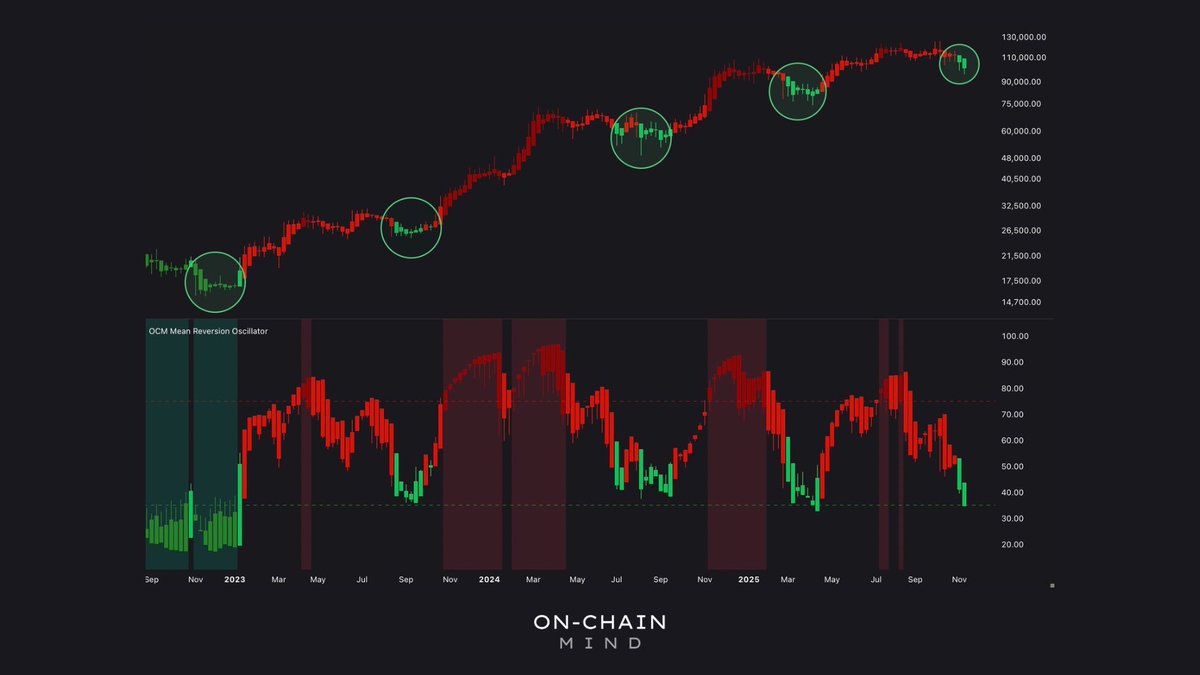
Mean Reversion Oscillator | Source: On-Chain Mind

According to On-Chain Mind, when this indicator flashes green during an ongoing bull market, it often marks textbook accumulation territory — the kind of opportunity that appears only a few times per cycle. The current setup resembles previous late-stage pullbacks rather than the beginning of a prolonged bear trend.

Adding to this outlook, NVIDIA’s blowout earnings delivered a major confidence boost to U.S. equities. With revenue and guidance far exceeding expectations, the results signal that AI-driven demand remains strong. In broader macro terms, such strength in tech leadership often spills over into higher-risk assets like crypto, improving liquidity and investor sentiment.

Testing Support as Momentum Begins to Stabilize

Bitcoin’s latest daily chart shows price attempting to stabilize after a sharp multi-week decline, with BTC currently trading near $92,000. This level is acting as a temporary support zone following the breakdown from the $100K area, where sellers aggressively dominated order books.

The chart reveals a series of lower highs and lower lows — a classic short-term downtrend structure — but the recent candlesticks hint at reduced selling momentum compared to the peak pressure seen earlier in November.
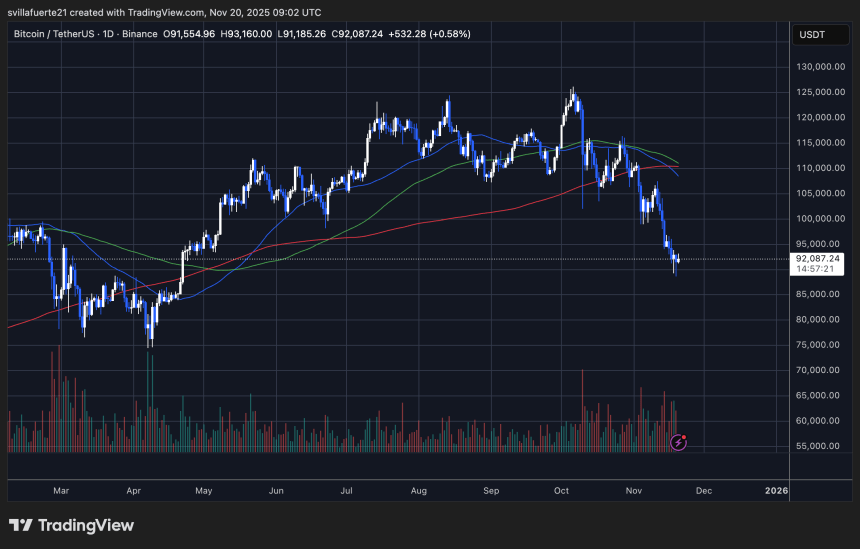
BTC testing fresh lows | Source: BTCUSDT chart on TradingView

The 50-day and 100-day moving averages have both turned downward, reflecting weakening short-term trend strength, while the 200-day MA remains far below price, highlighting that the broader bullish cycle may not be invalidated yet. Importantly, the current candle structure shows smaller bodies and longer lower wicks, suggesting buyers are beginning to absorb sell-side liquidity around the $90K–$92K region.

Volume profiles also support this shift. While capitulation-like spikes occurred during the heaviest drop, trading activity has now normalized, indicating panic selling is cooling off. Historically, such deceleration after a steep leg down often precedes a relief bounce, even if volatility persists.

Featured image from ChatGPT, chart from TradingView.com

Market Opportunity
FC Barcelona FT Logo
FC Barcelona FT Price(BAR)
$0.5572
$0.5572$0.5572
+0.16%
USD
FC Barcelona FT (BAR) Live Price Chart
Disclaimer: The articles reposted on this site are sourced from public platforms and are provided for informational purposes only. They do not necessarily reflect the views of MEXC. All rights remain with the original authors. If you believe any content infringes on third-party rights, please contact [email protected] for removal. MEXC makes no guarantees regarding the accuracy, completeness, or timeliness of the content and is not responsible for any actions taken based on the information provided. The content does not constitute financial, legal, or other professional advice, nor should it be considered a recommendation or endorsement by MEXC.

You May Also Like

The Channel Factories We’ve Been Waiting For

The Channel Factories We’ve Been Waiting For

The post The Channel Factories We’ve Been Waiting For appeared on BitcoinEthereumNews.com. Visions of future technology are often prescient about the broad strokes while flubbing the details. The tablets in “2001: A Space Odyssey” do indeed look like iPads, but you never see the astronauts paying for subscriptions or wasting hours on Candy Crush.  Channel factories are one vision that arose early in the history of the Lightning Network to address some challenges that Lightning has faced from the beginning. Despite having grown to become Bitcoin’s most successful layer-2 scaling solution, with instant and low-fee payments, Lightning’s scale is limited by its reliance on payment channels. Although Lightning shifts most transactions off-chain, each payment channel still requires an on-chain transaction to open and (usually) another to close. As adoption grows, pressure on the blockchain grows with it. The need for a more scalable approach to managing channels is clear. Channel factories were supposed to meet this need, but where are they? In 2025, subnetworks are emerging that revive the impetus of channel factories with some new details that vastly increase their potential. They are natively interoperable with Lightning and achieve greater scale by allowing a group of participants to open a shared multisig UTXO and create multiple bilateral channels, which reduces the number of on-chain transactions and improves capital efficiency. Achieving greater scale by reducing complexity, Ark and Spark perform the same function as traditional channel factories with new designs and additional capabilities based on shared UTXOs.  Channel Factories 101 Channel factories have been around since the inception of Lightning. A factory is a multiparty contract where multiple users (not just two, as in a Dryja-Poon channel) cooperatively lock funds in a single multisig UTXO. They can open, close and update channels off-chain without updating the blockchain for each operation. Only when participants leave or the factory dissolves is an on-chain transaction…
Share
BitcoinEthereumNews2025/09/18 00:09
Top 3 Altcoins for the Next Bull Run Ethereum, Solana and Mutuum Finance

Top 3 Altcoins for the Next Bull Run Ethereum, Solana and Mutuum Finance

Ethereum and Solana already sit near the top of most serious altcoin watchlists, and Mutuum Finance is starting to enter that same conversation from a very different
Share
Techbullion2026/03/20 23:07
Trump: We want to negotiate with Iran, but we have no negotiating partner.

Trump: We want to negotiate with Iran, but we have no negotiating partner.

PANews reported on March 20 that US President Trump stated: "We want to negotiate with Iran, but we have no one to negotiate with. Nobody wants to be Iran's leader
Share
PANews2026/03/20 23:04