What to Know: Tom Lee’s market maker balance sheet thesis suggests the crypto market crash on October 10, 2025, was driven by structural liquidity gaps, not just speculative panic. Liquidity crises can spread rapidly from institutional books to retail users, impacting execution quality, fees, and access to cross-chain opportunities as volatility spikes. Best Wallet Presale aims to target a 40 percent wallet market share by 2026, combining Fireblocks MPC security, multichain aggregation, and a mobile-first UX. Competition among wallets is shifting toward integrated tooling, with staking, presale access, and fee incentives becoming central to how users choose their primary crypto gateway. The October 10 crypto crash wasn’t just another violent wick on the chart. According to Tom Lee, chairman of Ether-focused treasury and market-making firm BitMine, the selloff exposed “structural weaknesses” within major liquidity providers that only become visible when volatility hits hard. Speaking with CNBC, Lee said the record liquidation cascade, nearly $20B wiped out in hours, forced over-leveraged market makers to rapidly unwind positions as collateral values sank. That derisking drained liquidity from order books, widened spreads, and accelerated the crash in a classic feedback loop. For regular users, that kind of liquidity vacuum isn’t just macro noise. It’s when swaps fail, fees spike, and centralized wallet pipelines become bottlenecks precisely when you need them most. When the infrastructure you rely on cracks under pressure, you’re effectively outsourcing your survival to someone else’s balance sheet. That’s why many investors are now shifting their focus from price action to tools that hold up during stress. Best Wallet is positioning its presale around that exact narrative: a mobile-first, non-custodial ecosystem built to keep users in control even when market plumbing breaks elsewhere. In a post-crash environment where structural fragility is once again front and center, that message is resonating. How a Market-Maker Liquidity Crunch Spills Into Everyday Crypto Use Lee’s point is simple but uncomfortable: when major market makers run aggressively leveraged books, a shock like the October 10, 2025, crash can flip a liquidity provider into a forced seller almost instantly. Once those books start unwinding, liquidity doesn’t just thin, it evaporates. Slippage spikes, execution quality drops, and long-tail tokens or smaller venues become structurally untradeable for hours. We’ve seen versions of this story before. Centralized exchanges and brokerages often look stable right up until volatility reveals mismatched liabilities or overextended positions. For everyday users, the question is painfully practical: How do you trade, route liquidity, or rebalance portfolios without being dependent on a single entity’s balance sheet or uptime when markets are blowing up? Different wallets are attempting their own solutions. MetaMask is leaning hard into smarter routing and institutional integrations. Trust Wallet focuses on simplicity and broad asset support for casual users. Phantom expanded from Solana to EVM chains to capture multichain retail flow. Best Wallet Token, currently in presale, aims to join this field from a different angle, pairing a consumer-grade mobile UX with a security-centric backend built on Fireblocks’ MPC-CMP infrastructure. In a cycle where liquidity reliability is suddenly front-page news again, that positioning stands out. Why Best Wallet Is Positioning Itself as “Crash-Resistant” Infrastructure Most wallets still act as thin front-ends. Best Wallet is taking a different route, building a full-stack, volatility-aware ecosystem that assumes turbulence is the norm, not the exception. The team is openly targeting 40% of the global wallet market by the end of 2026, aiming at users who want institutional-grade security packaged inside a mobile-first interface. At its core is what the team calls the first fully integrated Fireblocks MPC-CMP wallet, housed within a retail app. Instead of relying on a single private key, multi-party computation splits signing across independent shards, eliminating a single-point-of-failure while keeping transactions fast enough for everyday trading. The app’s multi-wallet portfolio system lets users cleanly separate long-term holdings, active trading, and experimental positions without juggling addresses. Beyond storage, the product places a strong emphasis on access. The Upcoming Tokens portal curates early-stage presales and embeds a streamlined purchase flow, allowing users to participate in vetted launches without jumping through third-party sites. The Best DEX aggregator, powered by Rubic, pulls routes from multiple chains, DEXs, and cross-chain bridges, optimizing trades for both price and execution in real-time. On the token side, $BEST is designed to tie utility directly to user activity. Holders receive reduced in-app fees and can stake into a dedicated 800M-token rewards pool (8% of supply). Payouts scale proportionally with each staker’s share of the pool, and staking is live during the presale, giving early buyers a head start on compounding. That pitch appears to be resonating. The presale has already raised over $17.2M with tokens priced at $0.025975 and just 7 days remaining. Whale-tracking data shows two recent large purchases totaling $136k, including a confirmed $56K buy on September 2, 2025, a signal that some larger players are willing to take early directional exposure. For anyone recalibrating after the October 2025 crypto crash, tools like Best Wallet offer a more constructive response than trying to time the exact bottom. Rather than betting on perfect entries, you can build a stack that remains flexible, fee-efficient, and self-custodial the next time liquidity disappears without warning. Join the $BEST presale today. This article is for informational purposes only and should not be considered financial, investment, or trading advice. Authored by Aaron Walker, NewsBTC – https://www.newsbtc.com/news/crypto-market-crash-october-10-2025-best-wallet-presaleWhat to Know: Tom Lee’s market maker balance sheet thesis suggests the crypto market crash on October 10, 2025, was driven by structural liquidity gaps, not just speculative panic. Liquidity crises can spread rapidly from institutional books to retail users, impacting execution quality, fees, and access to cross-chain opportunities as volatility spikes. Best Wallet Presale aims to target a 40 percent wallet market share by 2026, combining Fireblocks MPC security, multichain aggregation, and a mobile-first UX. Competition among wallets is shifting toward integrated tooling, with staking, presale access, and fee incentives becoming central to how users choose their primary crypto gateway. The October 10 crypto crash wasn’t just another violent wick on the chart. According to Tom Lee, chairman of Ether-focused treasury and market-making firm BitMine, the selloff exposed “structural weaknesses” within major liquidity providers that only become visible when volatility hits hard. Speaking with CNBC, Lee said the record liquidation cascade, nearly $20B wiped out in hours, forced over-leveraged market makers to rapidly unwind positions as collateral values sank. That derisking drained liquidity from order books, widened spreads, and accelerated the crash in a classic feedback loop. For regular users, that kind of liquidity vacuum isn’t just macro noise. It’s when swaps fail, fees spike, and centralized wallet pipelines become bottlenecks precisely when you need them most. When the infrastructure you rely on cracks under pressure, you’re effectively outsourcing your survival to someone else’s balance sheet. That’s why many investors are now shifting their focus from price action to tools that hold up during stress. Best Wallet is positioning its presale around that exact narrative: a mobile-first, non-custodial ecosystem built to keep users in control even when market plumbing breaks elsewhere. In a post-crash environment where structural fragility is once again front and center, that message is resonating. How a Market-Maker Liquidity Crunch Spills Into Everyday Crypto Use Lee’s point is simple but uncomfortable: when major market makers run aggressively leveraged books, a shock like the October 10, 2025, crash can flip a liquidity provider into a forced seller almost instantly. Once those books start unwinding, liquidity doesn’t just thin, it evaporates. Slippage spikes, execution quality drops, and long-tail tokens or smaller venues become structurally untradeable for hours. We’ve seen versions of this story before. Centralized exchanges and brokerages often look stable right up until volatility reveals mismatched liabilities or overextended positions. For everyday users, the question is painfully practical: How do you trade, route liquidity, or rebalance portfolios without being dependent on a single entity’s balance sheet or uptime when markets are blowing up? Different wallets are attempting their own solutions. MetaMask is leaning hard into smarter routing and institutional integrations. Trust Wallet focuses on simplicity and broad asset support for casual users. Phantom expanded from Solana to EVM chains to capture multichain retail flow. Best Wallet Token, currently in presale, aims to join this field from a different angle, pairing a consumer-grade mobile UX with a security-centric backend built on Fireblocks’ MPC-CMP infrastructure. In a cycle where liquidity reliability is suddenly front-page news again, that positioning stands out. Why Best Wallet Is Positioning Itself as “Crash-Resistant” Infrastructure Most wallets still act as thin front-ends. Best Wallet is taking a different route, building a full-stack, volatility-aware ecosystem that assumes turbulence is the norm, not the exception. The team is openly targeting 40% of the global wallet market by the end of 2026, aiming at users who want institutional-grade security packaged inside a mobile-first interface. At its core is what the team calls the first fully integrated Fireblocks MPC-CMP wallet, housed within a retail app. Instead of relying on a single private key, multi-party computation splits signing across independent shards, eliminating a single-point-of-failure while keeping transactions fast enough for everyday trading. The app’s multi-wallet portfolio system lets users cleanly separate long-term holdings, active trading, and experimental positions without juggling addresses. Beyond storage, the product places a strong emphasis on access. The Upcoming Tokens portal curates early-stage presales and embeds a streamlined purchase flow, allowing users to participate in vetted launches without jumping through third-party sites. The Best DEX aggregator, powered by Rubic, pulls routes from multiple chains, DEXs, and cross-chain bridges, optimizing trades for both price and execution in real-time. On the token side, $BEST is designed to tie utility directly to user activity. Holders receive reduced in-app fees and can stake into a dedicated 800M-token rewards pool (8% of supply). Payouts scale proportionally with each staker’s share of the pool, and staking is live during the presale, giving early buyers a head start on compounding. That pitch appears to be resonating. The presale has already raised over $17.2M with tokens priced at $0.025975 and just 7 days remaining. Whale-tracking data shows two recent large purchases totaling $136k, including a confirmed $56K buy on September 2, 2025, a signal that some larger players are willing to take early directional exposure. For anyone recalibrating after the October 2025 crypto crash, tools like Best Wallet offer a more constructive response than trying to time the exact bottom. Rather than betting on perfect entries, you can build a stack that remains flexible, fee-efficient, and self-custodial the next time liquidity disappears without warning. Join the $BEST presale today. This article is for informational purposes only and should not be considered financial, investment, or trading advice. Authored by Aaron Walker, NewsBTC – https://www.newsbtc.com/news/crypto-market-crash-october-10-2025-best-wallet-presale

Tom Lee Knows Why the Crypto Market Crashed: $BEST May Be the Safest Investment Now

2025/11/21 20:17
5 min read
For feedback or concerns regarding this content, please contact us at [email protected]
What to Know:
  • Tom Lee’s market maker balance sheet thesis suggests the crypto market crash on October 10, 2025, was driven by structural liquidity gaps, not just speculative panic.
  • Liquidity crises can spread rapidly from institutional books to retail users, impacting execution quality, fees, and access to cross-chain opportunities as volatility spikes.
  • Best Wallet Presale aims to target a 40 percent wallet market share by 2026, combining Fireblocks MPC security, multichain aggregation, and a mobile-first UX.
  • Competition among wallets is shifting toward integrated tooling, with staking, presale access, and fee incentives becoming central to how users choose their primary crypto gateway.

The October 10 crypto crash wasn’t just another violent wick on the chart. According to Tom Lee, chairman of Ether-focused treasury and market-making firm BitMine, the selloff exposed “structural weaknesses” within major liquidity providers that only become visible when volatility hits hard.

Speaking with CNBC, Lee said the record liquidation cascade, nearly $20B wiped out in hours, forced over-leveraged market makers to rapidly unwind positions as collateral values sank. That derisking drained liquidity from order books, widened spreads, and accelerated the crash in a classic feedback loop.

For regular users, that kind of liquidity vacuum isn’t just macro noise. It’s when swaps fail, fees spike, and centralized wallet pipelines become bottlenecks precisely when you need them most.

When the infrastructure you rely on cracks under pressure, you’re effectively outsourcing your survival to someone else’s balance sheet.

That’s why many investors are now shifting their focus from price action to tools that hold up during stress. Best Wallet is positioning its presale around that exact narrative: a mobile-first, non-custodial ecosystem built to keep users in control even when market plumbing breaks elsewhere.

In a post-crash environment where structural fragility is once again front and center, that message is resonating.

How a Market-Maker Liquidity Crunch Spills Into Everyday Crypto Use

Lee’s point is simple but uncomfortable: when major market makers run aggressively leveraged books, a shock like the October 10, 2025, crash can flip a liquidity provider into a forced seller almost instantly.

Once those books start unwinding, liquidity doesn’t just thin, it evaporates. Slippage spikes, execution quality drops, and long-tail tokens or smaller venues become structurally untradeable for hours.
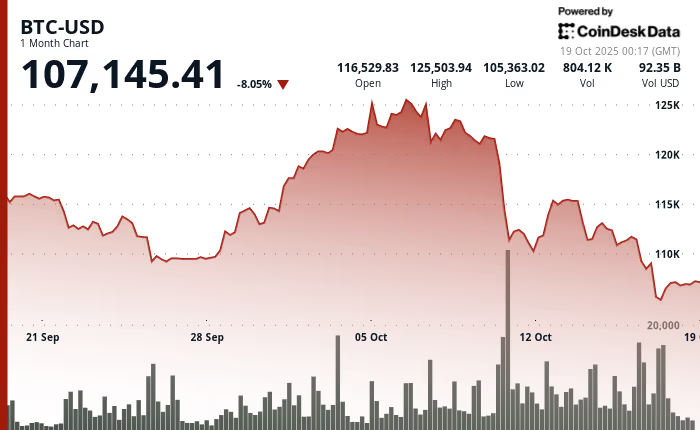
CoinDesk Bitcoin Price October 10 Crash

We’ve seen versions of this story before. Centralized exchanges and brokerages often look stable right up until volatility reveals mismatched liabilities or overextended positions. For everyday users, the question is painfully practical:

How do you trade, route liquidity, or rebalance portfolios without being dependent on a single entity’s balance sheet or uptime when markets are blowing up?

Different wallets are attempting their own solutions.

  • MetaMask is leaning hard into smarter routing and institutional integrations.
  • Trust Wallet focuses on simplicity and broad asset support for casual users.
  • Phantom expanded from Solana to EVM chains to capture multichain retail flow.

Best Wallet Token, currently in presale, aims to join this field from a different angle, pairing a consumer-grade mobile UX with a security-centric backend built on Fireblocks’ MPC-CMP infrastructure. In a cycle where liquidity reliability is suddenly front-page news again, that positioning stands out.

Why Best Wallet Is Positioning Itself as “Crash-Resistant” Infrastructure

Most wallets still act as thin front-ends. Best Wallet is taking a different route, building a full-stack, volatility-aware ecosystem that assumes turbulence is the norm, not the exception.

The team is openly targeting 40% of the global wallet market by the end of 2026, aiming at users who want institutional-grade security packaged inside a mobile-first interface.

At its core is what the team calls the first fully integrated Fireblocks MPC-CMP wallet, housed within a retail app. Instead of relying on a single private key, multi-party computation splits signing across independent shards, eliminating a single-point-of-failure while keeping transactions fast enough for everyday trading.

The app’s multi-wallet portfolio system lets users cleanly separate long-term holdings, active trading, and experimental positions without juggling addresses.

Beyond storage, the product places a strong emphasis on access.

  • The Upcoming Tokens portal curates early-stage presales and embeds a streamlined purchase flow, allowing users to participate in vetted launches without jumping through third-party sites.
  • The Best DEX aggregator, powered by Rubic, pulls routes from multiple chains, DEXs, and cross-chain bridges, optimizing trades for both price and execution in real-time.

On the token side, $BEST is designed to tie utility directly to user activity. Holders receive reduced in-app fees and can stake into a dedicated 800M-token rewards pool (8% of supply).

Payouts scale proportionally with each staker’s share of the pool, and staking is live during the presale, giving early buyers a head start on compounding.

That pitch appears to be resonating. The presale has already raised over $17.2M with tokens priced at $0.025975 and just 7 days remaining.

Whale-tracking data shows two recent large purchases totaling $136k, including a confirmed $56K buy on September 2, 2025, a signal that some larger players are willing to take early directional exposure.

For anyone recalibrating after the October 2025 crypto crash, tools like Best Wallet offer a more constructive response than trying to time the exact bottom. Rather than betting on perfect entries, you can build a stack that remains flexible, fee-efficient, and self-custodial the next time liquidity disappears without warning.

Join the $BEST presale today.

This article is for informational purposes only and should not be considered financial, investment, or trading advice.

Authored by Aaron Walker, NewsBTC – https://www.newsbtc.com/news/crypto-market-crash-october-10-2025-best-wallet-presale

Market Opportunity
TOMCoin Logo
TOMCoin Price(TOM)
$0,00006886
$0,00006886$0,00006886
-%0,39
USD
TOMCoin (TOM) Live Price Chart
Disclaimer: The articles reposted on this site are sourced from public platforms and are provided for informational purposes only. They do not necessarily reflect the views of MEXC. All rights remain with the original authors. If you believe any content infringes on third-party rights, please contact [email protected] for removal. MEXC makes no guarantees regarding the accuracy, completeness, or timeliness of the content and is not responsible for any actions taken based on the information provided. The content does not constitute financial, legal, or other professional advice, nor should it be considered a recommendation or endorsement by MEXC.

You May Also Like

IP Hits $11.75, HYPE Climbs to $55, BlockDAG Surpasses Both with $407M Presale Surge!

IP Hits $11.75, HYPE Climbs to $55, BlockDAG Surpasses Both with $407M Presale Surge!

The post IP Hits $11.75, HYPE Climbs to $55, BlockDAG Surpasses Both with $407M Presale Surge! appeared on BitcoinEthereumNews.com. Crypto News 17 September 2025 | 18:00 Discover why BlockDAG’s upcoming Awakening Testnet launch makes it the best crypto to buy today as Story (IP) price jumps to $11.75 and Hyperliquid hits new highs. Recent crypto market numbers show strength but also some limits. The Story (IP) price jump has been sharp, fueled by big buybacks and speculation, yet critics point out that revenue still lags far behind its valuation. The Hyperliquid (HYPE) price looks solid around the mid-$50s after a new all-time high, but questions remain about sustainability once the hype around USDH proposals cools down. So the obvious question is: why chase coins that are either stretched thin or at risk of retracing when you could back a network that’s already proving itself on the ground? That’s where BlockDAG comes in. While other chains are stuck dealing with validator congestion or outages, BlockDAG’s upcoming Awakening Testnet will be stress-testing its EVM-compatible smart chain with real miners before listing. For anyone looking for the best crypto coin to buy, the choice between waiting on fixes or joining live progress feels like an easy one. BlockDAG: Smart Chain Running Before Launch Ethereum continues to wrestle with gas congestion, and Solana is still known for network freezes, yet BlockDAG is already showing a different picture. Its upcoming Awakening Testnet, set to launch on September 25, isn’t just a demo; it’s a live rollout where the chain’s base protocols are being stress-tested with miners connected globally. EVM compatibility is active, account abstraction is built in, and tools like updated vesting contracts and Stratum integration are already functional. Instead of waiting for fixes like other networks, BlockDAG is proving its infrastructure in real time. What makes this even more important is that the technology is operational before the coin even hits exchanges. That…
Share
BitcoinEthereumNews2025/09/18 00:32
Bless announced that it has opened airdrop applications

Bless announced that it has opened airdrop applications

PANews reported on September 24 that the shared computer network Bless announced on the X platform that BLESS tokens are now open for airdrop applications. Users who have locked in their BLESS tokens can start staking today, and trading on multiple platforms has been launched.
Share
PANews2025/09/24 17:56
How Firms May Use AI As A Deceptive Cover For Planned Workforce Reductions

How Firms May Use AI As A Deceptive Cover For Planned Workforce Reductions

The post How Firms May Use AI As A Deceptive Cover For Planned Workforce Reductions appeared on BitcoinEthereumNews.com. Crypto Layoffs Exposed: How Firms May Use
Share
BitcoinEthereumNews2026/03/21 02:36