Bitcoin is struggling to reclaim momentum as it trades below the critical $90,000 level, with selling pressure dominating the market and fear spreading rapidly. Many analysts are leaning toward calling the start of a new bear market, arguing that Bitcoin likely topped in early October near $126,000. Momentum has weakened sharply since then, and investor behavior now reflects a shift toward risk-off positioning. Related Reading: Anti-CZ Whale Loses Big: $61M in Profit Wiped Out As Ethereum and XRP Longs Collapse A new report from CryptoOnchain, published via CryptoQuant, highlights one of the most significant developments of this cycle: a historic 63,000 BTC has moved from long-term holders (LTHs) to short-term holders (STHs). This unprecedented transfer is clearly visible in the Long-Term Holder Net Position Change chart, which shows a massive red bar — a negative daily difference signaling heavy outflows from long-term holder wallets. This type of behavior typically appears during late-stage bull markets or near local and cycle tops, when long-time investors with substantial profit margins begin realizing gains. At the same time, the corresponding Short-Term Holder Net Position Change chart shows a huge green bar, confirming that newer, more reactive market participants are buying these coins, often at elevated prices. Long-Term Holders Distribute as Short-Term Buyers Absorb Supply CryptoOnchain explains that the current market structure is being shaped by a clear divergence in behavior between Long-Term Holders (LTHs) and Short-Term Holders (STHs). LTHs — historically considered the “strong hands” of the market — are now heavily distributing, sending large amounts of Bitcoin into the market after months or even years of holding. At the same time, STHs are aggressively buying and accumulating this supply, often entering positions at elevated prices despite growing volatility. This dynamic is not inherently a bearish signal on its own. In fact, such transitions are common during late-stage bull markets, where early investors secure profits while new participants enter the market with fresh capital. It reflects a natural rotation of supply from experienced holders to newer ones, a pattern seen repeatedly in previous cycles. However, the volume of distribution is significant, and it raises an important risk: if incoming demand fails to fully absorb the coins being offloaded by LTHs, the market could face a deeper correction or extended consolidation phase. This supply pressure can weigh on price, especially in a context where sentiment is fragile and macro conditions remain uncertain. Related Reading: STH Panic Emerges as Bitcoin Crashes To $81K: Realized P/L Turns Negative For The First Time This Cycle Weekly Chart Signals a Critical Retest of Macro Support Bitcoin is attempting to stabilize around the $87,000 level after an intense multi-week sell-off that dragged price as low as $85,946. On the weekly chart, Bitcoin has now tapped the 100-week moving average (green line), a historically important support level during bull-market retracements. This line acted as a springboard in previous cycles, but the current bounce remains weak and indecisive, reflecting the fear dominating the market. Momentum has clearly shifted bearish. The breakdown from the $110K–$100K consolidation zone triggered accelerated selling, confirming a loss of market structure on the weekly timeframe. Candles over the past three weeks show high-volume distribution, with sellers overwhelming demand each time Bitcoin attempted to reclaim higher levels. The steep slope of the 50-week MA turning slightly down is another sign that trend strength has softened. Related Reading: Bitcoin OG Owen Gunden Deposits Final 2,499 BTC ($228M) to Kraken – Details However, the reaction at the 100-week MA is critical. Bulls aggressively defended this area in prior macro corrections, and holding above $83K–$86K keeps the long-term bull structure intact. A weekly close below this zone, however, opens the door to deeper downside toward the 200-week MA near $56K–$60K. Featured image from ChatGPT, chart from TradingView.comBitcoin is struggling to reclaim momentum as it trades below the critical $90,000 level, with selling pressure dominating the market and fear spreading rapidly. Many analysts are leaning toward calling the start of a new bear market, arguing that Bitcoin likely topped in early October near $126,000. Momentum has weakened sharply since then, and investor behavior now reflects a shift toward risk-off positioning. Related Reading: Anti-CZ Whale Loses Big: $61M in Profit Wiped Out As Ethereum and XRP Longs Collapse A new report from CryptoOnchain, published via CryptoQuant, highlights one of the most significant developments of this cycle: a historic 63,000 BTC has moved from long-term holders (LTHs) to short-term holders (STHs). This unprecedented transfer is clearly visible in the Long-Term Holder Net Position Change chart, which shows a massive red bar — a negative daily difference signaling heavy outflows from long-term holder wallets. This type of behavior typically appears during late-stage bull markets or near local and cycle tops, when long-time investors with substantial profit margins begin realizing gains. At the same time, the corresponding Short-Term Holder Net Position Change chart shows a huge green bar, confirming that newer, more reactive market participants are buying these coins, often at elevated prices. Long-Term Holders Distribute as Short-Term Buyers Absorb Supply CryptoOnchain explains that the current market structure is being shaped by a clear divergence in behavior between Long-Term Holders (LTHs) and Short-Term Holders (STHs). LTHs — historically considered the “strong hands” of the market — are now heavily distributing, sending large amounts of Bitcoin into the market after months or even years of holding. At the same time, STHs are aggressively buying and accumulating this supply, often entering positions at elevated prices despite growing volatility. This dynamic is not inherently a bearish signal on its own. In fact, such transitions are common during late-stage bull markets, where early investors secure profits while new participants enter the market with fresh capital. It reflects a natural rotation of supply from experienced holders to newer ones, a pattern seen repeatedly in previous cycles. However, the volume of distribution is significant, and it raises an important risk: if incoming demand fails to fully absorb the coins being offloaded by LTHs, the market could face a deeper correction or extended consolidation phase. This supply pressure can weigh on price, especially in a context where sentiment is fragile and macro conditions remain uncertain. Related Reading: STH Panic Emerges as Bitcoin Crashes To $81K: Realized P/L Turns Negative For The First Time This Cycle Weekly Chart Signals a Critical Retest of Macro Support Bitcoin is attempting to stabilize around the $87,000 level after an intense multi-week sell-off that dragged price as low as $85,946. On the weekly chart, Bitcoin has now tapped the 100-week moving average (green line), a historically important support level during bull-market retracements. This line acted as a springboard in previous cycles, but the current bounce remains weak and indecisive, reflecting the fear dominating the market. Momentum has clearly shifted bearish. The breakdown from the $110K–$100K consolidation zone triggered accelerated selling, confirming a loss of market structure on the weekly timeframe. Candles over the past three weeks show high-volume distribution, with sellers overwhelming demand each time Bitcoin attempted to reclaim higher levels. The steep slope of the 50-week MA turning slightly down is another sign that trend strength has softened. Related Reading: Bitcoin OG Owen Gunden Deposits Final 2,499 BTC ($228M) to Kraken – Details However, the reaction at the 100-week MA is critical. Bulls aggressively defended this area in prior macro corrections, and holding above $83K–$86K keeps the long-term bull structure intact. A weekly close below this zone, however, opens the door to deeper downside toward the 200-week MA near $56K–$60K. Featured image from ChatGPT, chart from TradingView.com

63K Bitcoin Exits Long-Term Wallets: A Surge of Speculative Short-Term Buying

2025/11/25 09:00

Bitcoin is struggling to reclaim momentum as it trades below the critical $90,000 level, with selling pressure dominating the market and fear spreading rapidly. Many analysts are leaning toward calling the start of a new bear market, arguing that Bitcoin likely topped in early October near $126,000. Momentum has weakened sharply since then, and investor behavior now reflects a shift toward risk-off positioning.

A new report from CryptoOnchain, published via CryptoQuant, highlights one of the most significant developments of this cycle: a historic 63,000 BTC has moved from long-term holders (LTHs) to short-term holders (STHs). This unprecedented transfer is clearly visible in the Long-Term Holder Net Position Change chart, which shows a massive red bar — a negative daily difference signaling heavy outflows from long-term holder wallets.

Bitcoin Long-Term Holder Net Position Change | Source: CryptoQuant

This type of behavior typically appears during late-stage bull markets or near local and cycle tops, when long-time investors with substantial profit margins begin realizing gains. At the same time, the corresponding Short-Term Holder Net Position Change chart shows a huge green bar, confirming that newer, more reactive market participants are buying these coins, often at elevated prices.

Long-Term Holders Distribute as Short-Term Buyers Absorb Supply

CryptoOnchain explains that the current market structure is being shaped by a clear divergence in behavior between Long-Term Holders (LTHs) and Short-Term Holders (STHs). LTHs — historically considered the “strong hands” of the market — are now heavily distributing, sending large amounts of Bitcoin into the market after months or even years of holding.

At the same time, STHs are aggressively buying and accumulating this supply, often entering positions at elevated prices despite growing volatility.

This dynamic is not inherently a bearish signal on its own. In fact, such transitions are common during late-stage bull markets, where early investors secure profits while new participants enter the market with fresh capital. It reflects a natural rotation of supply from experienced holders to newer ones, a pattern seen repeatedly in previous cycles.

However, the volume of distribution is significant, and it raises an important risk: if incoming demand fails to fully absorb the coins being offloaded by LTHs, the market could face a deeper correction or extended consolidation phase. This supply pressure can weigh on price, especially in a context where sentiment is fragile and macro conditions remain uncertain.

Weekly Chart Signals a Critical Retest of Macro Support

Bitcoin is attempting to stabilize around the $87,000 level after an intense multi-week sell-off that dragged price as low as $85,946. On the weekly chart, Bitcoin has now tapped the 100-week moving average (green line), a historically important support level during bull-market retracements. This line acted as a springboard in previous cycles, but the current bounce remains weak and indecisive, reflecting the fear dominating the market.
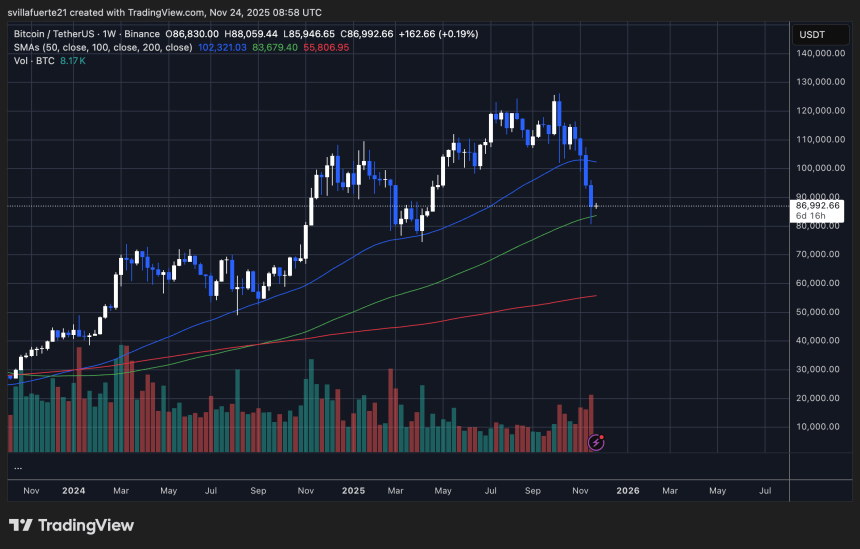
BTC holding key support | Source: BTCUSDT chart on TradingView

Momentum has clearly shifted bearish. The breakdown from the $110K–$100K consolidation zone triggered accelerated selling, confirming a loss of market structure on the weekly timeframe. Candles over the past three weeks show high-volume distribution, with sellers overwhelming demand each time Bitcoin attempted to reclaim higher levels. The steep slope of the 50-week MA turning slightly down is another sign that trend strength has softened.

However, the reaction at the 100-week MA is critical. Bulls aggressively defended this area in prior macro corrections, and holding above $83K–$86K keeps the long-term bull structure intact. A weekly close below this zone, however, opens the door to deeper downside toward the 200-week MA near $56K–$60K.

Featured image from ChatGPT, chart from TradingView.com

Market Opportunity
Belong Logo
Belong Price(LONG)
$0.003714
$0.003714$0.003714
-0.02%
USD
Belong (LONG) Live Price Chart
Disclaimer: The articles reposted on this site are sourced from public platforms and are provided for informational purposes only. They do not necessarily reflect the views of MEXC. All rights remain with the original authors. If you believe any content infringes on third-party rights, please contact [email protected] for removal. MEXC makes no guarantees regarding the accuracy, completeness, or timeliness of the content and is not responsible for any actions taken based on the information provided. The content does not constitute financial, legal, or other professional advice, nor should it be considered a recommendation or endorsement by MEXC.

You May Also Like

Zero Knowledge Proof Stage 2 Coin Burns Signal a Possible 7000x Explosion! ETH Slows Down & Pepe Drops

Zero Knowledge Proof Stage 2 Coin Burns Signal a Possible 7000x Explosion! ETH Slows Down & Pepe Drops

Explore how experts are pointing to a possible 7000x rise for Zero Knowledge Proof (ZKP) while ETH slows and Pepe moves sideways, driven by ongoing coin burns and
Share
CoinLive2026/01/19 07:00
IP Hits $11.75, HYPE Climbs to $55, BlockDAG Surpasses Both with $407M Presale Surge!

IP Hits $11.75, HYPE Climbs to $55, BlockDAG Surpasses Both with $407M Presale Surge!

The post IP Hits $11.75, HYPE Climbs to $55, BlockDAG Surpasses Both with $407M Presale Surge! appeared on BitcoinEthereumNews.com. Crypto News 17 September 2025 | 18:00 Discover why BlockDAG’s upcoming Awakening Testnet launch makes it the best crypto to buy today as Story (IP) price jumps to $11.75 and Hyperliquid hits new highs. Recent crypto market numbers show strength but also some limits. The Story (IP) price jump has been sharp, fueled by big buybacks and speculation, yet critics point out that revenue still lags far behind its valuation. The Hyperliquid (HYPE) price looks solid around the mid-$50s after a new all-time high, but questions remain about sustainability once the hype around USDH proposals cools down. So the obvious question is: why chase coins that are either stretched thin or at risk of retracing when you could back a network that’s already proving itself on the ground? That’s where BlockDAG comes in. While other chains are stuck dealing with validator congestion or outages, BlockDAG’s upcoming Awakening Testnet will be stress-testing its EVM-compatible smart chain with real miners before listing. For anyone looking for the best crypto coin to buy, the choice between waiting on fixes or joining live progress feels like an easy one. BlockDAG: Smart Chain Running Before Launch Ethereum continues to wrestle with gas congestion, and Solana is still known for network freezes, yet BlockDAG is already showing a different picture. Its upcoming Awakening Testnet, set to launch on September 25, isn’t just a demo; it’s a live rollout where the chain’s base protocols are being stress-tested with miners connected globally. EVM compatibility is active, account abstraction is built in, and tools like updated vesting contracts and Stratum integration are already functional. Instead of waiting for fixes like other networks, BlockDAG is proving its infrastructure in real time. What makes this even more important is that the technology is operational before the coin even hits exchanges. That…
Share
BitcoinEthereumNews2025/09/18 00:32
The Alarming 80% Failure Rate And The Critical Path To Survival

The Alarming 80% Failure Rate And The Critical Path To Survival

The post The Alarming 80% Failure Rate And The Critical Path To Survival appeared on BitcoinEthereumNews.com. Crypto Hack Recovery: The Alarming 80% Failure Rate
Share
BitcoinEthereumNews2026/01/19 07:08





