Bitcoin Magazine Bitcoin Price Sits Down Over 30% From All-Time Highs as Market Waits for Next Catalyst The Bitcoin price has fallen over 30% since October, dropping another 1% overnight to around $87,000 amid a nearly two-month drawdown. This post Bitcoin Price Sits Down Over 30% From All-Time Highs as Market Waits for Next Catalyst first appeared on Bitcoin Magazine and is written by Micah Zimmerman.Bitcoin Magazine Bitcoin Price Sits Down Over 30% From All-Time Highs as Market Waits for Next Catalyst The Bitcoin price has fallen over 30% since October, dropping another 1% overnight to around $87,000 amid a nearly two-month drawdown. This post Bitcoin Price Sits Down Over 30% From All-Time Highs as Market Waits for Next Catalyst first appeared on Bitcoin Magazine and is written by Micah Zimmerman.

Bitcoin Price Sits Down Over 30% From All-Time Highs as Market Waits for Next Catalyst

Bitcoin Magazine

Bitcoin Price Sits Down Over 30% From All-Time Highs as Market Waits for Next Catalyst

Bitcoin price is down more than 30% from its October record and continues to leak lower, slipping another 1% overnight to trade near $87,000 this morning. It’s the latest episode of a near two-month-long drawdown that has caught traders off guard. 

And while the selling has slowed, the mood across markets remains fragile.

The move reflects a global risk-off tone. S&P 500 futures were slightly red after a strong rebound yesterday. Asia traded mixed. Europe opened flat-to-lower. The bitcoin price followed suit, behaving more like a high-beta tech asset than a macro hedge — a correlation that has only strengthened in recent weeks.

The slide puts the Bitcoin price back near levels where bulls say the next battle will be fought. Analysts consistently highlight the $80,000–$83,000 region as the line that must hold. That area already saved Bitcoin twice this month, including last week’s violent flush to $80,915. But each test weakens the floor.

Whale activity is sending mixed signals

New on-chain data is adding another wrinkle. Wallets holding at least 100 BTC — often viewed as mid-tier whales — are rising again after hitting a two-year low earlier this month. Santiment says these wallets have climbed by 0.47% since Nov. 11, equivalent to 91 new whale entities.

That’s a subtle but notable shift. These holders tend to scale in during deep corrections. Their return hints at early bargain hunting.

But the broader whale picture is less comforting. Wallets holding more than 1,000 BTC continue to shrink. The largest whales — those with over 10,000 BTC — trimmed around 1.5% of their holdings in October. 

Citi estimates the market now lacks the spot inflow cushion normally required to stabilize prices. In their view, roughly $1 billion in weekly inflows is needed to lift the bitcoin price 4%. That demand simply isn’t there right now.

Bitcoin price: Brief rebounds, bigger questions

The Bitcoin price clawed back to $86,000 over the weekend after last week’s crash, but the bounce felt shaky. Every recovery has been capped by selling pressure near the mid-$80Ks. Earlier today, in Asia trading hours, the Bitcoin price briefly touched above $89,000 before slumping to $87,000.

That hesitation mirrors the broader macro setup. Fed Governor Christopher Waller backed a December rate cut, citing softening labor data. But he made clear the central bank remains fully data-dependent. Markets heard “maybe,” not “yes.” 

Rate-cut optimism had been a major engine for the Bitcoin price’s breakout above $100K earlier this year. Now traders are grappling with uncertainty.

Meanwhile, institutional flows remain negative. Funds continue trimming exposure heading into year-end, and US regulatory drift is not helping. The Senate slowdown on digital-asset legislation has dampened confidence just as ETFs helped push new capital into the market.

Technicians eye $80,000 — and then $70,000

Technical analysts from Bitcoin Magazine say Bitcoin’s structure is damaged but not broken. The break of the multi-week broadening wedge points to a possible retest of $70,000, even if the market manages a temporary rally first.

For now, the path is simple: hold above $84,000 and bulls keep a real shot at retaking $91,400 and $94,000. Lose $84,000, and the market likely slides toward $75,000, with a break below that opening the high-volume support zone at $72,000–$69,000.

Veteran analysts note that 30% drawdowns are routine for Bitcoin. Anthony Pompliano reminded CNBC viewers yesterday that the asset has endured 21 such drops in the past decade. Seven were deeper than 50%. Bitcoin’s long-term holders tend to treat these episodes as background noise — painful, but familiar.

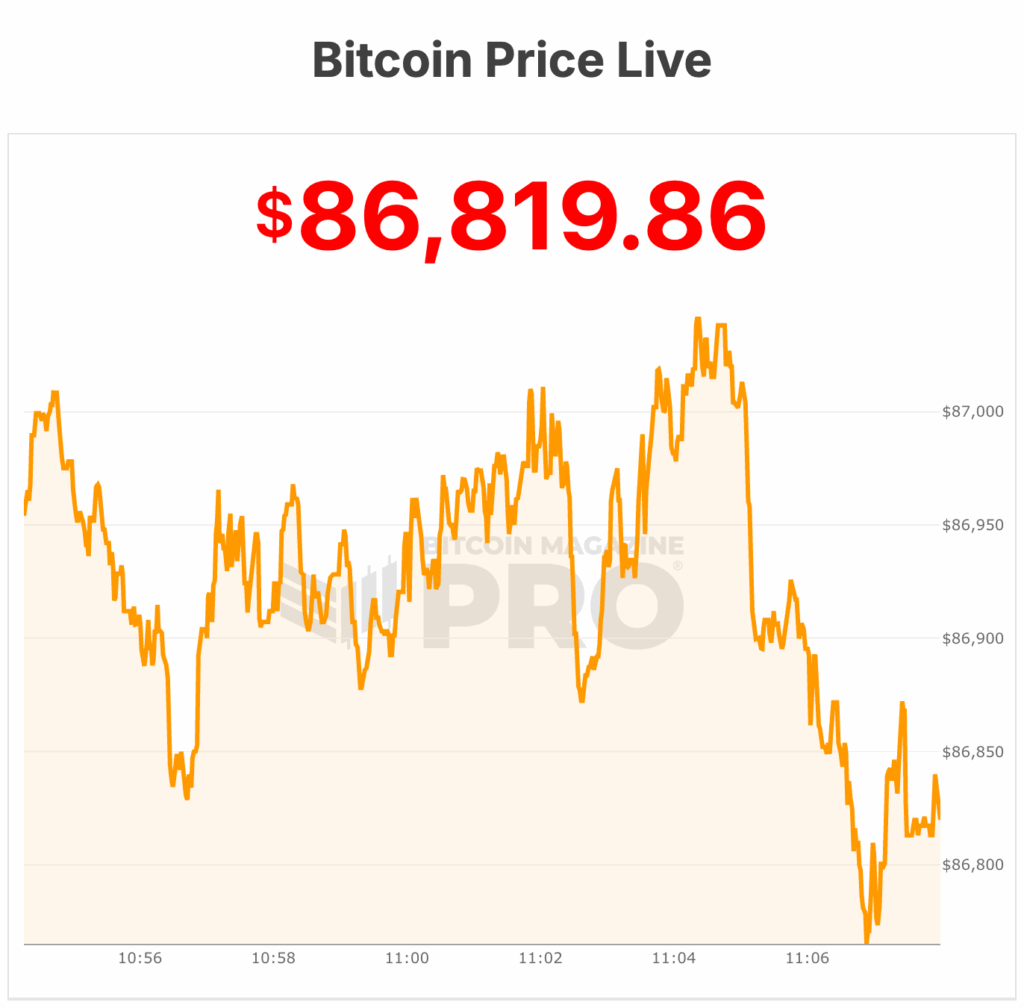
For now, traders are watching the charts, the whales, the Fed, and their own nerves. Bitcoin price sits at $86,819 — bruised, but not broken — waiting for its next catalyst.
bitcoin price

This post Bitcoin Price Sits Down Over 30% From All-Time Highs as Market Waits for Next Catalyst first appeared on Bitcoin Magazine and is written by Micah Zimmerman.

Market Opportunity
1 Logo
1 Price(1)
$0.006236
$0.006236$0.006236
-7.79%
USD
1 (1) Live Price Chart
Disclaimer: The articles reposted on this site are sourced from public platforms and are provided for informational purposes only. They do not necessarily reflect the views of MEXC. All rights remain with the original authors. If you believe any content infringes on third-party rights, please contact [email protected] for removal. MEXC makes no guarantees regarding the accuracy, completeness, or timeliness of the content and is not responsible for any actions taken based on the information provided. The content does not constitute financial, legal, or other professional advice, nor should it be considered a recommendation or endorsement by MEXC.

You May Also Like

Optum Golf Channel Games Debut In Prime Time

Optum Golf Channel Games Debut In Prime Time

The post Optum Golf Channel Games Debut In Prime Time appeared on BitcoinEthereumNews.com. FARMINGDALE, NEW YORK – SEPTEMBER 28: (L-R) Scottie Scheffler of Team
Share
BitcoinEthereumNews2025/12/18 07:21
Google's AP2 protocol has been released. Does encrypted AI still have a chance?

Google's AP2 protocol has been released. Does encrypted AI still have a chance?

Following the MCP and A2A protocols, the AI Agent market has seen another blockbuster arrival: the Agent Payments Protocol (AP2), developed by Google. This will clearly further enhance AI Agents' autonomous multi-tasking capabilities, but the unfortunate reality is that it has little to do with web3AI. Let's take a closer look: What problem does AP2 solve? Simply put, the MCP protocol is like a universal hook, enabling AI agents to connect to various external tools and data sources; A2A is a team collaboration communication protocol that allows multiple AI agents to cooperate with each other to complete complex tasks; AP2 completes the last piece of the puzzle - payment capability. In other words, MCP opens up connectivity, A2A promotes collaboration efficiency, and AP2 achieves value exchange. The arrival of AP2 truly injects "soul" into the autonomous collaboration and task execution of Multi-Agents. Imagine AI Agents connecting Qunar, Meituan, and Didi to complete the booking of flights, hotels, and car rentals, but then getting stuck at the point of "self-payment." What's the point of all that multitasking? So, remember this: AP2 is an extension of MCP+A2A, solving the last mile problem of AI Agent automated execution. What are the technical highlights of AP2? The core innovation of AP2 is the Mandates mechanism, which is divided into real-time authorization mode and delegated authorization mode. Real-time authorization is easy to understand. The AI Agent finds the product and shows it to you. The operation can only be performed after the user signs. Delegated authorization requires the user to set rules in advance, such as only buying the iPhone 17 when the price drops to 5,000. The AI Agent monitors the trigger conditions and executes automatically. The implementation logic is cryptographically signed using Verifiable Credentials (VCs). Users can set complex commission conditions, including price ranges, time limits, and payment method priorities, forming a tamper-proof digital contract. Once signed, the AI Agent executes according to the conditions, with VCs ensuring auditability and security at every step. Of particular note is the "A2A x402" extension, a technical component developed by Google specifically for crypto payments, developed in collaboration with Coinbase and the Ethereum Foundation. This extension enables AI Agents to seamlessly process stablecoins, ETH, and other blockchain assets, supporting native payment scenarios within the Web3 ecosystem. What kind of imagination space can AP2 bring? After analyzing the technical principles, do you think that's it? Yes, in fact, the AP2 is boring when it is disassembled alone. Its real charm lies in connecting and opening up the "MCP+A2A+AP2" technology stack, completely opening up the complete link of AI Agent's autonomous analysis+execution+payment. From now on, AI Agents can open up many application scenarios. For example, AI Agents for stock investment and financial management can help us monitor the market 24/7 and conduct independent transactions. Enterprise procurement AI Agents can automatically replenish and renew without human intervention. AP2's complementary payment capabilities will further expand the penetration of the Agent-to-Agent economy into more scenarios. Google obviously understands that after the technical framework is established, the ecological implementation must be relied upon, so it has brought in more than 60 partners to develop it, almost covering the entire payment and business ecosystem. Interestingly, it also involves major Crypto players such as Ethereum, Coinbase, MetaMask, and Sui. Combined with the current trend of currency and stock integration, the imagination space has been doubled. Is web3 AI really dead? Not entirely. Google's AP2 looks complete, but it only achieves technical compatibility with Crypto payments. It can only be regarded as an extension of the traditional authorization framework and belongs to the category of automated execution. There is a "paradigm" difference between it and the autonomous asset management pursued by pure Crypto native solutions. The Crypto-native solutions under exploration are taking the "decentralized custody + on-chain verification" route, including AI Agent autonomous asset management, AI Agent autonomous transactions (DeFAI), AI Agent digital identity and on-chain reputation system (ERC-8004...), AI Agent on-chain governance DAO framework, AI Agent NPC and digital avatars, and many other interesting and fun directions. Ultimately, once users get used to AI Agent payments in traditional fields, their acceptance of AI Agents autonomously owning digital assets will also increase. And for those scenarios that AP2 cannot reach, such as anonymous transactions, censorship-resistant payments, and decentralized asset management, there will always be a time for crypto-native solutions to show their strength? The two are more likely to be complementary rather than competitive, but to be honest, the key technological advancements behind AI Agents currently all come from web2AI, and web3AI still needs to keep up the good work!
Share
PANews2025/09/18 07:00
Read Trend And Momentum Across Markets

Read Trend And Momentum Across Markets

The post Read Trend And Momentum Across Markets appeared on BitcoinEthereumNews.com. Widely used in technical analysis, the MACD indicator helps traders read trend
Share
BitcoinEthereumNews2025/12/18 07:14