

Must Read
META. Small toy figures are seen in front of Meta's logo in this illustration taken, October 28, 2021.META. Small toy figures are seen in front of Meta's logo in this illustration taken, October 28, 2021.
24th Jaime V. Ongpin lecture focuses on fighting disinformation in the age of AI
For feedback or concerns regarding this content, please contact us at [email protected]
MANILA, Philippines – Artificial intelligence (AI) can both be a potential vector for spreading and a means of fighting disinformation, according to experts who spoke at the 24th Jaime V. Ongpin Annual Memorial Lecture at the Ateneo Professional Schools on Monday, November 24
In her keynote speech, Professor Maria Mercedes Rodrigo, head of the Ateneo Laboratory for the Learning Sciences, said that “AI has accelerated and democratized the capacity to create deepfakes — synthetic text, images, audio, video of events that never took place.”
She added, “Generative AI has the potential to inundate media with deepfakes, misinformation, and synthetic content, and the Philippines has been designated patient zero in the context of global disinformation largely attributable to the significant prevalence of misinformation during the 2016 Philippine elections.”
The study said 14 experts — six industry professionals, three academics, three civil society members, and two members of the media — were gathered in a series of interviews for the purpose of the study.
Within the industry, the two most common applications of AI were fraud detection and anti-money laundering campaigns, as well as personalized marketing campaigns.
In her speech, Rodrigo cited the need for regulatory policies and a code of ethics governing AI use. Industry and academic key informants, she said, affirmed the need for ethical and regulatory policies to ensure AI safety.
Meanwhile, “users and creators of AI applications need to be cognizant of safety, security, and intellectual property implications.”
“Based on our interviews, we can see that we as a country have the internal capacity and expertise. We have the education and the awareness, What we seem to lack is scale, and what we need is scale,” Rodrigo said.
To cap off her speech, Rodrigo mentioned some of the proposed remedies in the study, which focused on combating disinformation through effective implementation of governance structures, policy adaptations, and collaboration across sectors.
These included a call for a national AI governance framework, aligning with the Department of Trade and Industry’s National AI Strategy Roadmap 2.0, as well as promoting media literacy and public awareness regarding AI as a tool and a means of spreading disinformation to the unwary.
Play Video 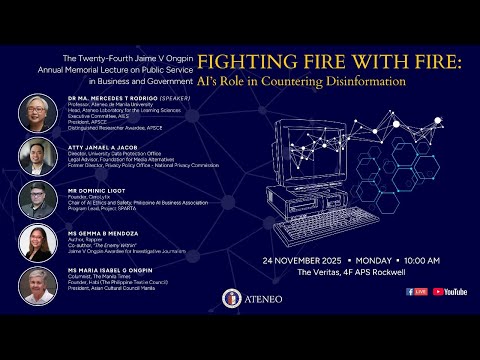
Panel of reactors
A panel of reactors was also on hand to give remarks regarding the possibilities and pitfalls of artificial intelligence. Alongside Rodrigo were lawyer Jamael Jacob, director of the university’s data protection office; Dominic Ligot, the founder of Cirrolytix and the chair of AI ethics and safety at the Philippine AI Business Association; and, Gemma Mendoza, Rappler’s head of digital services and lead researcher on disinformation and platforms.
According to Jacob, critics and proponents of AI both readily admit that AI isn’t perfect, and makes mistakes or “hallucinates.” As such, the jury is still out on using AI to combat the bad uses of AI.
He added that transparency was crucial to ascribing responsibility for AI’s uses and any potential missteps, though calls for transparency and accountability are often rejected as AI’s algorithms are treated as trade secrets by big technology companies.
For Ligot, meanwhile, his position is that AI is neither a savior nor a villain, and that we must treat deepfakes as a present operational threat rather than a distant one. Ligot also stood for limiting the reach of bad actors rather than policing free expression by detecting the coordinated spread of falsehoods. The reach of paid disinformation, he explained, vastly outpaces truth, with disinformation amplified by design and more readily going viral.
Mendoza discussed the accountability of tech companies to labeling fake content. She mentioned how a rise in synthetic content and AI slop — especially deepfakes like hyperrealistic video content — has drowned out real content on social media feeds. This is made worse by the existence of well-used but still little-known AI tools to generate deepfakes.
She mentioned how platforms profit from the spread of deepfakes, with a Reuters report mentioning that, based on internal documents, Meta earns a fortune on fraudulent ads by charging suspected fraudsters more to be amplified rather than investigating the source of the fraud.
Mendoza added, “While innovation should be welcomed, guard rails should be in place and platforms should not be allowed to profit from content theft. This will ultimately kill that rich marketplace of information, art, and culture that AI is currently benefiting from.”
The study by Rodrigo, Rommel Jude Ong, Karen Claire Garcia, Charisse Erinn Flores, and Johanna Marion Torres is available to download for free on this page. It was funded by the Konrad Adenauer Stiftung Foundation. – Rappler.com
Market Opportunity

null Price(null)
--
----
USD
null (null) Live Price Chart
Disclaimer: The articles reposted on this site are sourced from public platforms and are provided for informational purposes only. They do not necessarily reflect the views of MEXC. All rights remain with the original authors. If you believe any content infringes on third-party rights, please contact [email protected] for removal. MEXC makes no guarantees regarding the accuracy, completeness, or timeliness of the content and is not responsible for any actions taken based on the information provided. The content does not constitute financial, legal, or other professional advice, nor should it be considered a recommendation or endorsement by MEXC.
You May Also Like

XRP Builds Case For $22 With Major Chart Shift – But Only If This Breakout Retest Holds
XRP is exhibiting a large-scale technical formation on its monthly chart that has drawn significant attention. Egrag Crypto, a widely followed XRP analyst on X,
Share
Bitcoinist2026/03/23 03:00

Fan Token Firm Chiliz Acquires 2-Time ‘Dota 2’ Champions, OG Esports
The post Fan Token Firm Chiliz Acquires 2-Time ‘Dota 2’ Champions, OG Esports appeared on BitcoinEthereumNews.com. In brief The Chiliz Group has acquired a controlling stake in OG Esports, a prominent competitive gaming organization. OG Esports unveiled its own fan token on Chiliz’s Socios.com platform back in 2020. It recently hit an all-time high price. Chiliz has teased various future team-related benefits for OG token holders, along with a new Web3-related project. The Chiliz Group, which operates the Socios.com crypto fan token platform, announced Tuesday that it has acquired a 51% controlling stake in OG Esports, the competitive gaming organization founded in 2015 by Dota 2 legends Johan “nOtail” Sundstein and Sébastien “Ceb” Debs. OG made history as the first team to win consecutive titles at The International—the annual, high-profile Dota 2 world championship tournament—in 2018 and 2019, and has since expanded into multiple games including Counter-Strike, Honor of Kings, and Marvel Rivals. The team was also the first esports organization to join the Socios platform with the 2020 debut of its own fan token, which Chiliz said recently became the first esports team token to exceed a $100 million market capitalization. OG was recently priced at $16.88, up nearly 9% on the day following the announcement. The token’s price peaked at a new all-time high of $24.78 last week ahead of The International 2025, where OG did not compete this year. Following the acquisition, Xavier Oswald will assume the CEO role, while the co-founders will turn their attention to “a new strategic project consolidating the team’s competitive foundation [and] driving innovation at the intersection of esports and Web3,” per a press release. No further details were provided regarding that project. “Bringing OG into the Chiliz Group is a major step toward further strengthening fan experiences, one where the community doesn’t just watch from the sidelines but gets to shape the journey,” Chiliz CEO Alex Dreyfus…
Share
BitcoinEthereumNews2025/09/18 09:40

The 1875 Carta General del Archipielago Filipino
This is it! “This map of the Philippine Archipelago was first published in 1875 by the Direccion Hidografia and reissued in 1888 with minor corrections. This map
Share
Bworldonline2026/03/23 00:02
