

Ethereum price struggles below $3k as staking demand weakens: Can bulls regain control?
Ethereum price failed to bounce back above $3,000 today as investor demand for staking the token continues to weaken. Can Ethereum bulls manage to regain momentum and push past this crucial level?
- Ethereum price is down 30% over the past month.
- The amount of staked ETH has significantly dropped over the past months.
- A death cross pattern is looming on the daily chart.
Crypto.news data shows Ethereum (ETH) rose to an intraday high of $2,973 on Nov. 26. However, it failed to breach the key psychological resistance at $3,000, settling at $2,938 at press time. At this level, the second-largest crypto asset by market cap, valued at $354.5 billion, remains down nearly 30% over the past month and is trading 40.6% below its all-time high reached in August this year.
Ethereum’s price has repeatedly faced resistance at $3,000 and, once again, failed to breach that level earlier today amid ongoing weak staking inflows.
For context, staking inflows are a metric that indicates when investors withdraw their ETH holdings from exchanges to stake them. As a proof-of-stake cryptocurrency, staking helps bolster the Ethereum network’s security. It is generally seen as supportive of the asset’s price, as staked ETH is locked and effectively removed from circulation.
Data from CryptoQuant shows that staking inflows have dropped from $160,000 near the end of October to just $2,941 today, as traders continue rotating into other cryptocurrencies that offer higher yields at a lower investment threshold.
“Investors still find Ethereum, currently priced [around $2,900], too expensive to stake. This situation could push the price down toward $2,500,” CryptoQuant analysts noted in a recent market report.
At press time, the annual staking yield for Ethereum was around 1.9–2%, far lower than some of its competing proof-of-stake cryptocurrencies, such as Avalanche at 4.7%, Solana at 4.2%, and Bittensor at 14.7%.
Adding to the bearish outlook, Ethereum ETFs have also recorded significant net outflows since the beginning of November, totaling $1.56 billion so far. This suggests that institutional investors who had previously been supporting ETH through ETF exposure have also turned their backs on the asset, at least for now.
Ethereum price analysis
On the daily chart, Ethereum’s price has formed multiple bearish patterns that could keep traders at bay and potentially trigger a steeper short-term correction.
The 50-day simple moving average is approaching a crossover with the 200-day one, which would form a death cross, a pattern that typically precedes a prolonged downtrend and signals weakening market momentum.
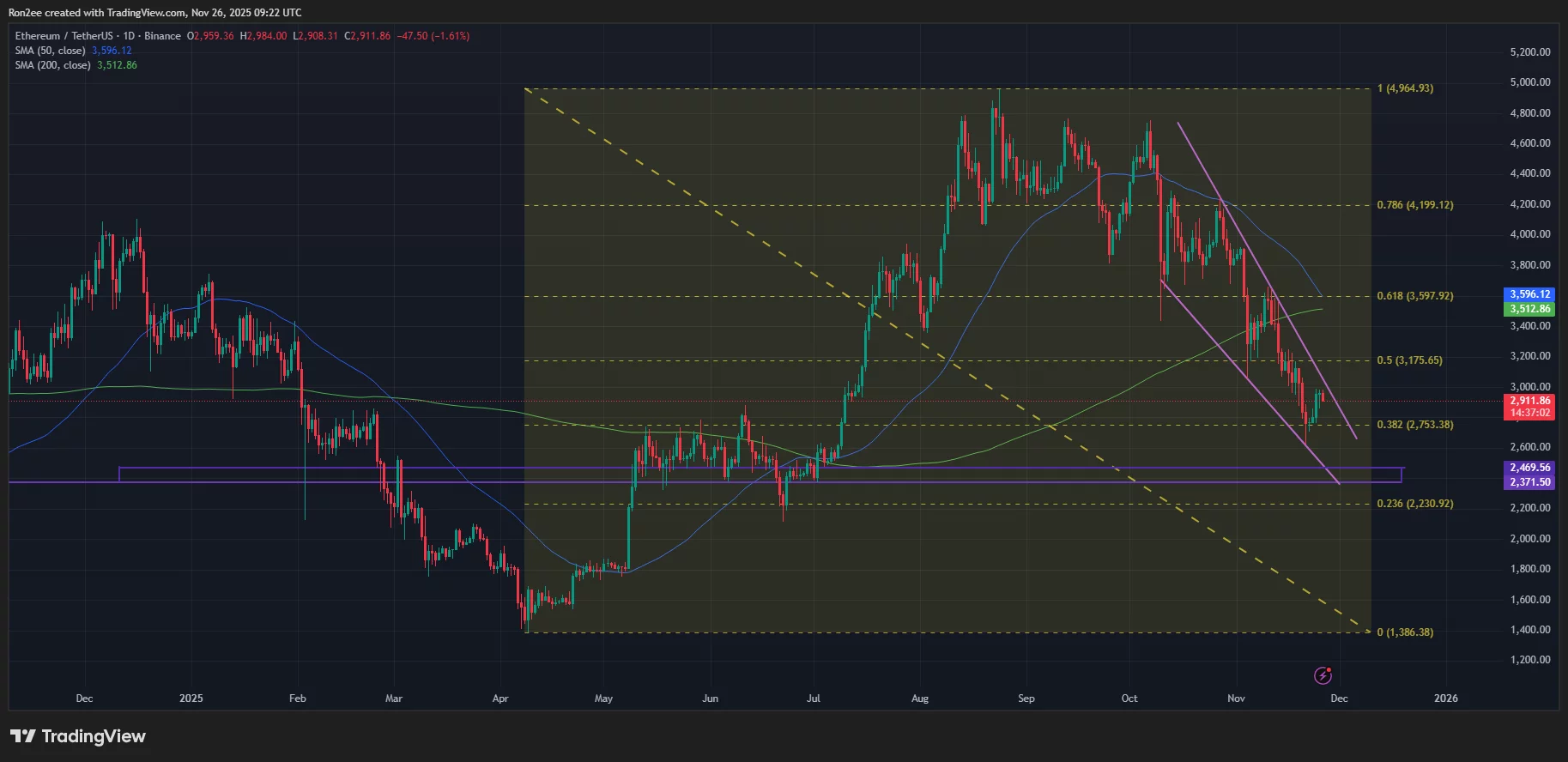
As per a previous report from crypto.news, the altcoin’s price action also appears to have shaped a rounded top pattern. This is another bearish formation that often signals exhaustion of buying pressure and may pave the way for an extended pullback.
For now, traders are likely keeping a close eye on the $2,370 to $2,470 zone, a range that has historically served as strong support earlier this year and where bulls previously staged a successful rebound. A decisive drop below this area could open the door for deeper losses.
However, on a more positive note, Ethereum could see a recovery rally if it breaks out of the falling wedge pattern that has also formed on the daily chart. When an asset breaks out of a falling wedge, it is usually taken as a sign of an impending bullish reversal, especially when accompanied by substantial volume and positive market sentiment.
Disclosure: This article does not represent investment advice. The content and materials featured on this page are for educational purposes only.
You May Also Like

Crypto execs met with US lawmakers to discuss Bitcoin reserve, market structure bills
Lawmakers in the US House of Representatives and Senate met with cryptocurrency industry leaders in three separate roundtable events this week. Members of the US Congress met with key figures in the cryptocurrency industry to discuss issues and potential laws related to the establishment of a strategic Bitcoin reserve and a market structure.On Tuesday, a group of lawmakers that included Alaska Representative Nick Begich and Ohio Senator Bernie Moreno met with Strategy co-founder Michael Saylor and others in a roundtable event regarding the BITCOIN Act, a bill to establish a strategic Bitcoin (BTC) reserve. The discussion was hosted by the advocacy organization Digital Chamber and its affiliates, the Digital Power Network and Bitcoin Treasury Council.“Legislators and the executives at yesterday’s roundtable agree, there is a need [for] a Strategic Bitcoin Reserve law to ensure its longevity for America’s financial future,” Hailey Miller, director of government affairs and public policy at Digital Power Network, told Cointelegraph. “Most attendees are looking for next steps, which may mean including the SBR within the broader policy frameworks already advancing.“Read more

The co-founder of CoinDCX was arrested by Indian police on suspicion of fraud; the exchange claims it was a fake website impersonating him.

