

Nigeria’s smartphone shipment grew by 29% in Q3 2025 driven by naira stability
Nigeria’s smartphone market has recorded its highest growth of 29% surge in shipments in the third quarter of 2025. This was revealed in a recent report by Omdia, a global technology market analyst firm.
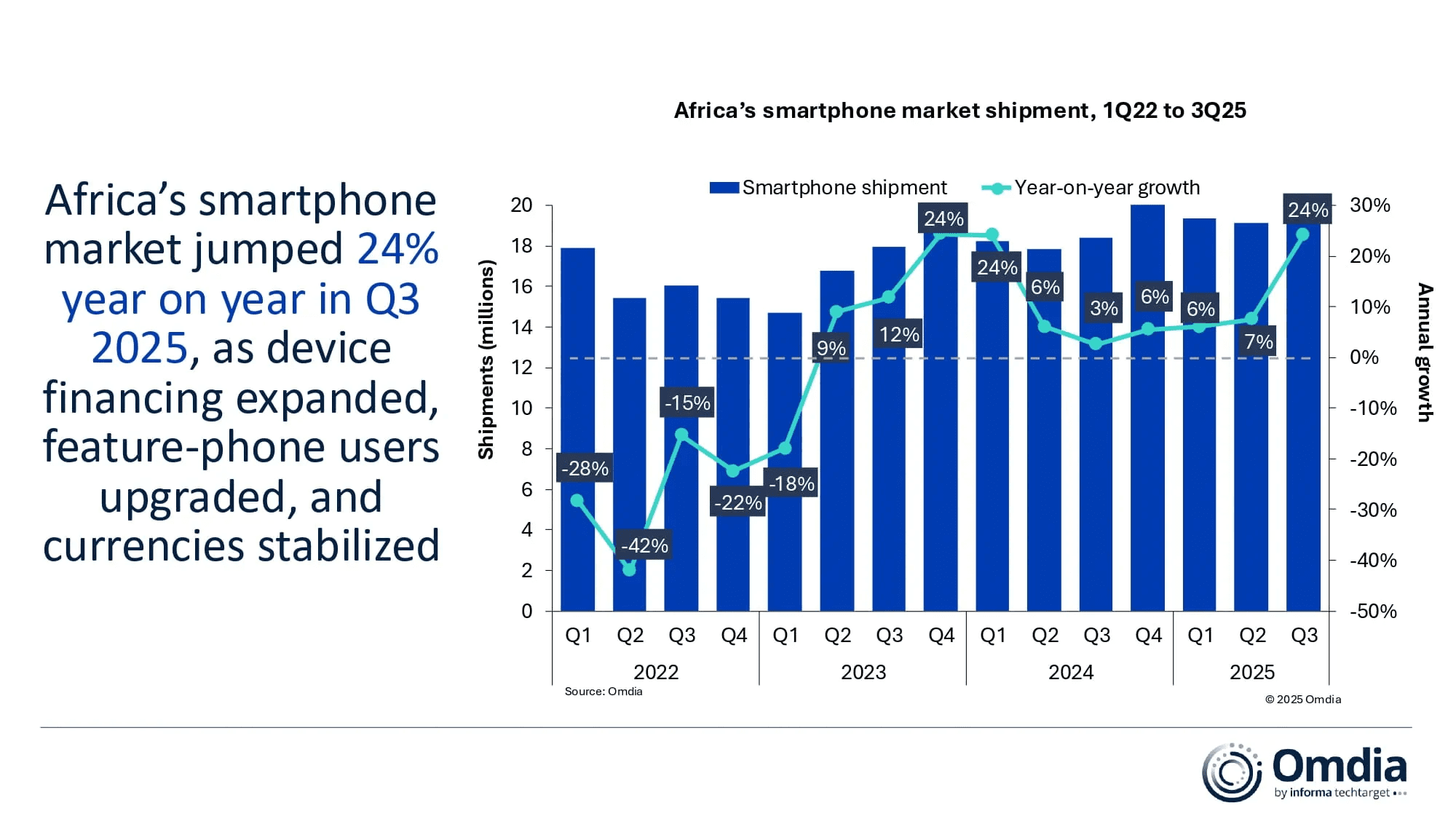
According to the report, Nigeria’s Q3 2025 growth was driven by naira stability and accelerated imports by vendors. This growth marks the second consecutive quarter of expansion for the sector, finally pulling the market out of its difficult performance in 2024.
Recall that in 2024, the Central Bank of Nigeria’s (CBN) foreign exchange (FX) reforms led to a sharp devaluation of the Naira. This volatility caused smartphone prices to skyrocket, pushing devices out of the budget for many consumers.
Consequently, shipment slowed drastically in Q3 2024, effectively reversing a significant 63% surge seen at the end of 2023. Total smartphone imports into Nigeria fell from $704.76 million in 2023 to $467.70 million in 2024.
However, the tide has turned in 2025. With the Naira maintaining a relatively steady rate, hovering between N1,450 and N1,500 per US dollar since the beginning of the year. As such market conditions appeared to have improved significantly.
The global technology market analyst firm confirmed in its report that this stability was the primary catalyst for the recovery.
Because of that, vendors quickly boosted imports, focusing especially on more affordable smartphone models under $150 to meet the demand of price-sensitive Nigerian consumers. This, in turn, spurred a major upgrade cycle across the open market.
“Nigeria’s market surged 29% as vendors accelerated imports following Naira stabilising and refreshed sub-$150 portfolios, spurring upgrades in open-market retail,” the report said.
Read also: Smartphone prices have surged by 50% across Nigeria in one month (see price list)
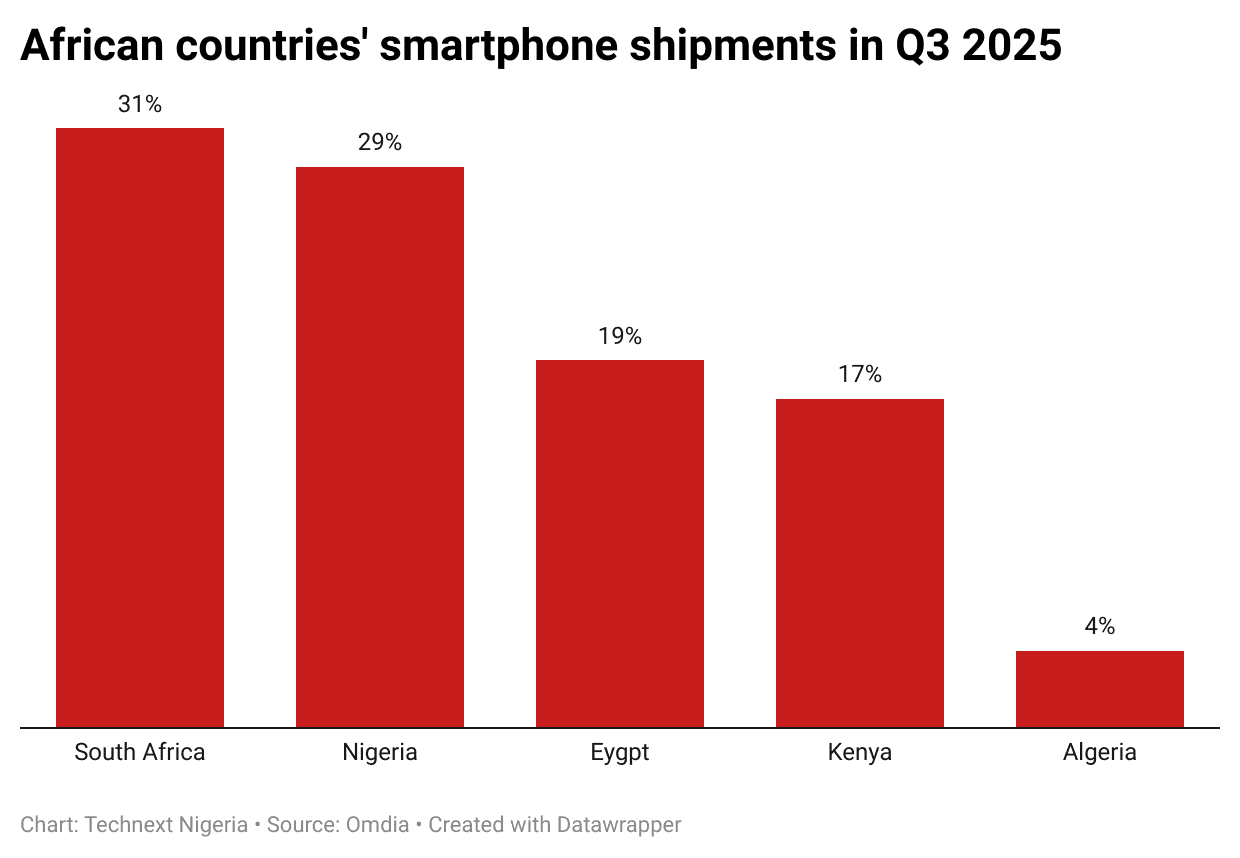
Nigeria records second-highest growth rate in African
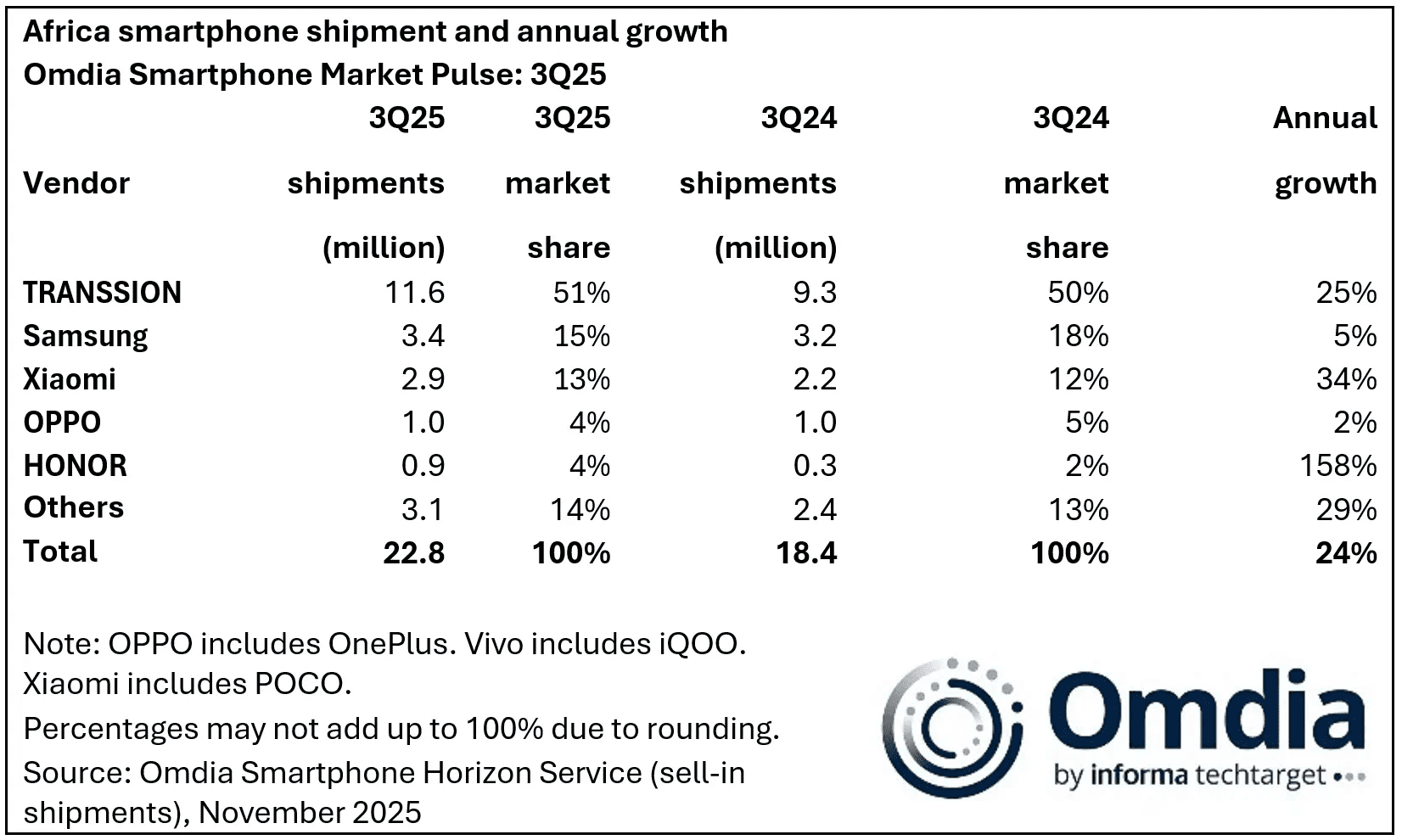
This localised success mirrors a broader recovery across the African continent. According to Omdia, Africa’s total smartphone shipments jumped by 24% year-on-year in Q3 2025, reaching 22.8 million units and effectively ending five quarters of decline.
However, other major African markets also recorded strong double-digit growth, highlighting the widespread nature of the recovery.
“Most markets across North and Sub-Saharan Africa posted double-digit smartphone growth in Q3, with Algeria the only outlier at 4%. Nigeria and Egypt each accounted for 14% of regional shipments, though their recoveries were driven by very different smartphone dynamics,” the report said.
Egypt’s smartphone shipment rose by 19% on the back of stronger mid-range momentum. Brands also pushed aggressively into the $150–250 band through bundled offers while expanding into mass market channels.
“South Africa led with 31% growth, boosted by prepaid acceleration in the value and mid-tier segments, supported by new launches and deeper retail promotions with retailers such as Pepkor and Ackerman’s benefiting from the removal of the 9% ad valorem tax earlier this year,” the report added.
It noted that Kenya grew 17% year on year, powered by rising device-financing penetration – now a major driver of smartphone sell-through. Retailers and operators are also scaling instalment-based plans which boosted demand for refreshed entry-level models.
 Source: Omdia
Transsion leads Africa’s shipment growth
According to Omdia, the market’s growth was notably diverse. The surge was driven by two key segments: First is the most affordable smartphones (under $100), which saw a steep climb of 57%, then there is the high-end, premium segment (above $500) which also grew substantially by 52%.
According to Manish Pravinkumar, Principal Analyst at Omdia, the entry tier was fueled by the TRANSSION smartphone, which posted 25% year-on-year growth driven by high demand across Algeria, Egypt, Morocco, Nigeria, Kenya, and South Africa.
“This growth was reinforced by refreshed hero models such as TECNO’s Camon 40 and Spark 40, Infinix’s Hot 60 and Smart 10, and itel’s A90. Samsung dominated premium-tier expansion with the Galaxy S24 and S24 FE 5G demand from markets like South Africa, Senegal, and Algeria. However, overall growth was modest, 5%, as consumers gravitated toward value models A06, A07, and A16,” he added.
This dual-layered growth indicates both renewed consumer affordability at the low end and increased purchasing power or willingness at the high end.
 Source: Omdia
Future outlook of Africa’s smartphone shipments
Despite the current boom in imports and shipments, the long-term forecast for the continent is less optimistic. According to Manish Pravinkumar, Principal Analyst at Omdia, Africa’s smartphone market is expected to decline 6% in 2026 as supply-side pressures intensify.
“Rising BOM costs, tight memory availability, elevated shipping and insurance fees, and persistent currency weakness will disproportionately affect the low-end 4G segment, where most African demand is concentrated. These pressures will push ASPs higher, especially in the $80–150 band, creating renewed affordability challenges for consumers,” he said.
To navigate this environment, Pravinkumar advised vendors to strengthen financing partnerships, optimise channel inventory, and localise more aggressively to manage costs and sustain upgrade momentum despite the economic headwinds.
Read also: GSMA, MTN and others target affordable 4G access with ₦44,000 smartphones


You May Also Like
Bitcoin (BTC) Steady at $65K as BlackRock Reveals $9 Trillion Capital Shift Coming

Placeholder Partner Chris Burniske Begins Buying, Calls October a ‘Critical Turning Point’ for Crypto

SpaceX Options Surge: Turning IPO Momentum Into a Volatility Test



