A pseudonymous analyst has set off a new narrative around Ethereum’s upcoming Fusaka upgrade, arguing it could be the most favorable event ever for ETH as an asset by finally turning Layer-2 networks into meaningful ETH burners. On X, crypto pundit Kira Sama framed Fusaka, scheduled for December 3, as a structural shift in Ethereum’s fee economics. The core of the thesis is a single change: EIP-7918. “Price wise, Ethereum Fusaka upgrade on december 3rd, will be the most bullish upgrade for eth the asset ever, why? One reason. ‘EIP 7918’,” Kira wrote, calling it “the next big catalyst for eth burn.” Ethereum L2 Will Burn ETH Kira’s argument rests on how Ethereum currently treats L2s. Since the rollup-centric roadmap took shape, Ethereum’s base layer has effectively subsidized L2 data availability. In his words, “for a long time, ETH L1 charged zero base fees to L2s, while L2 deployers made millions of profits. So L2s haven’t burnt any meaningful eth.” That subsidized regime has fueled explosive L2 growth but also limited how much L2 usage translates into ETH burn. Related Reading: Ethereum Is 58% ‘Undervalued’ Based On Intrinsic Metrics, Says Hashed CEO EIP-7918 is designed to change that by tying L2 data costs more tightly to mainnet gas prices. Kira summarizes it as follows: “L2 fees will be bounded by the execution cost which will help us reach L2 fees price discovery faster. It also helps maintain the fees during spikes so that L2 users won’t be rugged from absurd tx fees. Win-win.” In practice, that means rollups will face a non-trivial, protocol-enforced minimum on what they pay Ethereum for posting their batches. Crucially for ETH holders, those fees are paid in ETH and a portion is burned under the EIP-1559 mechanism. Kira argues that as L2 throughput scales, this will become a dominant driver of ETH’s burn dynamics: “They will just pay their fair share to Ethereum L1 and burn meaningful eth. It will be slow and steady at the beginning. This will eventually result in burning millions of dollars of eth long term and L2s will be main driving force of making eth deflationary.” Related Reading: Ethereum Price To Recover Or Crash? The Real ‘Leverage Point’ Investors Should Know About The narrative becomes more aggressive when Kira extrapolates to corporate and institutional rollups. He lists a series of existing and anticipated L2s and claims that “Coinbase’s base will burn eth, Robinhood’s L2 will burn eth, OpenAI’s Worlchain will burn eth, Sony’s Soneium will burn eth, Alibaba’s Jovay will burn eth, UAE’s ADI chain burn eth, Kraken’s Ink will burn eth, Lighter will burn eth, Deutsche Bank’s Memento chain will burn eth, Arbitrum will burn eth etc etc etc. Corporations will start burning eth.” From that, he extends the thesis to a broader, highly bullish vision: “Every company in the world will launch their own layer 2. Every alt-L1 will become L2 and start burning eth. Eth inflation will shrink.” While those universal claims go far beyond what the upgrade itself guarantees, they capture the heart of the bullish narrative: if enough economic activity migrates onto Ethereum-secured L2s that must pay non-negligible base fees, Ethereum becomes the settlement and value-capture layer beneath corporate and institutional chains. Kira explicitly compares Fusaka to the London hard fork that introduced EIP-1559 in 2021. “When Ethereum introduced burn through eip-1559 in 2021, it lifted the whole market up,” he wrote. “Everyone will be caught off guard this time as well. L2s burning eth incoming. Bullish eth. Bullish L2s.” For now, Kira is clear about his own conclusion: “December 3rd, tik-tok. The ticker is ETH.” At press time, ETH traded at $3,022. Featured image created with DALL.E, chart from TradingView.comA pseudonymous analyst has set off a new narrative around Ethereum’s upcoming Fusaka upgrade, arguing it could be the most favorable event ever for ETH as an asset by finally turning Layer-2 networks into meaningful ETH burners. On X, crypto pundit Kira Sama framed Fusaka, scheduled for December 3, as a structural shift in Ethereum’s fee economics. The core of the thesis is a single change: EIP-7918. “Price wise, Ethereum Fusaka upgrade on december 3rd, will be the most bullish upgrade for eth the asset ever, why? One reason. ‘EIP 7918’,” Kira wrote, calling it “the next big catalyst for eth burn.” Ethereum L2 Will Burn ETH Kira’s argument rests on how Ethereum currently treats L2s. Since the rollup-centric roadmap took shape, Ethereum’s base layer has effectively subsidized L2 data availability. In his words, “for a long time, ETH L1 charged zero base fees to L2s, while L2 deployers made millions of profits. So L2s haven’t burnt any meaningful eth.” That subsidized regime has fueled explosive L2 growth but also limited how much L2 usage translates into ETH burn. Related Reading: Ethereum Is 58% ‘Undervalued’ Based On Intrinsic Metrics, Says Hashed CEO EIP-7918 is designed to change that by tying L2 data costs more tightly to mainnet gas prices. Kira summarizes it as follows: “L2 fees will be bounded by the execution cost which will help us reach L2 fees price discovery faster. It also helps maintain the fees during spikes so that L2 users won’t be rugged from absurd tx fees. Win-win.” In practice, that means rollups will face a non-trivial, protocol-enforced minimum on what they pay Ethereum for posting their batches. Crucially for ETH holders, those fees are paid in ETH and a portion is burned under the EIP-1559 mechanism. Kira argues that as L2 throughput scales, this will become a dominant driver of ETH’s burn dynamics: “They will just pay their fair share to Ethereum L1 and burn meaningful eth. It will be slow and steady at the beginning. This will eventually result in burning millions of dollars of eth long term and L2s will be main driving force of making eth deflationary.” Related Reading: Ethereum Price To Recover Or Crash? The Real ‘Leverage Point’ Investors Should Know About The narrative becomes more aggressive when Kira extrapolates to corporate and institutional rollups. He lists a series of existing and anticipated L2s and claims that “Coinbase’s base will burn eth, Robinhood’s L2 will burn eth, OpenAI’s Worlchain will burn eth, Sony’s Soneium will burn eth, Alibaba’s Jovay will burn eth, UAE’s ADI chain burn eth, Kraken’s Ink will burn eth, Lighter will burn eth, Deutsche Bank’s Memento chain will burn eth, Arbitrum will burn eth etc etc etc. Corporations will start burning eth.” From that, he extends the thesis to a broader, highly bullish vision: “Every company in the world will launch their own layer 2. Every alt-L1 will become L2 and start burning eth. Eth inflation will shrink.” While those universal claims go far beyond what the upgrade itself guarantees, they capture the heart of the bullish narrative: if enough economic activity migrates onto Ethereum-secured L2s that must pay non-negligible base fees, Ethereum becomes the settlement and value-capture layer beneath corporate and institutional chains. Kira explicitly compares Fusaka to the London hard fork that introduced EIP-1559 in 2021. “When Ethereum introduced burn through eip-1559 in 2021, it lifted the whole market up,” he wrote. “Everyone will be caught off guard this time as well. L2s burning eth incoming. Bullish eth. Bullish L2s.” For now, Kira is clear about his own conclusion: “December 3rd, tik-tok. The ticker is ETH.” At press time, ETH traded at $3,022. Featured image created with DALL.E, chart from TradingView.com
Ethereum Fusaka Will Be ‘The Most Bullish Upgrade’ Ever, Pundit Claims

2025/11/29 03:00

A pseudonymous analyst has set off a new narrative around Ethereum’s upcoming Fusaka upgrade, arguing it could be the most favorable event ever for ETH as an asset by finally turning Layer-2 networks into meaningful ETH burners.

On X, crypto pundit Kira Sama framed Fusaka, scheduled for December 3, as a structural shift in Ethereum’s fee economics. The core of the thesis is a single change: EIP-7918.

“Price wise, Ethereum Fusaka upgrade on december 3rd, will be the most bullish upgrade for eth the asset ever, why? One reason. ‘EIP 7918’,” Kira wrote, calling it “the next big catalyst for eth burn.”

Ethereum L2 Will Burn ETH

Kira’s argument rests on how Ethereum currently treats L2s. Since the rollup-centric roadmap took shape, Ethereum’s base layer has effectively subsidized L2 data availability. In his words, “for a long time, ETH L1 charged zero base fees to L2s, while L2 deployers made millions of profits. So L2s haven’t burnt any meaningful eth.” That subsidized regime has fueled explosive L2 growth but also limited how much L2 usage translates into ETH burn.

EIP-7918 is designed to change that by tying L2 data costs more tightly to mainnet gas prices. Kira summarizes it as follows: “L2 fees will be bounded by the execution cost which will help us reach L2 fees price discovery faster. It also helps maintain the fees during spikes so that L2 users won’t be rugged from absurd tx fees. Win-win.” In practice, that means rollups will face a non-trivial, protocol-enforced minimum on what they pay Ethereum for posting their batches.

Crucially for ETH holders, those fees are paid in ETH and a portion is burned under the EIP-1559 mechanism. Kira argues that as L2 throughput scales, this will become a dominant driver of ETH’s burn dynamics: “They will just pay their fair share to Ethereum L1 and burn meaningful eth. It will be slow and steady at the beginning. This will eventually result in burning millions of dollars of eth long term and L2s will be main driving force of making eth deflationary.”

The narrative becomes more aggressive when Kira extrapolates to corporate and institutional rollups. He lists a series of existing and anticipated L2s and claims that “Coinbase’s base will burn eth, Robinhood’s L2 will burn eth, OpenAI’s Worlchain will burn eth, Sony’s Soneium will burn eth, Alibaba’s Jovay will burn eth, UAE’s ADI chain burn eth, Kraken’s Ink will burn eth, Lighter will burn eth, Deutsche Bank’s Memento chain will burn eth, Arbitrum will burn eth etc etc etc. Corporations will start burning eth.”

From that, he extends the thesis to a broader, highly bullish vision: “Every company in the world will launch their own layer 2. Every alt-L1 will become L2 and start burning eth. Eth inflation will shrink.” While those universal claims go far beyond what the upgrade itself guarantees, they capture the heart of the bullish narrative: if enough economic activity migrates onto Ethereum-secured L2s that must pay non-negligible base fees, Ethereum becomes the settlement and value-capture layer beneath corporate and institutional chains.

Kira explicitly compares Fusaka to the London hard fork that introduced EIP-1559 in 2021. “When Ethereum introduced burn through eip-1559 in 2021, it lifted the whole market up,” he wrote. “Everyone will be caught off guard this time as well. L2s burning eth incoming. Bullish eth. Bullish L2s.” For now, Kira is clear about his own conclusion: “December 3rd, tik-tok. The ticker is ETH.”

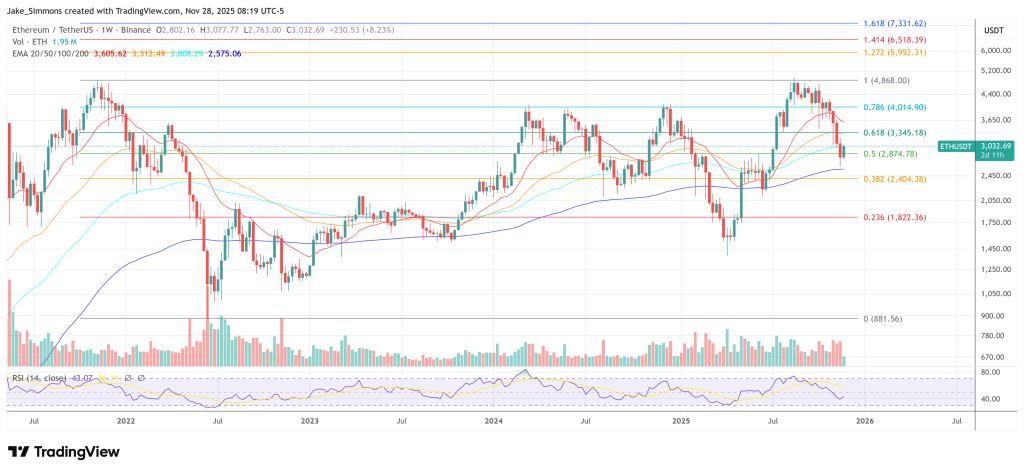
At press time, ETH traded at $3,022.

Ethereum price
Market Opportunity
Bullish Degen Logo
Bullish Degen Price(BULLISH)
$0.01668
$0.01668$0.01668
-15.41%
USD
Bullish Degen (BULLISH) Live Price Chart
Disclaimer: The articles reposted on this site are sourced from public platforms and are provided for informational purposes only. They do not necessarily reflect the views of MEXC. All rights remain with the original authors. If you believe any content infringes on third-party rights, please contact [email protected] for removal. MEXC makes no guarantees regarding the accuracy, completeness, or timeliness of the content and is not responsible for any actions taken based on the information provided. The content does not constitute financial, legal, or other professional advice, nor should it be considered a recommendation or endorsement by MEXC.

You May Also Like

What We Know (and Don’t) About Modern Code Reviews

What We Know (and Don’t) About Modern Code Reviews

This article traces the evolution of modern code review from formal inspections to tool-driven workflows, maps key research themes, and highlights a critical gap
Share
Hackernoon2025/12/17 17:00
X claims the right to share your private AI chats with everyone under new rules – no opt out

X claims the right to share your private AI chats with everyone under new rules – no opt out

X says its Terms of Service will change Jan. 15, 2026, expanding how the platform defines user “Content” and adding contract language tied to the operation and
Share
CryptoSlate2025/12/17 19:24
Michael Saylor Pushes Digital Capital Narrative At Bitcoin Treasuries Unconference

Michael Saylor Pushes Digital Capital Narrative At Bitcoin Treasuries Unconference

The post Michael Saylor Pushes Digital Capital Narrative At Bitcoin Treasuries Unconference appeared on BitcoinEthereumNews.com. The suitcoiners are in town.  From a low-key, circular podium in the middle of a lavish New York City event hall, Strategy executive chairman Michael Saylor took the mic and opened the Bitcoin Treasuries Unconference event. He joked awkwardly about the orange ties, dresses, caps and other merch to the (mostly male) audience of who’s-who in the bitcoin treasury company world.  Once he got onto the regular beat, it was much of the same: calm and relaxed, speaking freely and with confidence, his keynote was heavy on the metaphors and larger historical stories. Treasury companies are like Rockefeller’s Standard Oil in its early years, Michael Saylor said: We’ve just discovered crude oil and now we’re making sense of the myriad ways in which we can use it — the automobile revolution and jet fuel is still well ahead of us.  Established, trillion-dollar companies not using AI because of “security concerns” make them slow and stupid — just like companies and individuals rejecting digital assets now make them poor and weak.  “I’d like to think that we understood our business five years ago; we didn’t.”  We went from a defensive investment into bitcoin, Saylor said, to opportunistic, to strategic, and finally transformational; “only then did we realize that we were different.” Michael Saylor: You Come Into My Financial History House?! Jokes aside, Michael Saylor is very welcome to the warm waters of our financial past. He acquitted himself honorably by invoking the British Consol — though mispronouncing it, and misdating it to the 1780s; Pelham’s consolidation of debts happened in the 1750s and perpetual government debt existed well before then — and comparing it to the gold standard and the future of bitcoin. He’s right that Strategy’s STRC product in many ways imitates the consols; irredeemable, perpetual debt, issued at par, with…
Share
BitcoinEthereumNews2025/09/18 02:12

