Uzbekistan is preparing to integrate stablecoins into its formal payment system and allow the issuance of tokenized stocks and bonds under a tightly regulatedUzbekistan is preparing to integrate stablecoins into its formal payment system and allow the issuance of tokenized stocks and bonds under a tightly regulated

Uzbekistan Legalizes Stablecoins for Payments and Tokenized Stocks in Massive 2026 Overhaul

2025/11/29 04:02
4 min read
For feedback or concerns regarding this content, please contact us at [email protected]

Uzbekistan is preparing to integrate stablecoins into its formal payment system and allow the issuance of tokenized stocks and bonds under a tightly regulated framework starting in 2026, according to local media reports.

The plan positions the country to become one of Central Asia’s most structured environments for regulated digital-asset activity.

It also represents a major shift for a jurisdiction that once imposed broad restrictions on crypto use but has spent recent years building a more controlled and supervised system for the sector.

Uzbekistan Prepares Licensed Exchanges for Tokenized Securities Trading in 2026

According to a Friday report by local news outlet Kun, under the new rules, a special legal regime will take effect on January 1, 2026, introducing a regulatory sandbox managed by the National Agency for Perspective Projects together with the central bank.

The sandbox will allow stablecoins to be tested as a means of payment inside a controlled environment, where authorities will monitor risk, market behavior, and technical implementation.

Pilot programs will also explore a distributed-ledger-based payment system and develop a regulated market for tokenized equities and bonds.

Starting the same day, legal entities registered in Uzbekistan will be permitted to issue tokenized securities, with licensed stock exchanges preparing dedicated trading platforms to support placement and circulation.

The move follows months of review. In September, central bank chairman Timur Ishmetov said stablecoins could be approved for payments but only under strict oversight given their potential impact on monetary policy.

He cautioned that expectations for digital currencies often exceed their practical use in mature payment systems, yet confirmed the bank will continue testing various models, including a wholesale CBDC designed to speed interbank settlements rather than serve the public.

The decree builds on Uzbekistan’s ongoing regulatory framework, which, since January 2023, has required all crypto transactions by residents to flow through locally licensed crypto asset service providers.

These rules ban anonymous transactions, prohibit the use of foreign exchanges, require mandatory customer identification, and mandate that providers store transaction data for at least five years.

Crypto is treated as an asset rather than legal tender, though stablecoins will now become the first category permitted for payment use inside a controlled model.

Mining remains legal but regulated, with companies required to use solar energy and register with the agency.

New Rules Coincide With Industry Push to Standardize Blockchain Payments

The new stablecoin law follows a series of cost adjustments for the industry. In March 2024, monthly fees for crypto exchanges were doubled to roughly $20,000 as part of a wider effort to tighten the market and ensure compliance.

Uzbekistan has maintained a highly supervised approach even as activity grows. In 2024, nearly 1.5% of the population held cryptocurrency, and licensed domestic providers processed more than $1 billion in transactions.

The country ranked 33rd globally in adoption, leading Central Asia alongside Kazakhstan and Kyrgyzstan, which have each pursued their own approaches to mining, payments, and licensing.
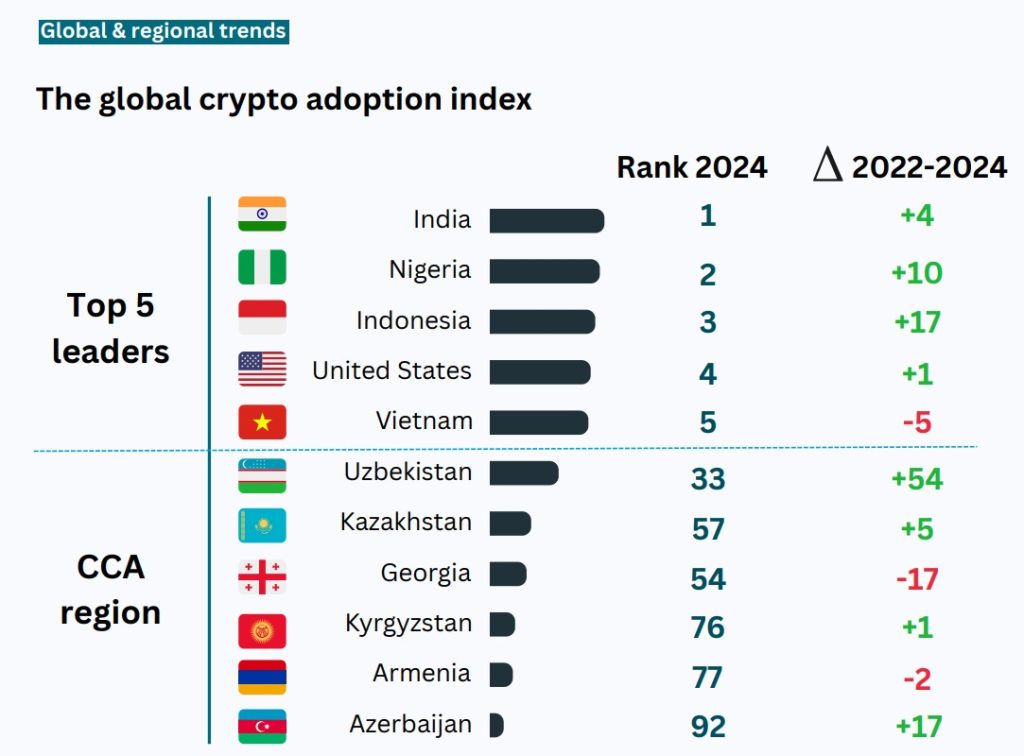
Source: Rise Research

The global context surrounding payments is also changing. Throughout 2025, several major jurisdictions formalized oversight for stablecoins.

The European Union began implementing its broad MiCA rules, the United States advanced federal legislation through the GENIUS Act, and regions such as Hong Kong and the UAE launched licensing systems that bring stablecoin issuers under direct supervision.

Canada proposed its Stablecoin Act, while South Africa, Kenya, and Brazil advanced frameworks for stablecoin usage in commerce and cross-border settlement.

These steps have come as blockchain-based payments continue to scale, with on-chain settlement volume surpassing levels seen in traditional card networks.

Another industry milestone came as Fireblocks, Polygon Labs, Mysten Labs, Solana Foundation, TON Foundation, Stellar Development Foundation, and Monad Foundation formed the Blockchain Payments Consortium intended to standardize how digital assets move across networks.

Disclaimer: The articles reposted on this site are sourced from public platforms and are provided for informational purposes only. They do not necessarily reflect the views of MEXC. All rights remain with the original authors. If you believe any content infringes on third-party rights, please contact [email protected] for removal. MEXC makes no guarantees regarding the accuracy, completeness, or timeliness of the content and is not responsible for any actions taken based on the information provided. The content does not constitute financial, legal, or other professional advice, nor should it be considered a recommendation or endorsement by MEXC.

You May Also Like

South Korea’s $657 Million Exit from Tesla Signals a Big Crypto Pivot
South Korea’s $657 Million Exit from Tesla Signals a Big Crypto Pivot

In a dramatic shift in investment patterns, South Korean retail investors withdrew $657 million from Tesla stock in August 2025, representing the largest monthly outflow in more than two years. At the same time, by mid-2025, they had shifted more than $12 billion into U.S.-listed companies tied to cryptocurrency, indicating a deepening preference for digital […]
Share
Tronweekly2025/09/18 14:00
MetaMask to Launch Its Token Sooner Than Expected, Says ConsenSys CEO

MetaMask to Launch Its Token Sooner Than Expected, Says ConsenSys CEO

The post MetaMask to Launch Its Token Sooner Than Expected, Says ConsenSys CEO appeared first on Coinpedia Fintech News MetaMask, the world’s leading Web3 wallet and gateway to decentralized apps, is gearing up to launch its own token. In a recent interview, Consensys CEO and Ethereum co-founder Joe Lubin revealed that a MetaMask token could be launched much earlier than people think, sparking excitement among users and investors who have long been waiting for …
Share
CoinPedia2025/09/19 12:56
How is the xStocks tokenized stock market developing?

How is the xStocks tokenized stock market developing?

Author: Heechang Compiled by: TechFlow xStocks offers a tokenized stock service, allowing investors to trade tokenized versions of popular US stocks like Tesla in real time. While still in its early stages, it’s already showing some interesting signs of growth. Observation 1: Trading is concentrated in Tesla (TSLA) As in many emerging markets, trading activity has quickly concentrated on a handful of stocks. Data shows a high concentration of trading volume in the most well-known and volatile stocks, with Tesla being the most prominent example. This concentration is not surprising: liquidity tends to accumulate in assets that retail investors already favor, and early adopters often use familiar high-beta stocks to test new infrastructure. Observation 2: Liquidity decreases on weekends Data shows that on-chain equity trading volume drops to 30% or less of weekday levels over the weekend. Unlike crypto-native assets, which trade seamlessly around the clock, tokenized stocks still inherit the behavioral inertia of traditional market trading hours. Traders appear less willing to trade when reference markets (such as Nasdaq and the New York Stock Exchange) are closed, likely due to concerns about arbitrage, price gaps, and the inability to hedge positions off-chain. Observation 3: Prices move in line with the Nasdaq Another key signal comes from pricing behavior during the initial launch period. Initially, xStocks tokens traded at a significant premium to their Nasdaq counterparts, reflecting market enthusiasm and potential friction in bridging fiat liquidity. However, these premiums gradually diminished over time. Current trading patterns show that the token price is at the upper limit of Tesla's intraday price range and is highly consistent with the Nasdaq reference price. Arbitrageurs appear to be maintaining this price discipline, but there are still small deviations from the intraday highs, indicating some market inefficiencies that may present opportunities and risks for active traders. New opportunities for Korean stock investors? South Korean investors currently hold over $100 billion in US stocks, with trading volume increasing 17-fold since January 2020. Existing infrastructure for South Korean investors to trade US stocks is limited by high fees, long settlement times, and slow cash-out processes, creating opportunities for tokenized or on-chain mirror stocks. As the infrastructure and platforms supporting on-chain US stock markets continue to improve, a new group of South Korean traders will enter the crypto market, which is undoubtedly a huge opportunity.
Share
PANews2025/09/18 08:00