

Strange New Chinese AI Predicts the Price of XRP, Solana, Cardano by the End of 2025
China’s mysterious ChatGPT-style rival, KIMI AI, predicts striking outcomes for XRP, Solana, and Cardano heading into the Christmas period. According to the model, all three altcoins could face an unusually turbulent December, with macroeconomic shifts and crypto-specific triggers determining whether prices soar or tumble.
The broader crypto market has spent the past month in a sharp downturn following a heavy wave of Bitcoin selling, which dragged most major tokens lower. Bitcoin briefly touched a seven-month low near $82,000 last Friday.
Despite the recent slump, long-term sentiment across the industry remains largely positive. Development activity on leading blockchains continues to accelerate, and high-resilience assets like XRP, Solana, and Cardano are still viewed as strong contenders for the next cycle. If market conditions calm, each could regain upward momentum.
Below is KIMI AI’s breakdown of potential bullish and bearish scenarios for December.
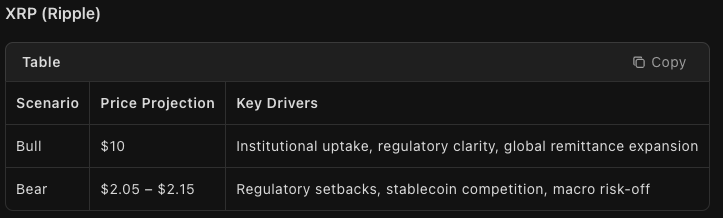
XRP (XRP): KIMI AI Expects a Possible Move Toward Either $10 or $2 Depending on December Sentiment
KIMI AI’s bearish projection puts Ripple’s XRP ($XRP) at roughly $2.05 by Christmas, should broader market sentiment weaken, a decline of about 6% from its current price of around $2.18.
 Source: KIMI
It would be an anticlimax to XRP’s impressive rally earlier this year, which sent the token to its first new all-time high in seven years, hitting $3.65 in July following Ripple’s major legal victory over the U.S. Securities and Exchange Commission.
XRP has spent several months consolidating inside multiple bullish flag patterns that didn’t result in a breakout. Its relative strength index (RSI) hovers near 50, and the token gained around 15% over the past seven days.
If conditions turn favorable, KIMI’s bullish target for XRP stretches to $10. The SEC’s recent approval of nine spot XRP ETFs may catalyze institutional demand, mirroring earlier responses to Bitcoin and Ethereum ETF launches. Additional ETF rollouts are likely to follow.

Ongoing regulatory clarification or new high-profile partnerships may set the stage for XRP to approach double-digit valuations by 2026.
Solana (SOL): KIMI’s Bear Case Targets $30, While a Bull Run Could Push SOL up 450%
Solana ($SOL) remains one of 2025’s most heavily used blockchains, currently securing nearly $9 billion in total value locked and maintaining a market cap of roughly $76.6 billion. Both developer activity and network utilization continue to grow rapidly.
Source: KIMI
New Solana ETFs from Bitwise and Grayscale generated early enthusiasm, with traders hoping for demand similar to earlier Bitcoin and Ethereum ETF rollouts.
However, this momentum hasn’t prevented recent weakness. SOL slipped 4% in the last 24 hours to trade around $137, and if this trend persists, KIMI estimates a potential drop toward $30 under a deep market downturn.
On the bullish side, KIMI AI projects Solana could surge to $750 within the next month, 450% up from current levels and around 2.5x its ATH of $293, set in January.
SOL previously rallied to $250 in January before sliding to near $100 in April. While today’s price remains far below previous highs, technical indicators suggest SOL may be nearing a breakout from a bullish flag pattern.
Growing interest in real-world asset tokenization, driven by major firms like BlackRock and Franklin Templeton experimenting with Solana, could lend weight to KIMI’s optimistic projection.
Cardano (ADA): KIMI Forecasts a Potential 2,300% December Surge
Cardano ($ADA) continues to hold a reputation as one of the most academically rigorous and research-driven projects in crypto. Founded by Ethereum co-creator Charles Hoskinson, Cardano emphasizes peer-reviewed development, security, scalability, and sustainability.
Source: KIMI
With a market cap near $15 billion and $190 million in TVL on the network, Cardano remains a major player in the upper tier of layer-1 blockchains, supported by steady developer engagement and a growing ecosystem of decentralized applications.
KIMI AI estimates ADA could rise to around $10 by early 2026, an astonishing 2,281% jump from its current price near $0.42 and more than triple its 2021 all-time high of $3.09.
Analysts argue that Cardano’s strong fundamentals and consistent upgrades position it as a potential leader in the next DeFi-driven market cycle.
However, KIMI’s bearish scenario warns ADA could fall to $0.18 if market conditions worsen, representing a drop of just over 50% for today’s holders.
Maxi Doge (MAXI): A Fast-Growing Meme Coin Outside KIMI AI’s Forecast Models
While KIMI anticipates that major altcoins may continue to struggle in the short term, presale tokens are still drawing substantial investor attention. Maxi Doge ($MAXI) is one of the most talked-about new meme coins, raising nearly $4.2 million in its presale. Positioned as a degen descendant of Dogecoin, MAXI blends tongue-in-cheek humor with active community involvement.
According to his lore, Maxi Doge spent years watching his distant cousin Dogecoin dominate the spotlight while grinding out trades in his mother’s basement, pumping weights, and biding his time as he prepared to take the crown. MAXI builds a competitive community culture through trading challenges, meme contests, and highly active social channels.
As an ERC-20 token on Ethereum, MAXI benefits from strong scalability options, a mature ecosystem, and lower environmental impact, advantages not offered by Dogecoin’s legacy proof-of-work design.
Staking rewards currently offer up to 73% APY, though yields will naturally decline as participation increases.
The presale price is set at $0.0002705, with automatic increments scheduled through later funding rounds. Buyers can join using MetaMask or Best Wallet.
Dogecoin stands no chance!
Stay updated through Maxi Doge’s official X and Telegram pages.
Visit the Official Website Here


You May Also Like

Malaysia’s new social plan is bold, hope it survives reality — Ahmad Ibrahim

Investors Find a Fashion Faux-Pas in Levi’s Upbeat Earnings
China’s ChangXin launches $4.3B memory IPO into an AI-driven chip boom



