Large Dogecoin holders have sharply reduced their on-chain activity, with whale transactions falling to their lowest level in more than two months, according to fresh network data shared by on-chain analyst Ali Martinez. Posting a Santiment chart on X, Martinez stated that “whale activity on the Dogecoin network has dropped to the lowest level in the past two months.” The chart tracks DOGE’s price against the number of transactions larger than $1 million. It shows frequent, tall spikes in high-value transfers in early October 2025, when price was oscillating near the upper end near $0.27. Dogecoin Whales Plummets Sharply On the day of the October 10 crash, the largest peak occurred when more than 280 Dogecoin whales made a transaction. This was followed by a progressive decline through late October and November. By November 29, the whale-transaction bar fell to 3 even as price trades around $0.15. The drop has sparked debate about what it signals for market structure and liquidity. Responding to Martinez, analyst account CryptoGames3D argued that “whale activity dropping on Dogecoin could mean one of two things: either whales are holding tight and waiting, or they’re stepping out of the game; both cases bring risk. With low liquidity from big holders, even modest selling could hit prices hard.” The comment underlines concerns that thinner participation from large entities can make order books more fragile if conditions turn. Related Reading: Can Dogecoin Price Still Reach $10 With The 3rd Wave Deadlock? In a separate post on November 29, Martinez outlined what he called “key levels for Dogecoin DOGE,” citing “support at $0.08” and “resistance at $0.20.” Those levels are mirrored in a Glassnode cost-basis distribution heatmap he shared, which maps DOGE’s price since early 2024 against realized price bands where supply last moved. Related Reading: Dogecoin Coils For A Monster 90% Breakout, Analyst Predicts The heatmap reveals a dense cluster of supply around $0.08. A highlighted range between roughly $0.07999 and $0.08145 contains about 27.37 billion DOGE, marking it as a major realized-price support zone. Higher up, a second but thinner band between approximately $0.20103 and $0.20470 holds around 12.22 billion DOGE, forming a significant resistance cohort. The color scale, running from about 5 million to 31 billion DOGE, emphasizes how pronounced the lower cluster is relative to other price areas. Taken together, the datasets present a tightly framed picture. DOGE is currently trading between a heavy long-term holder cost basis near $0.08 and a resistance pocket around $0.20, while the count of $1 million-plus transfers has compressed to a multi-month low. At press time, DOGE traded at $0.137. Featured image created with DALL.E, chart from TradingView.comLarge Dogecoin holders have sharply reduced their on-chain activity, with whale transactions falling to their lowest level in more than two months, according to fresh network data shared by on-chain analyst Ali Martinez. Posting a Santiment chart on X, Martinez stated that “whale activity on the Dogecoin network has dropped to the lowest level in the past two months.” The chart tracks DOGE’s price against the number of transactions larger than $1 million. It shows frequent, tall spikes in high-value transfers in early October 2025, when price was oscillating near the upper end near $0.27. Dogecoin Whales Plummets Sharply On the day of the October 10 crash, the largest peak occurred when more than 280 Dogecoin whales made a transaction. This was followed by a progressive decline through late October and November. By November 29, the whale-transaction bar fell to 3 even as price trades around $0.15. The drop has sparked debate about what it signals for market structure and liquidity. Responding to Martinez, analyst account CryptoGames3D argued that “whale activity dropping on Dogecoin could mean one of two things: either whales are holding tight and waiting, or they’re stepping out of the game; both cases bring risk. With low liquidity from big holders, even modest selling could hit prices hard.” The comment underlines concerns that thinner participation from large entities can make order books more fragile if conditions turn. Related Reading: Can Dogecoin Price Still Reach $10 With The 3rd Wave Deadlock? In a separate post on November 29, Martinez outlined what he called “key levels for Dogecoin DOGE,” citing “support at $0.08” and “resistance at $0.20.” Those levels are mirrored in a Glassnode cost-basis distribution heatmap he shared, which maps DOGE’s price since early 2024 against realized price bands where supply last moved. Related Reading: Dogecoin Coils For A Monster 90% Breakout, Analyst Predicts The heatmap reveals a dense cluster of supply around $0.08. A highlighted range between roughly $0.07999 and $0.08145 contains about 27.37 billion DOGE, marking it as a major realized-price support zone. Higher up, a second but thinner band between approximately $0.20103 and $0.20470 holds around 12.22 billion DOGE, forming a significant resistance cohort. The color scale, running from about 5 million to 31 billion DOGE, emphasizes how pronounced the lower cluster is relative to other price areas. Taken together, the datasets present a tightly framed picture. DOGE is currently trading between a heavy long-term holder cost basis near $0.08 and a resistance pocket around $0.20, while the count of $1 million-plus transfers has compressed to a multi-month low. At press time, DOGE traded at $0.137. Featured image created with DALL.E, chart from TradingView.com

Dogecoin Whale Activity Drops To Deepest Level In Two Months

2025/12/01 22:30
3 min read
For feedback or concerns regarding this content, please contact us at [email protected]

Large Dogecoin holders have sharply reduced their on-chain activity, with whale transactions falling to their lowest level in more than two months, according to fresh network data shared by on-chain analyst Ali Martinez.

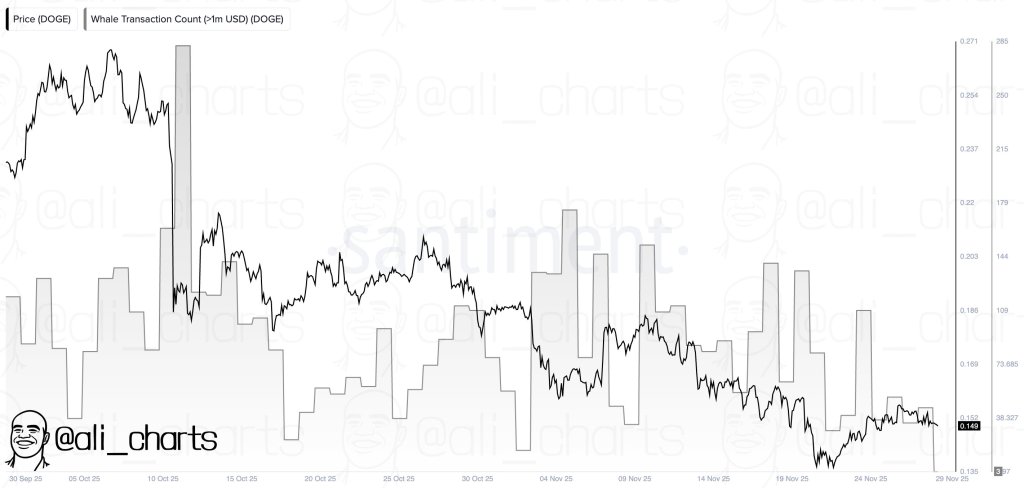
Posting a Santiment chart on X, Martinez stated that “whale activity on the Dogecoin network has dropped to the lowest level in the past two months.” The chart tracks DOGE’s price against the number of transactions larger than $1 million. It shows frequent, tall spikes in high-value transfers in early October 2025, when price was oscillating near the upper end near $0.27.

Dogecoin Whales Plummets Sharply

On the day of the October 10 crash, the largest peak occurred when more than 280 Dogecoin whales made a transaction. This was followed by a progressive decline through late October and November. By November 29, the whale-transaction bar fell to 3 even as price trades around $0.15.
Dogecoin whale activity

The drop has sparked debate about what it signals for market structure and liquidity. Responding to Martinez, analyst account CryptoGames3D argued that “whale activity dropping on Dogecoin could mean one of two things: either whales are holding tight and waiting, or they’re stepping out of the game; both cases bring risk. With low liquidity from big holders, even modest selling could hit prices hard.” The comment underlines concerns that thinner participation from large entities can make order books more fragile if conditions turn.

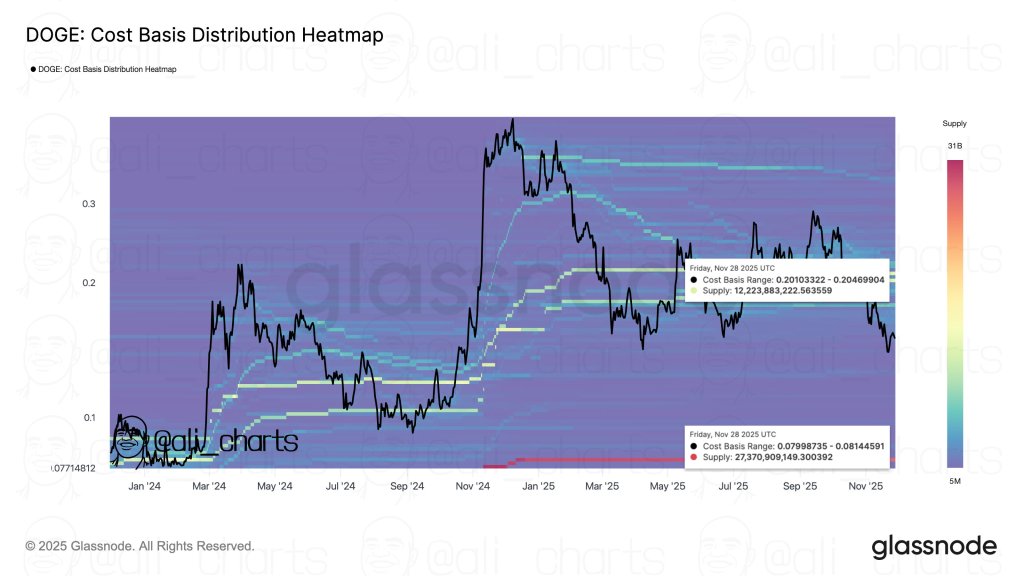
In a separate post on November 29, Martinez outlined what he called “key levels for Dogecoin DOGE,” citing “support at $0.08” and “resistance at $0.20.” Those levels are mirrored in a Glassnode cost-basis distribution heatmap he shared, which maps DOGE’s price since early 2024 against realized price bands where supply last moved.
Dogecoin Cost Basis Distribution heatmap

The heatmap reveals a dense cluster of supply around $0.08. A highlighted range between roughly $0.07999 and $0.08145 contains about 27.37 billion DOGE, marking it as a major realized-price support zone. Higher up, a second but thinner band between approximately $0.20103 and $0.20470 holds around 12.22 billion DOGE, forming a significant resistance cohort. The color scale, running from about 5 million to 31 billion DOGE, emphasizes how pronounced the lower cluster is relative to other price areas.

Taken together, the datasets present a tightly framed picture. DOGE is currently trading between a heavy long-term holder cost basis near $0.08 and a resistance pocket around $0.20, while the count of $1 million-plus transfers has compressed to a multi-month low.

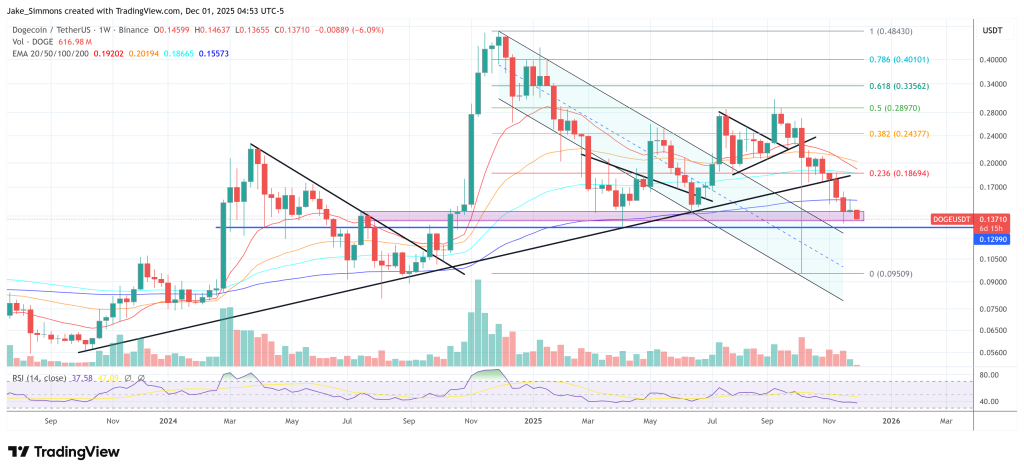
At press time, DOGE traded at $0.137.
Dogecoin news
Market Opportunity
Moonveil Logo
Moonveil Price(MORE)
$0.0001187
$0.0001187$0.0001187
-3.73%
USD
Moonveil (MORE) Live Price Chart
Disclaimer: The articles reposted on this site are sourced from public platforms and are provided for informational purposes only. They do not necessarily reflect the views of MEXC. All rights remain with the original authors. If you believe any content infringes on third-party rights, please contact [email protected] for removal. MEXC makes no guarantees regarding the accuracy, completeness, or timeliness of the content and is not responsible for any actions taken based on the information provided. The content does not constitute financial, legal, or other professional advice, nor should it be considered a recommendation or endorsement by MEXC.

You May Also Like

Is Putnam Global Technology A (PGTAX) a strong mutual fund pick right now?

Is Putnam Global Technology A (PGTAX) a strong mutual fund pick right now?

The post Is Putnam Global Technology A (PGTAX) a strong mutual fund pick right now? appeared on BitcoinEthereumNews.com. On the lookout for a Sector – Tech fund? Starting with Putnam Global Technology A (PGTAX – Free Report) should not be a possibility at this time. PGTAX possesses a Zacks Mutual Fund Rank of 4 (Sell), which is based on various forecasting factors like size, cost, and past performance. Objective We note that PGTAX is a Sector – Tech option, and this area is loaded with many options. Found in a wide number of industries such as semiconductors, software, internet, and networking, tech companies are everywhere. Thus, Sector – Tech mutual funds that invest in technology let investors own a stake in a notoriously volatile sector, but with a much more diversified approach. History of fund/manager Putnam Funds is based in Canton, MA, and is the manager of PGTAX. The Putnam Global Technology A made its debut in January of 2009 and PGTAX has managed to accumulate roughly $650.01 million in assets, as of the most recently available information. The fund is currently managed by Di Yao who has been in charge of the fund since December of 2012. Performance Obviously, what investors are looking for in these funds is strong performance relative to their peers. PGTAX has a 5-year annualized total return of 14.46%, and is in the middle third among its category peers. But if you are looking for a shorter time frame, it is also worth looking at its 3-year annualized total return of 27.02%, which places it in the middle third during this time-frame. It is important to note that the product’s returns may not reflect all its expenses. Any fees not reflected would lower the returns. Total returns do not reflect the fund’s [%] sale charge. If sales charges were included, total returns would have been lower. When looking at a fund’s performance, it…
Share
BitcoinEthereumNews2025/09/18 04:05
Circle Expands USDC Into Africa Through Sasai Deal, Targeting Cross-Border Payments Boom

Circle Expands USDC Into Africa Through Sasai Deal, Targeting Cross-Border Payments Boom

USDC integration into Sasai signals rising stablecoin demand for cross-border trade and FX stability in Africa. Circle Internet Group agreed to a landmark partnership
Share
LiveBitcoinNews2026/03/25 06:39
Forward Industries Files $4 Billion ATM Offering to Boost Solana Treasury

Forward Industries Files $4 Billion ATM Offering to Boost Solana Treasury

Forward Industries filed an automatic shelf to offer up to $4 billion in at-the-market common stock to support its Solana (SOL) treasury strategy.
Share
Blockchainreporter2025/09/18 05:10