BitcoinWorld US Stock Indices Close Lower: Decoding Monday’s Market Pullback If you watched the markets on Monday, you saw a sea of red. In a notable shift, the major US stock indices close lower, snapping recent momentum and putting investors on alert. This wasn’t a minor blip; the Dow Jones Industrial Average led the decline with a nearly 1% drop. Let’s unpack what drove this […] This post US Stock Indices Close Lower: Decoding Monday’s Market Pullback first appeared on BitcoinWorld.BitcoinWorld US Stock Indices Close Lower: Decoding Monday’s Market Pullback If you watched the markets on Monday, you saw a sea of red. In a notable shift, the major US stock indices close lower, snapping recent momentum and putting investors on alert. This wasn’t a minor blip; the Dow Jones Industrial Average led the decline with a nearly 1% drop. Let’s unpack what drove this […] This post US Stock Indices Close Lower: Decoding Monday’s Market Pullback first appeared on BitcoinWorld.

US Stock Indices Close Lower: Decoding Monday’s Market Pullback

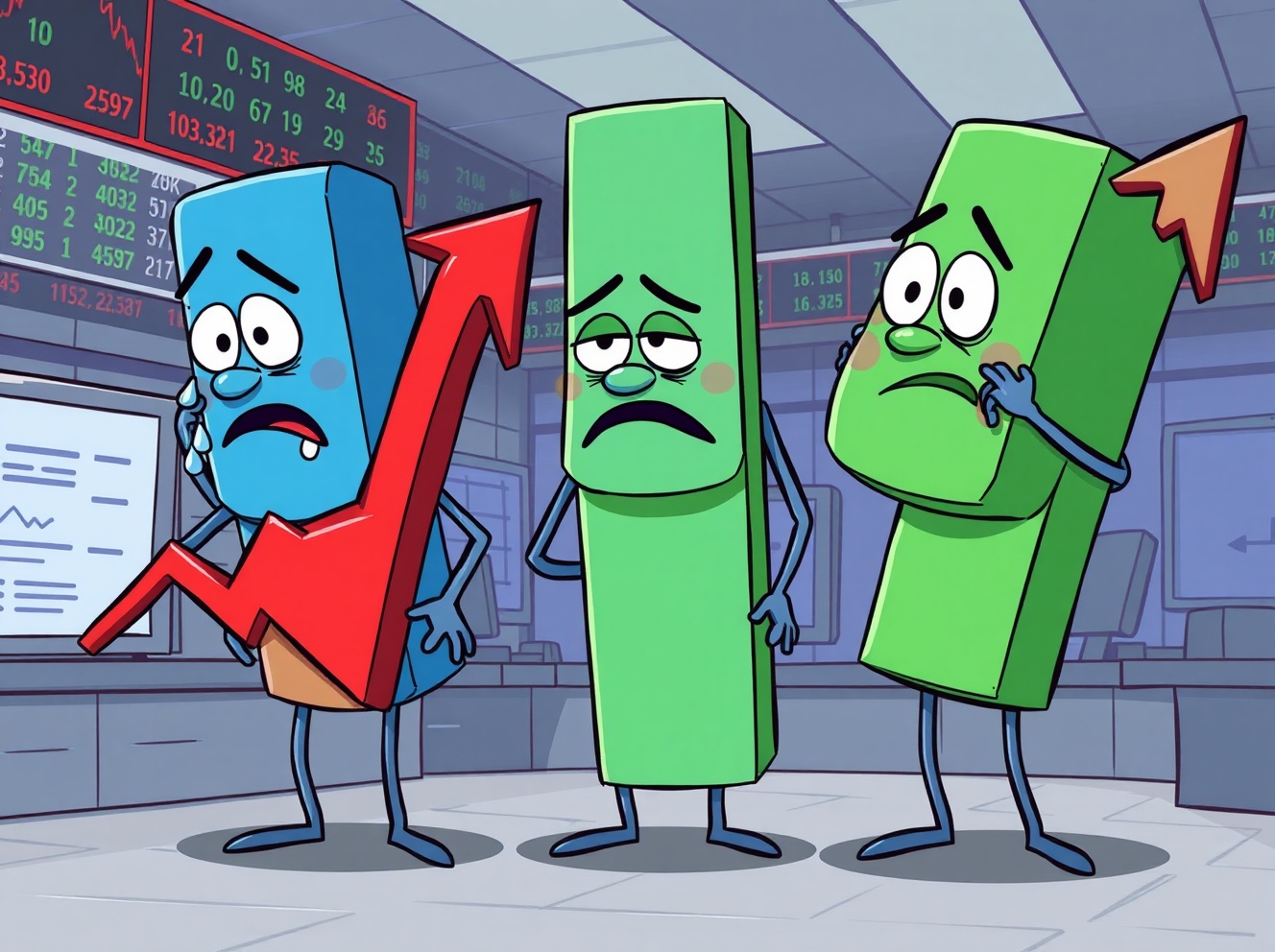
Cartoon illustration of dejected US stock indices closing lower on a trading day.

BitcoinWorld

US Stock Indices Close Lower: Decoding Monday’s Market Pullback

If you watched the markets on Monday, you saw a sea of red. In a notable shift, the major US stock indices close lower, snapping recent momentum and putting investors on alert. This wasn’t a minor blip; the Dow Jones Industrial Average led the decline with a nearly 1% drop. Let’s unpack what drove this pullback and what savvy market participants should watch next.

Why Did US Stock Indices Close Lower on Monday?

The trading session wasn’t dominated by a single catastrophic event. Instead, a confluence of factors weighed on investor sentiment. Rising bond yields often make stocks less attractive by comparison, and concerns about the pace of future economic growth created a cautious atmosphere. Furthermore, profit-taking after recent gains is a typical market behavior. This combination prompted a broad-based retreat, confirming that the US stock indices close lower was a reaction to several underlying pressures.

A Closer Look at the Numbers: Which Index Fell the Most?

The declines were widespread, but not uniform. Understanding the breakdown is crucial for gauging market sector health.

  • The Dow Jones Industrial Average dropped 0.89%, suffering the largest loss. This suggests traditional industrial and financial giants faced significant selling pressure.
  • The S&P 500 fell 0.53%. As the broadest benchmark, this indicates a general market pullback affecting a wide range of companies.
  • The Nasdaq Composite declined a relatively milder 0.38%. This hints that technology stocks showed slightly more resilience compared to other sectors.

This pattern tells us the sell-off had a particular impact on blue-chip and cyclical stocks, even as the tech-heavy Nasdaq held up a bit better.

What Does This Mean for Your Portfolio?

A single down day does not define a trend. However, when the US stock indices close lower in unison, it’s a clear signal for review. For long-term investors, such pullbacks can be normal volatility. For active traders, it may signal a shift in short-term momentum. The key is context: is this a healthy correction within a bull market, or the start of a deeper decline? Monitoring follow-through in the coming sessions is essential. Therefore, avoid panic selling based on one session, but do reassess your risk exposure.

Actionable Insights for Navigating Market Downturns

Market dips are inevitable. The question is how you respond. Here are practical steps:

  • Review Your Asset Allocation: Ensure your portfolio’s mix of stocks, bonds, and other assets still matches your risk tolerance.
  • Look for Quality Opportunities: A broad market decline can lower the price of strong companies, potentially creating entry points.
  • Avoid Emotional Decisions: History shows that knee-jerk reactions to short-term drops often harm long-term returns.

Remember, the fact that US stock indices close lower on any given day is a feature of the market, not a bug. It’s part of the cycle.

Conclusion: Keeping Perspective on Market Movements

Monday’s session served as a stark reminder that markets don’t move in a straight line. The decline across the board was a collective pause, driven by a mix of technical and fundamental factors. While headlines focusing on the US stock indices close lower can sound alarming, informed investors see them as data points. The path forward depends on upcoming economic data, corporate earnings, and global events. Stay informed, stay diversified, and let a disciplined strategy guide you through both up and down days.

Frequently Asked Questions (FAQs)

Q: Is a single day where US stock indices close lower a reason to sell my investments?
A: Generally, no. Single-day movements are normal volatility. Making investment decisions based on one day is typically an emotional reaction. Review your long-term strategy instead.

Q: Which sector was hit the hardest when the US stock indices closed lower?
A: The significant drop in the Dow Jones suggests traditional sectors like industrials and financials faced more pressure than the technology-heavy Nasdaq Composite.

Q: Could this pullback be a buying opportunity?
A> It can be for disciplined investors. A market-wide dip can lower prices of quality stocks. However, thorough research on individual companies is crucial before buying.

Q: How often do all three major US indices close lower on the same day?
A> It’s a common occurrence. While not an everyday event, synchronized down days happen regularly as part of market cycles and are not inherently unusual.

Q: What should I monitor after a day like this?
A> Watch for follow-through in the next few sessions. Also, keep an eye on bond yields, key economic reports, and comments from the Federal Reserve for clues on market direction.

Found this analysis of why US stock indices close lower helpful? Market knowledge is power. Share this article with fellow investors on Twitter or LinkedIn to spark a smarter conversation.

To learn more about the latest financial market trends, explore our article on key developments shaping investor sentiment and future market outlook.

This post US Stock Indices Close Lower: Decoding Monday’s Market Pullback first appeared on BitcoinWorld.

Market Opportunity
RedStone Logo
RedStone Price(RED)
$0.2507
$0.2507$0.2507
+0.07%
USD
RedStone (RED) Live Price Chart
Disclaimer: The articles reposted on this site are sourced from public platforms and are provided for informational purposes only. They do not necessarily reflect the views of MEXC. All rights remain with the original authors. If you believe any content infringes on third-party rights, please contact [email protected] for removal. MEXC makes no guarantees regarding the accuracy, completeness, or timeliness of the content and is not responsible for any actions taken based on the information provided. The content does not constitute financial, legal, or other professional advice, nor should it be considered a recommendation or endorsement by MEXC.

You May Also Like

Taiko Makes Chainlink Data Streams Its Official Oracle

Taiko Makes Chainlink Data Streams Its Official Oracle

The post Taiko Makes Chainlink Data Streams Its Official Oracle appeared on BitcoinEthereumNews.com. Key Notes Taiko has officially integrated Chainlink Data Streams for its Layer 2 network. The integration provides developers with high-speed market data to build advanced DeFi applications. The move aims to improve security and attract institutional adoption by using Chainlink’s established infrastructure. Taiko, an Ethereum-based ETH $4 514 24h volatility: 0.4% Market cap: $545.57 B Vol. 24h: $28.23 B Layer 2 rollup, has announced the integration of Chainlink LINK $23.26 24h volatility: 1.7% Market cap: $15.75 B Vol. 24h: $787.15 M Data Streams. The development comes as the underlying Ethereum network continues to see significant on-chain activity, including large sales from ETH whales. The partnership establishes Chainlink as the official oracle infrastructure for the network. It is designed to provide developers on the Taiko platform with reliable and high-speed market data, essential for building a wide range of decentralized finance (DeFi) applications, from complex derivatives platforms to more niche projects involving unique token governance models. According to the project’s official announcement on Sept. 17, the integration enables the creation of more advanced on-chain products that require high-quality, tamper-proof data to function securely. Taiko operates as a “based rollup,” which means it leverages Ethereum validators for transaction sequencing for strong decentralization. Boosting DeFi and Institutional Interest Oracles are fundamental services in the blockchain industry. They act as secure bridges that feed external, off-chain information to on-chain smart contracts. DeFi protocols, in particular, rely on oracles for accurate, real-time price feeds. Taiko leadership stated that using Chainlink’s infrastructure aligns with its goals. The team hopes the partnership will help attract institutional crypto investment and support the development of real-world applications, a goal that aligns with Chainlink’s broader mission to bring global data on-chain. Integrating real-world economic information is part of a broader industry trend. Just last week, Chainlink partnered with the Sei…
Share
BitcoinEthereumNews2025/09/18 03:34
Kalshi Prediction Markets Are Pulling In $1 Billion Monthly as State Regulators Loom

Kalshi Prediction Markets Are Pulling In $1 Billion Monthly as State Regulators Loom

The post Kalshi Prediction Markets Are Pulling In $1 Billion Monthly as State Regulators Loom appeared on BitcoinEthereumNews.com. In brief Kalshi reached $1 billion in monthly volume and now dominates 62% of the global prediction market industry, surpassing Polymarket’s 37% share. Four states including Massachusetts have filed lawsuits claiming Kalshi operates as an unlicensed sportsbook, with Massachusetts seeking to permanently bar the platform. Kalshi operates under federal CFTC regulation as a designated contract market, arguing this preempts state gambling laws that require separate licensing. Prediction market Kalshi just topped $1 billion in monthly volume as state regulators nip at its heels with lawsuits alleging that it’s an unregistered sports betting platform. “Despite being limited to only American customers, Kalshi has now risen to dominate the global prediction market industry,” the company said in a press release. “New data scraped from publicly available activity metrics details this rise.” The publicly available data appears on a Dune Analytics dashboard that’s been tracking prediction market notional volume. The data show that Kalshi now accounts for roughly 62% of global prediction market volume, Polymarket for 37%, and the rest split between Limitless and Myriad, the prediction market owned by Decrypt parent company Dastan. Trading volume on Kalshi skyrocketed in August, not coincidentally at the start of the NFL season and as the prediction market pushes further into sports.  But regulators in Maryland, Nevada, and New Jersey have all issued cease-and-desist orders, arguing Kalshi’s event contracts amount to unlicensed sports betting. Each case has spilled into federal court, with judges issuing preliminary rulings but no final decisions yet. Last week, Massachusetts went further, filing a lawsuit that calls Kalshi’s sports contracts “illegal and unsafe sports wagering.” The 43-page Massachusetts lawsuit seeks to stop the company from allowing state residents on its platform—much the way Coinbase has had to do with its staking offerings in parts of the United States. Massachusetts Attorney General…
Share
BitcoinEthereumNews2025/09/19 09:21
[Pastilan] End the confidential fund madness

[Pastilan] End the confidential fund madness

UPDATE RULES. Former Commission on Audit commissioner Heidi Mendoza speaks during a public forum.
Share
Rappler2026/01/16 14:02