Ethereum Whale Awakens After a Decade, Chooses Staking Over Selling A dormant Ethereum whale has reawakened after nearly ten years, but instead of liquidating their holdings, the large investor has chosen to deploy their entire stash into staking. This move signals ongoing conviction in Ethereum’s long-term potential amidst recent market activity. The whale’s wallet contains [...]Ethereum Whale Awakens After a Decade, Chooses Staking Over Selling A dormant Ethereum whale has reawakened after nearly ten years, but instead of liquidating their holdings, the large investor has chosen to deploy their entire stash into staking. This move signals ongoing conviction in Ethereum’s long-term potential amidst recent market activity. The whale’s wallet contains [...]

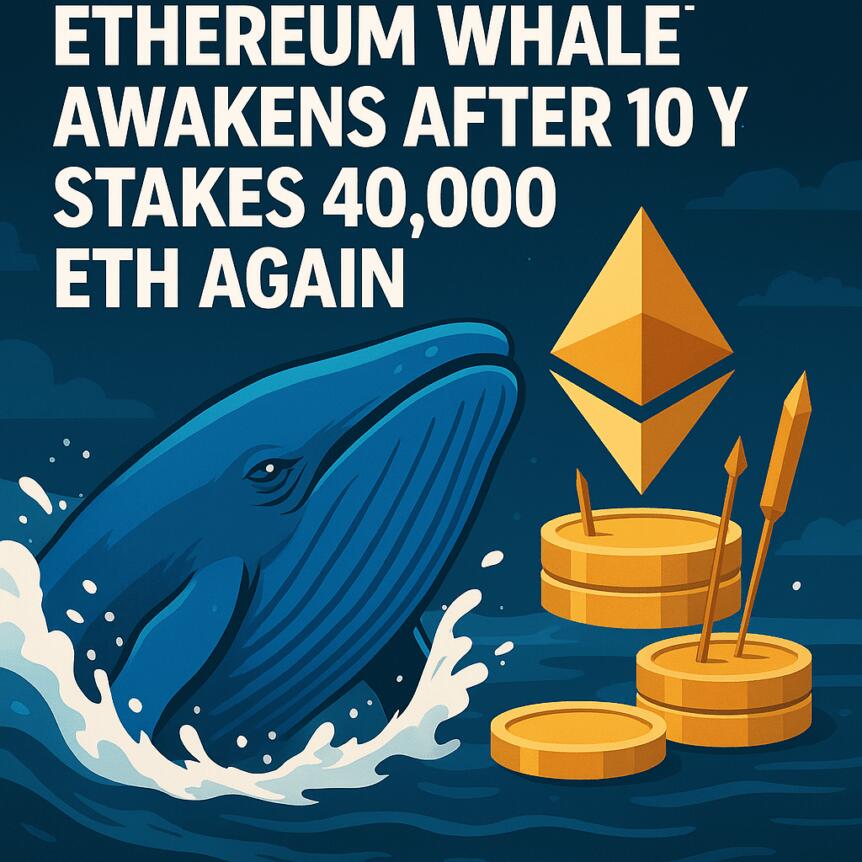
Ethereum Whale Awakens After 10 Years, Stakes 40,000 ETH Again
For feedback or concerns regarding this content, please contact us at [email protected]
Ethereum Whale Awakens After 10 Years, Stakes 40,000 Eth Again

Ethereum Whale Awakens After a Decade, Chooses Staking Over Selling

A dormant Ethereum whale has reawakened after nearly ten years, but instead of liquidating their holdings, the large investor has chosen to deploy their entire stash into staking. This move signals ongoing conviction in Ethereum’s long-term potential amidst recent market activity.

The whale’s wallet contains 40,000 ETH, which the holder acquired for approximately $12,000 during Ethereum’s ICO in July 2015, at the launch of the genesis block. This investment, now valued at around $120 million, has remained untouched until recent activity. Instead of transferring funds to an exchange, the whale has staked their complete ETH holdings—an indication of confidence in Ethereum’s staking and network security, especially as the DeFi and proof-of-stake ecosystems continue to evolve.

Source: Lookonchain

Over the past month, industry chatter has intensified regarding large crypto whales moving significant assets, with some observers attributing recent price volatility to these high-net-worth investors liquidating or repositioning their holdings. The recent behavior of some early Ethereum adopters underscores this dynamic, as a few have started reducing their stakes while others continue to accumulate.

Other Notable ETH Movements from OG Holders

One prominent Ethereum investor—who acquired over 254,908 tokens during the ICO—began selling their holdings on November 26. Initially offloading 20,000 ETH, they progressively reduced their position, leaving approximately $9.3 million worth of ETH as of Saturday. Meanwhile, another veteran of the ecosystem, with an initial stash of 154,076 ETH starting in 2017, sent 18,000 tokens to Bitstamp after previously selling nearly 88,000 ETH at an average of $1,694 per token.

In parallel, a significant ICO wallet that remained inactive for eight years re-engaged in staking activities, acquiring 1 million ETH at launch and moving 150,000 ETH into a new staking wallet. These actions highlight the ongoing confidence of certain key players in Ethereum’s future and its staking ecosystem’s robustness.

Whales Keep Accumulating ETH

Despite some early investors reducing their exposure, data indicates that the largest Ethereum addresses continue to accumulate. The top 1% of ETH holders now control approximately 97.6% of the circulating supply—an increase from 96.1% a year ago, according to blockchain analytics platform Glassnode. Notably, the Eth2 Beacon Deposit Contract holds 72.4 million ETH, roughly $203 billion, accounting for about 60% of the total supply, as reported by Arkham.

Major holders like Binance and asset management firms such as BlackRock maintain substantial ETH reserves, with 4 million and 3.9 million ETH respectively, emphasizing institutional interest in Ethereum’s future prospects.

This article was originally published as Ethereum Whale Awakens After 10 Years, Stakes 40,000 ETH Again on Crypto Breaking News – your trusted source for crypto news, Bitcoin news, and blockchain updates.


Market Opportunity
Ethereum Logo
Ethereum Price(ETH)
$2,098.06
$2,098.06$2,098.06
-1.37%
USD
Ethereum (ETH) Live Price Chart

AI Strategy: Powered 24/7

AI Strategy: Powered 24/7AI Strategy: Powered 24/7

Generate automated strategies using natural language

Disclaimer: The articles reposted on this site are sourced from public platforms and are provided for informational purposes only. They do not necessarily reflect the views of MEXC. All rights remain with the original authors. If you believe any content infringes on third-party rights, please contact [email protected] for removal. MEXC makes no guarantees regarding the accuracy, completeness, or timeliness of the content and is not responsible for any actions taken based on the information provided. The content does not constitute financial, legal, or other professional advice, nor should it be considered a recommendation or endorsement by MEXC.

You May Also Like

Chainlink Whale Activity Rises While Price Bleeds for 7 Straight Months

Chainlink Whale Activity Rises While Price Bleeds for 7 Straight Months

The post Chainlink Whale Activity Rises While Price Bleeds for 7 Straight Months appeared on BitcoinEthereumNews.com. Chainlink (LINK) is seeing an increase in
Share
BitcoinEthereumNews2026/04/02 18:51
Revolutionary: CME SOL XRP Futures Options Set to Transform Crypto Trading

Revolutionary: CME SOL XRP Futures Options Set to Transform Crypto Trading

BitcoinWorld Revolutionary: CME SOL XRP Futures Options Set to Transform Crypto Trading Exciting news is rippling through the cryptocurrency world! The U.S. Chicago Mercantile Exchange (CME), a titan in traditional finance, is reportedly planning to launch CME SOL XRP futures options. This significant development, initially reported by Walter Bloomberg, marks a pivotal moment for institutional involvement in the altcoin market. It signals a new era for how Solana (SOL) and Ripple (XRP) might be traded, potentially opening doors to broader adoption and increased market maturity. What Does the Launch of CME SOL XRP Futures Mean for Crypto? When an institution like CME, known for its rigorous standards and vast trading volume, enters a new market, it brings a wave of legitimacy. The introduction of CME SOL XRP futures options indicates a growing acceptance of these digital assets within mainstream finance. This move could fundamentally change how investors perceive and interact with SOL and XRP. Futures options are financial derivatives that give traders the right, but not the obligation, to buy or sell an underlying asset at a specific price on or before a certain date. For SOL and XRP, this means: Enhanced Price Discovery: More participants and trading volume can lead to more efficient and accurate pricing. Institutional Access: It provides regulated avenues for large institutional investors to gain exposure to SOL and XRP without directly owning the underlying assets. Risk Management: Traders can use these options to hedge against potential price fluctuations in their existing SOL and XRP holdings. Why Are SOL and XRP Chosen for CME SOL XRP Futures? The selection of Solana (SOL) and Ripple (XRP) for these new futures options is not arbitrary. Both cryptocurrencies hold significant positions in the market and offer distinct value propositions: Solana (SOL): Known for its high-performance blockchain, offering fast transaction speeds and low costs. Its robust ecosystem supports numerous decentralized applications (dApps), NFTs, and DeFi projects, attracting considerable developer and user interest. Ripple (XRP): Primarily focused on facilitating fast, low-cost international payments for financial institutions. Despite ongoing regulatory discussions, XRP maintains a strong market presence and a dedicated community, highlighting its potential for cross-border transactions. Their substantial market capitalization and existing liquidity make them attractive candidates for institutional-grade derivative products. This choice reflects a strategic assessment by CME of assets that can sustain significant trading interest and volume. Navigating the Landscape: Opportunities and Considerations for CME SOL XRP Futures The introduction of CME SOL XRP futures options presents a wealth of opportunities, yet it also comes with important considerations. On the opportunity front, we can expect increased liquidity, which benefits all market participants by making it easier to buy and sell without significant price impact. Moreover, it could attract new capital from traditional financial players who prefer regulated products. However, traders and investors should also consider the implications: Market Volatility: While derivatives can offer hedging, they can also amplify market movements. Regulatory Clarity: The regulatory landscape for cryptocurrencies, particularly for XRP, continues to evolve. CME’s move might encourage further clarity but also means ongoing scrutiny. Learning Curve: Understanding futures options requires a certain level of financial literacy, which new entrants to the crypto market may need to develop. These products offer sophisticated tools for managing exposure and speculating on price movements, but they demand a careful approach. What’s Next for the Crypto Market with CME SOL XRP Futures? The reported launch of CME SOL XRP futures options is more than just a new product offering; it represents a significant milestone in the ongoing convergence of traditional finance and the digital asset space. It underscores the growing maturity of the cryptocurrency market and its increasing integration into global financial systems. As institutional interest continues to surge, we can anticipate further innovation and a broader range of regulated products for other altcoins. This development is poised to offer sophisticated tools for investors and traders, potentially stabilizing market dynamics while simultaneously introducing new avenues for growth and investment. The crypto market is evolving rapidly, and CME’s latest initiative is a clear indicator of this exciting trajectory. To learn more about the latest crypto market trends, explore our article on key developments shaping the cryptocurrency market institutional adoption. Frequently Asked Questions (FAQs) What is the Chicago Mercantile Exchange (CME)? The CME is one of the world’s largest and most diverse derivatives marketplaces, offering a wide range of futures and options products across various asset classes, including equities, commodities, and now, expanding into specific cryptocurrencies. What are futures options in the context of SOL and XRP? Futures options for SOL and XRP are financial contracts that give the holder the right, but not the obligation, to buy or sell SOL or XRP futures contracts at a predetermined price on or before a specific date. They allow for hedging and speculation on price movements. Why are Solana (SOL) and Ripple (XRP) chosen for these new options? SOL and XRP were likely chosen due to their significant market capitalization, established liquidity, and distinct use cases within the crypto ecosystem, making them attractive for institutional-grade derivative products. How might CME SOL XRP futures options affect the prices of SOL and XRP? The introduction of these options could lead to increased liquidity and institutional participation, potentially influencing price discovery and stability. However, like all derivatives, they can also contribute to market volatility. When are these CME SOL XRP futures options expected to launch? While Walter Bloomberg reported CME’s plans, an official launch date has not yet been publicly announced by CME. Market participants should monitor official CME channels for updates. If you found this article insightful, please consider sharing it with your network! Help us spread the word about the exciting developments in the crypto space by sharing this article on your social media platforms. This post Revolutionary: CME SOL XRP Futures Options Set to Transform Crypto Trading first appeared on BitcoinWorld.
Share
Coinstats2025/09/18 00:45
Franklin Templeton CEO Dismisses 50bps Rate Cut Ahead FOMC

Franklin Templeton CEO Dismisses 50bps Rate Cut Ahead FOMC

The post Franklin Templeton CEO Dismisses 50bps Rate Cut Ahead FOMC appeared on BitcoinEthereumNews.com. Franklin Templeton CEO Jenny Johnson has weighed in on whether the Federal Reserve should make a 25 basis points (bps) Fed rate cut or 50 bps cut. This comes ahead of the Fed decision today at today’s FOMC meeting, with the market pricing in a 25 bps cut. Bitcoin and the broader crypto market are currently trading flat ahead of the rate cut decision. Franklin Templeton CEO Weighs In On Potential FOMC Decision In a CNBC interview, Jenny Johnson said that she expects the Fed to make a 25 bps cut today instead of a 50 bps cut. She acknowledged the jobs data, which suggested that the labor market is weakening. However, she noted that this data is backward-looking, indicating that it doesn’t show the current state of the economy. She alluded to the wage growth, which she remarked is an indication of a robust labor market. She added that retail sales are up and that consumers are still spending, despite inflation being sticky at 3%, which makes a case for why the FOMC should opt against a 50-basis-point Fed rate cut. In line with this, the Franklin Templeton CEO said that she would go with a 25 bps rate cut if she were Jerome Powell. She remarked that the Fed still has the October and December FOMC meetings to make further cuts if the incoming data warrants it. Johnson also asserted that the data show a robust economy. However, she noted that there can’t be an argument for no Fed rate cut since Powell already signaled at Jackson Hole that they were likely to lower interest rates at this meeting due to concerns over a weakening labor market. Notably, her comment comes as experts argue for both sides on why the Fed should make a 25 bps cut or…
Share
BitcoinEthereumNews2025/09/18 00:36

No Chart Skills? Still Profit

No Chart Skills? Still ProfitNo Chart Skills? Still Profit

Copy top traders in 3s with auto trading!