Bitcoin miner revenues have fallen to their lowest levels in two months, according to analysts at on-chain and market data CryptoQuant . On June 22, daily earnings dropped to $34 million, a level not seen since April 20, 2025. The downturn is mainly being attributed to reduced transaction fees and a decline in the market price of Bitcoin. The combination of these factors is leading to an environment where miners are experiencing some of the lowest compensation rates recorded in the past year. As reported in CryptoQuant’s weekly analysis, miners are currently “the most underpaid they have been in the last year.” Bitcoin miners just saw their worst payday in a year. Daily revenue slipped to $34 million in June, the lowest since April. Falling fees and Bitcoin’s price drop are crushing margins. pic.twitter.com/TXdN06CU1F — CryptoQuant.com (@cryptoquant_com) June 26, 2025 Hashrate Falls, But Miner Selling Stays Low Despite the drop in revenue, miners have not responded with increased selling. CryptoQuant reports that Bitcoin outflows from miner wallets have steadily decreased, falling from a peak of 23,000 BTC per day in February to around 6,000 BTC today. This represents a significant reduction in selling activity, especially given the recent price volatility. Notably, the network’s hashrate has experienced a 3.5% drawdown since June 16, marking the largest decline in nearly a year. However, this drop in computational power has not translated into heightened liquidations by miners. In addition, so-called “Satoshi-era” miners have sold only 150 BTC so far in 2025, compared to nearly 10,000 BTC in 2024. Miner Reserves Grow Despite Lower Income CryptoQuant analysts also note that instead of selling, miners are increasing their reserves. Addresses holding between 100 and 1,000 BTC have grown their combined holdings from 61,000 BTC on March 31 to 65,000 BTC as of late June. This is the highest level of reserve accumulation by this group of miners since November 2024. The steady accumulation trend suggests that most miners are not facing immediate financial stress, even amid falling revenues. Their continued reserve growth indicates a long-term outlook and confidence in future price recovery, rather than capitulation under current market conditions. Overall, while Bitcoin miner revenues have declined to a two-month low, there is no evidence of widespread selling pressure in response. CryptoQuant’s findings portray a mining sector that, though underpaid by recent standards, remains resilient and strategically focused on long-term accumulation.Bitcoin miner revenues have fallen to their lowest levels in two months, according to analysts at on-chain and market data CryptoQuant . On June 22, daily earnings dropped to $34 million, a level not seen since April 20, 2025. The downturn is mainly being attributed to reduced transaction fees and a decline in the market price of Bitcoin. The combination of these factors is leading to an environment where miners are experiencing some of the lowest compensation rates recorded in the past year. As reported in CryptoQuant’s weekly analysis, miners are currently “the most underpaid they have been in the last year.” Bitcoin miners just saw their worst payday in a year. Daily revenue slipped to $34 million in June, the lowest since April. Falling fees and Bitcoin’s price drop are crushing margins. pic.twitter.com/TXdN06CU1F — CryptoQuant.com (@cryptoquant_com) June 26, 2025 Hashrate Falls, But Miner Selling Stays Low Despite the drop in revenue, miners have not responded with increased selling. CryptoQuant reports that Bitcoin outflows from miner wallets have steadily decreased, falling from a peak of 23,000 BTC per day in February to around 6,000 BTC today. This represents a significant reduction in selling activity, especially given the recent price volatility. Notably, the network’s hashrate has experienced a 3.5% drawdown since June 16, marking the largest decline in nearly a year. However, this drop in computational power has not translated into heightened liquidations by miners. In addition, so-called “Satoshi-era” miners have sold only 150 BTC so far in 2025, compared to nearly 10,000 BTC in 2024. Miner Reserves Grow Despite Lower Income CryptoQuant analysts also note that instead of selling, miners are increasing their reserves. Addresses holding between 100 and 1,000 BTC have grown their combined holdings from 61,000 BTC on March 31 to 65,000 BTC as of late June. This is the highest level of reserve accumulation by this group of miners since November 2024. The steady accumulation trend suggests that most miners are not facing immediate financial stress, even amid falling revenues. Their continued reserve growth indicates a long-term outlook and confidence in future price recovery, rather than capitulation under current market conditions. Overall, while Bitcoin miner revenues have declined to a two-month low, there is no evidence of widespread selling pressure in response. CryptoQuant’s findings portray a mining sector that, though underpaid by recent standards, remains resilient and strategically focused on long-term accumulation.

Bitcoin Miner Revenues Hit Two-Month Low, Selling Activity Remains Muted: CryptoQuant

Bitcoin miner revenues have fallen to their lowest levels in two months, according to analysts at on-chain and market data CryptoQuant.

On June 22, daily earnings dropped to $34 million, a level not seen since April 20, 2025. The downturn is mainly being attributed to reduced transaction fees and a decline in the market price of Bitcoin.
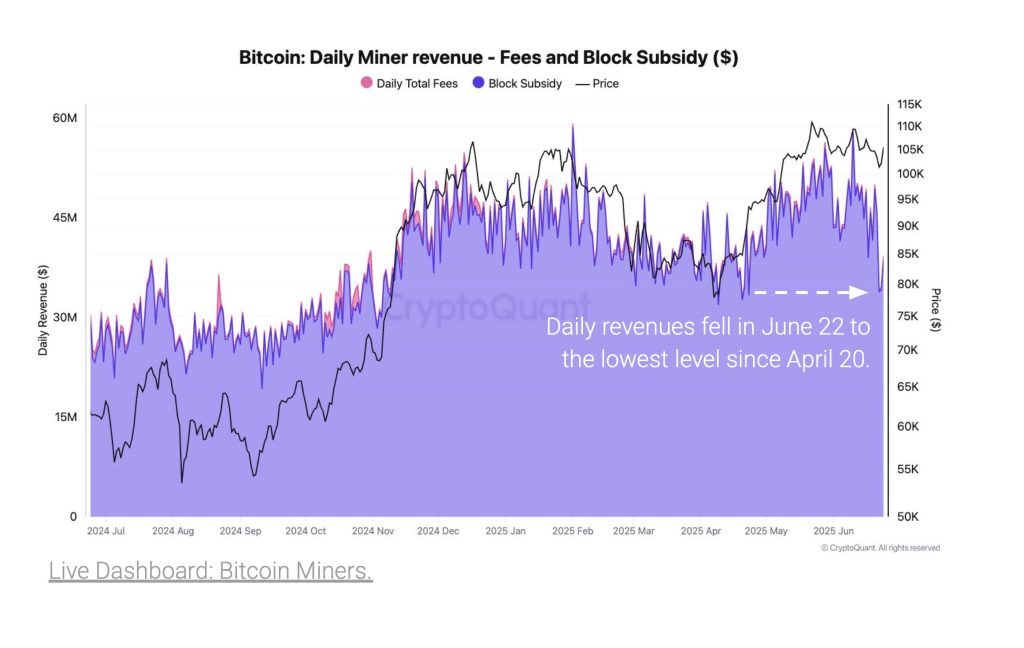
The combination of these factors is leading to an environment where miners are experiencing some of the lowest compensation rates recorded in the past year. As reported in CryptoQuant’s weekly analysis, miners are currently “the most underpaid they have been in the last year.”

Hashrate Falls, But Miner Selling Stays Low

Despite the drop in revenue, miners have not responded with increased selling. CryptoQuant reports that Bitcoin outflows from miner wallets have steadily decreased, falling from a peak of 23,000 BTC per day in February to around 6,000 BTC today.

This represents a significant reduction in selling activity, especially given the recent price volatility. Notably, the network’s hashrate has experienced a 3.5% drawdown since June 16, marking the largest decline in nearly a year.

However, this drop in computational power has not translated into heightened liquidations by miners. In addition, so-called “Satoshi-era” miners have sold only 150 BTC so far in 2025, compared to nearly 10,000 BTC in 2024.

Miner Reserves Grow Despite Lower Income

CryptoQuant analysts also note that instead of selling, miners are increasing their reserves. Addresses holding between 100 and 1,000 BTC have grown their combined holdings from 61,000 BTC on March 31 to 65,000 BTC as of late June. This is the highest level of reserve accumulation by this group of miners since November 2024.

The steady accumulation trend suggests that most miners are not facing immediate financial stress, even amid falling revenues. Their continued reserve growth indicates a long-term outlook and confidence in future price recovery, rather than capitulation under current market conditions.

Overall, while Bitcoin miner revenues have declined to a two-month low, there is no evidence of widespread selling pressure in response. CryptoQuant’s findings portray a mining sector that, though underpaid by recent standards, remains resilient and strategically focused on long-term accumulation.


Market Opportunity
Bitcoin Logo
Bitcoin Price(BTC)
$88,267.09
$88,267.09$88,267.09
+0.10%
USD
Bitcoin (BTC) Live Price Chart
Disclaimer: The articles reposted on this site are sourced from public platforms and are provided for informational purposes only. They do not necessarily reflect the views of MEXC. All rights remain with the original authors. If you believe any content infringes on third-party rights, please contact [email protected] for removal. MEXC makes no guarantees regarding the accuracy, completeness, or timeliness of the content and is not responsible for any actions taken based on the information provided. The content does not constitute financial, legal, or other professional advice, nor should it be considered a recommendation or endorsement by MEXC.

You May Also Like

U.S. Moves Grip on Crypto Regulation Intensifies

U.S. Moves Grip on Crypto Regulation Intensifies

The post U.S. Moves Grip on Crypto Regulation Intensifies appeared on BitcoinEthereumNews.com. The United States is contending with the intricacies of cryptocurrency regulation as newly enacted legislation stirs debate over centralized versus decentralized finance. The recent passage of the GENIUS Act under Bo Hines’ leadership is perceived to skew favor towards centralized entities, potentially disadvantaging decentralized innovations. Continue Reading:U.S. Moves Grip on Crypto Regulation Intensifies Source: https://en.bitcoinhaber.net/u-s-moves-grip-on-crypto-regulation-intensifies
Share
BitcoinEthereumNews2025/09/18 01:09
Shocking OpenVPP Partnership Claim Draws Urgent Scrutiny

Shocking OpenVPP Partnership Claim Draws Urgent Scrutiny

The post Shocking OpenVPP Partnership Claim Draws Urgent Scrutiny appeared on BitcoinEthereumNews.com. The cryptocurrency world is buzzing with a recent controversy surrounding a bold OpenVPP partnership claim. This week, OpenVPP (OVPP) announced what it presented as a significant collaboration with the U.S. government in the innovative field of energy tokenization. However, this claim quickly drew the sharp eye of on-chain analyst ZachXBT, who highlighted a swift and official rebuttal that has sent ripples through the digital asset community. What Sparked the OpenVPP Partnership Claim Controversy? The core of the issue revolves around OpenVPP’s assertion of a U.S. government partnership. This kind of collaboration would typically be a monumental endorsement for any private cryptocurrency project, especially given the current regulatory climate. Such a partnership could signify a new era of mainstream adoption and legitimacy for energy tokenization initiatives. OpenVPP initially claimed cooperation with the U.S. government. This alleged partnership was said to be in the domain of energy tokenization. The announcement generated considerable interest and discussion online. ZachXBT, known for his diligent on-chain investigations, was quick to flag the development. He brought attention to the fact that U.S. Securities and Exchange Commission (SEC) Commissioner Hester Peirce had directly addressed the OpenVPP partnership claim. Her response, delivered within hours, was unequivocal and starkly contradicted OpenVPP’s narrative. How Did Regulatory Authorities Respond to the OpenVPP Partnership Claim? Commissioner Hester Peirce’s statement was a crucial turning point in this unfolding story. She clearly stated that the SEC, as an agency, does not engage in partnerships with private cryptocurrency projects. This response effectively dismantled the credibility of OpenVPP’s initial announcement regarding their supposed government collaboration. Peirce’s swift clarification underscores a fundamental principle of regulatory bodies: maintaining impartiality and avoiding endorsements of private entities. Her statement serves as a vital reminder to the crypto community about the official stance of government agencies concerning private ventures. Moreover, ZachXBT’s analysis…
Share
BitcoinEthereumNews2025/09/18 02:13
OpenVPP accused of falsely advertising cooperation with the US government; SEC commissioner clarifies no involvement

OpenVPP accused of falsely advertising cooperation with the US government; SEC commissioner clarifies no involvement

PANews reported on September 17th that on-chain sleuth ZachXBT tweeted that OpenVPP ( $OVPP ) announced this week that it was collaborating with the US government to advance energy tokenization. SEC Commissioner Hester Peirce subsequently responded, stating that the company does not collaborate with or endorse any private crypto projects. The OpenVPP team subsequently hid the response. Several crypto influencers have participated in promoting the project, and the accounts involved have been questioned as typical influencer accounts.
Share
PANews2025/09/17 23:58