

If Ozak AI Mirrors Solana’s Early Run, It Could Reach $10 by 2028 — Turning $1,000 Into $700,000
Ozak AI ($OZ), an AI-crypto project that positions itself at the intersection of blockchain technology and artificial intelligence, is getting significant support from early investors. This draws comparisons to Solana’s explosive early trajectory.
As its presale gains momentum, analysts are suggesting Ozak AI could mirror Solana’s growth curve, potentially hitting $10 by 2028. If that occurs, a little investment of $1,000 today may grow to an incredible $700,000, making Ozak AI one of the next-generation tokens with revolutionary potential.
Strong Presale Momentum Pushes Ozak AI Into Final Phase
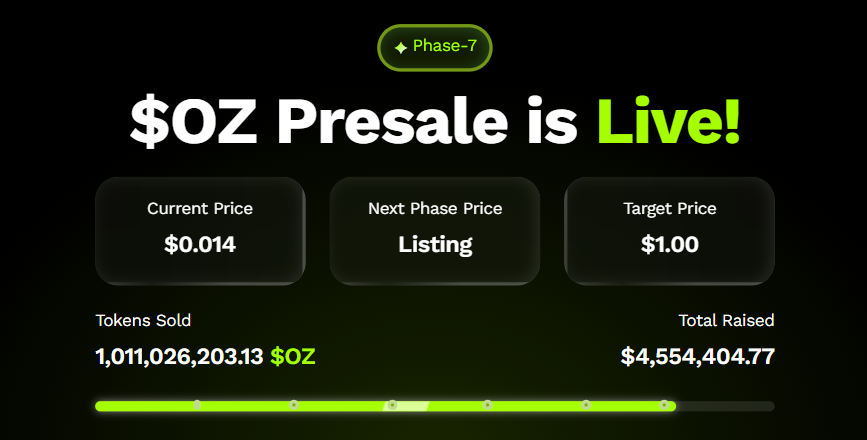
Ozak AI began its presale at $0.001 price in Phase 1, and the price increase in subsequent Phases, which showcases the strong investor accumulation. With this demand, Ozak AI currently stands in Phase 7, and each token is being sold at $0.014.
From Phase 1 to now, the fund has collected more than $4.5 million and sold over 1 billion tokens. Those very early buyers are 1300% up from now. So, investors considered this final presale phase as the best opportunity to grab the position as early investors to gain massive upside before the mainstream adoption.
AI Ecosystem & Partnerships Fuel Ozak AI’s Presale Surge
Ozak AI is developing an advanced predictive intelligence platform for financial markets. This ecosystem is built on a DePIN (Decentralized Physical Infrastructure Network) to enable secure data handling. The Ozak Streaming Network (OSN) receives and processes data from numerous sources before securely storing it in Ozak Data Vaults, the platform’s intelligence library.
When it comes to features, Eon Dashboard allows users to submit inquiries and receive real-time AI findings. In addition, Prediction Agents (PAs) are unique AI models that users can train to provide tailored trading tips beyond general market patterns.
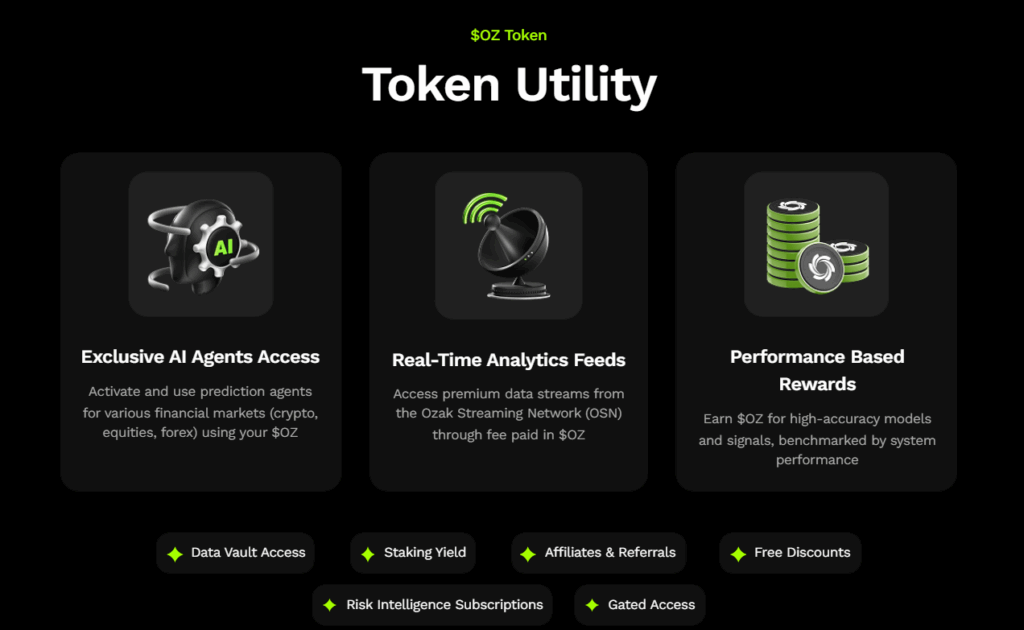
Then it offers an encrypted Data Vault for connecting wallets, exchanges, and social streams with a single access. These features are unlocked by the platform’s native token $OZ, and it has several other use cases.
Ozak AI’s ecosystem, with expanding partners, increases the project’s growth potential. Its collaboration with Meganet provides access to a decentralized broadband infrastructure, faster data processing, and significantly improves the platform’s capacity for large-scale, real-time AI forecasting. Meanwhile, Ozak AI’s partnership with Phala Network strengthens its privacy framework, enabling protected data processing.
Ozak AI ($OZ) Targets $10 by 2028
Ozak AI ($OZ) is predicted by analysts to hit a $10 price target by 2028, mirroring the early, explosive growth curve of Solana ($SOL).This bullish forecast is based on the project’s accelerating development of its AI-powered ecosystem, its real-world utility, and rapidly increasing investor confidence.
Consequently, if Ozak AI reaches the $10 mark, a $1,000 investment made at the current price could potentially transform into over $700,000, offering early investors an extraordinary return opportunity before the token officially lists, making Ozak AI a great opportunity to both seasoned and beginner level crypto investors for massive returns.
For more information about Ozak AI, visit the links below,
- Website: https://ozak.ai/
- Twitter/X: https://x.com/OzakAGI
- Telegram: https://t.me/OzakAGI
Disclaimer: TheNewsCrypto does not endorse any content on this page. The content depicted in this Press Release does not represent any investment advice. TheNewsCrypto recommends our readers to make decisions based on their own research. TheNewsCrypto is not accountable for any damage or loss related to content, products, or services stated in this Press Release.


You May Also Like

Riot Platforms Shocks Market With Another 500 BTC Sale Worth $33.26 Million

Pundit Says Hold Your XRP Through the Shake Out Until July 4. Here’s What Is Coming




