Major bank recommends 1-4% portfolio allocation as cryptocurrency markets recover from Monday's selloffMajor bank recommends 1-4% portfolio allocation as cryptocurrency markets recover from Monday's selloff

Bitcoin Rebounds Above $92,000 as Bank of America Endorses Crypto Allocations

Bitcoin Rebounds Above $92,000 as Bank of America Endorses Crypto Allocations

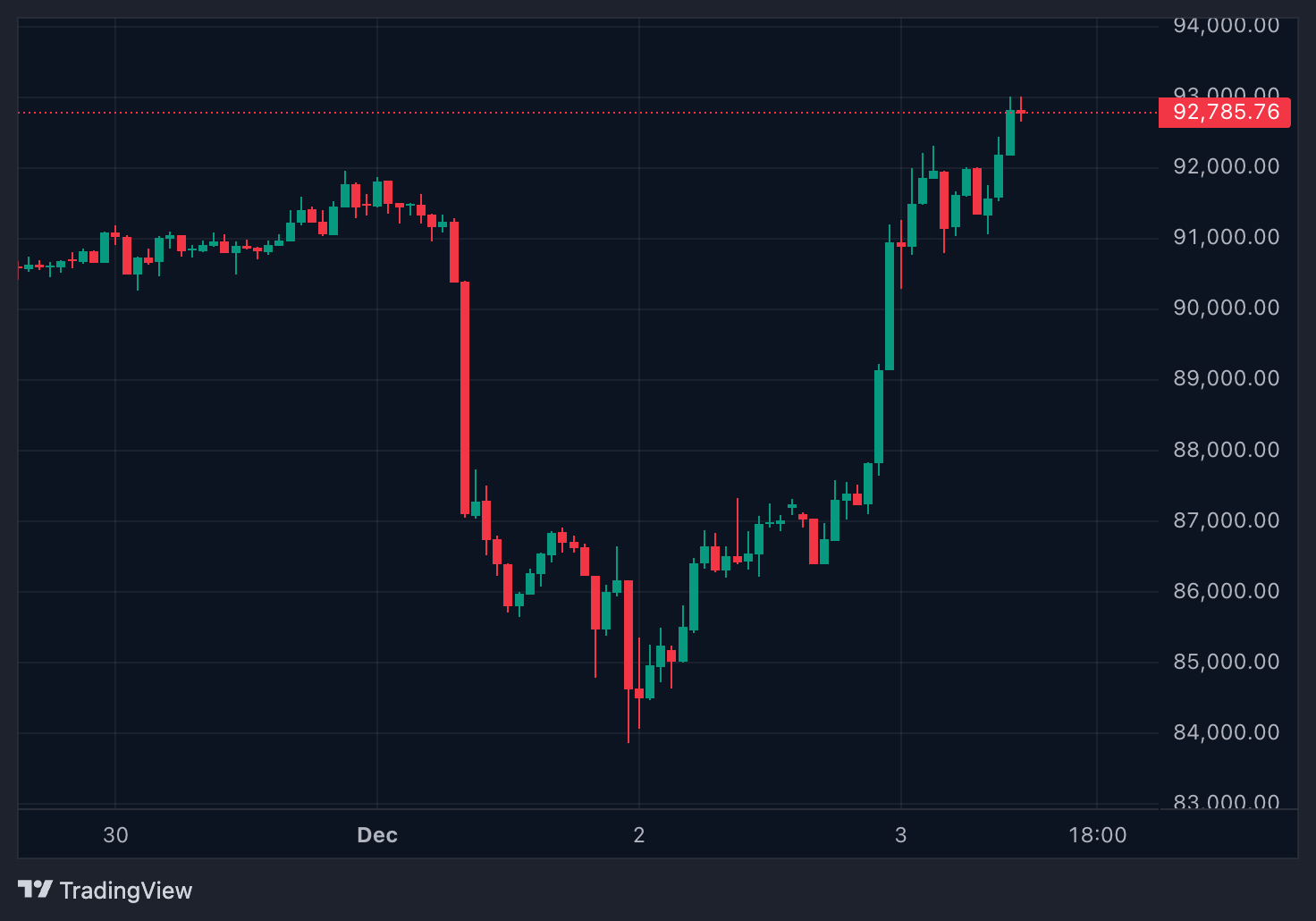
Bitcoin surged past $92,000 on Wednesday, rebounding sharply from Monday's flash crash as Bank of America became the latest major financial institution to recommend cryptocurrency allocations for wealth management clients.

The largest cryptocurrency gained over 7% in 24 hours to trade around $92,690 as of publication time, per Coinmarketcap data, marking its strongest daily performance since April. Ethereum rose 8% to $3,023, while Solana jumped 10% to $140. Total cryptocurrency market capitalization climbed 6.2% to $3.13 trillion, recovering roughly $190 billion from Monday's lows.

Despite the recovery Wednesday morning, Bitcoin remains roughly 26% below its October 2025 all-time high above $126,270.
Bitcoin Rebounds Above $92,000 as Bank of America Endorses Crypto Allocations

The rebound comes as Bank of America announced Tuesday it will endorse a 1%-4% digital asset allocation for clients of its Merrill, Bank of America Private Bank, and Merrill Edge platforms. Starting January 5, the firm's investment strategists will begin covering four bitcoin ETFs: Bitwise's BITB, Fidelity's FBTC, Grayscale's BTC, and BlackRock's IBIT.

"For investors with a strong interest in thematic innovation and comfort with elevated volatility, a modest allocation of 1% to 4% in digital assets could be appropriate," Chris Hyzy, chief investment officer at Bank of America Private Bank, said in a statement.

Previously, the bank's wealthy clients could only access crypto products upon request, meaning its network of over 15,000 wealth advisers could not proactively recommend exposure.

The policy shift follows similar moves by other major institutions. Morgan Stanley's global investment committee recommended 2%-4% crypto allocations in October, while BlackRock suggested 1%-2% at the start of 2025. Fidelity Investments has recommended 2%-5% allocations, increasing to 7.5% for investors under age 30.

On Tuesday, Vanguard reversed its longstanding opposition to digital assets, announcing it would allow cryptocurrency ETFs and mutual funds to trade on its platform for more than 50 million brokerage customers. The world's second-largest asset manager had been the last major U.S. brokerage to resist offering crypto access.

U.S. stocks also recovered Tuesday, with the S&P 500 rising 0.3% and the Nasdaq Composite gaining 0.6%. Crypto-linked stocks including Coinbase and Robinhood rebounded after getting hit during Monday's selloff.

Markets are pricing in an 87% probability of a Federal Reserve rate cut at the central bank's December 10-11 meeting, up significantly from mid-November, according to CME FedWatch data. The improved odds for monetary easing have supported risk assets including cryptocurrencies.

Bitcoin had plunged to as low as $84,000 on Monday in its worst daily performance since March, triggering over $350 million in liquidations of leveraged positions. The flash crash wiped roughly $140 billion from total cryptocurrency market capitalization before buyers stepped in at lower levels.

The recovery comes as institutional adoption accelerates. Morgan Stanley, Charles Schwab, Fidelity Investments, and JP Morgan Chase already allow customers to invest in certain crypto ETFs, while fintech bank SoFi began offering direct crypto trading to retail customers last month. Several banks including Charles Schwab, Morgan Stanley, and PNC are expected to launch direct crypto trading services.

"This update reflects growing client demand for access to digital assets," said Nancy Fahmy, head of Bank of America's investment solutions group.

The institutional endorsements mark a significant shift in Wall Street's approach to cryptocurrencies. Major banks had largely avoided recommending crypto exposure until spot Bitcoin ETFs launched in January 2024, providing regulated investment vehicles that simplified custody and compliance requirements.


➢ Stay ahead of the curve. Join Blockhead on Telegram today for all the latest in crypto.
+ Follow Blockhead on Google News
Market Opportunity
Lorenzo Protocol Logo
Lorenzo Protocol Price(BANK)
$0.05024
$0.05024$0.05024
-4.06%
USD
Lorenzo Protocol (BANK) Live Price Chart
Disclaimer: The articles reposted on this site are sourced from public platforms and are provided for informational purposes only. They do not necessarily reflect the views of MEXC. All rights remain with the original authors. If you believe any content infringes on third-party rights, please contact [email protected] for removal. MEXC makes no guarantees regarding the accuracy, completeness, or timeliness of the content and is not responsible for any actions taken based on the information provided. The content does not constitute financial, legal, or other professional advice, nor should it be considered a recommendation or endorsement by MEXC.

You May Also Like

Sui Mainnet Recovers After 6-Hour Network Stall: No Funds at Risk

Sui Mainnet Recovers After 6-Hour Network Stall: No Funds at Risk

On January 14, 2026, Sui Mainnet faced a significant disruption, leaving the network stalled for roughly six hours. The incident was caused by an internal divergence
Share
Tronweekly2026/01/17 09:30
Will There Be A ’28 Years Later 3’ After ‘The Bone Temple’? Here’s The Good News

Will There Be A ’28 Years Later 3’ After ‘The Bone Temple’? Here’s The Good News

The post Will There Be A ’28 Years Later 3’ After ‘The Bone Temple’? Here’s The Good News appeared on BitcoinEthereumNews.com. Chi Lewis-Parry and Ralph Fiennes
Share
BitcoinEthereumNews2026/01/17 09:21
Urgent: Coinbase CEO Pushes for Crucial Crypto Market Structure Bill

Urgent: Coinbase CEO Pushes for Crucial Crypto Market Structure Bill

BitcoinWorld Urgent: Coinbase CEO Pushes for Crucial Crypto Market Structure Bill The cryptocurrency world is buzzing with significant developments as Coinbase CEO Brian Armstrong recently took to Washington, D.C., advocating passionately for a clearer regulatory path. His mission? To champion the passage of a vital crypto market structure bill, specifically the Digital Asset Market Clarity (CLARITY) Act. This legislative push is not just about policy; it’s about safeguarding investor rights and fostering innovation in the digital asset space. Why a Clear Crypto Market Structure Bill is Essential Brian Armstrong’s visit underscores a growing sentiment within the crypto industry: the urgent need for regulatory clarity. Without clear guidelines, the market operates in a gray area, leaving both innovators and investors vulnerable. The proposed crypto market structure bill aims to bring much-needed definition to this dynamic sector. Armstrong explicitly stated on X that this legislation is crucial to prevent a recurrence of actions that infringe on investor rights, citing past issues with former U.S. Securities and Exchange Commission (SEC) Chair Gary Gensler. This proactive approach seeks to establish a stable and predictable environment for digital assets. Understanding the CLARITY Act: A Blueprint for Digital Assets The Digital Asset Market Clarity (CLARITY) Act is designed to establish a robust regulatory framework for the cryptocurrency industry. It seeks to delineate the responsibilities of key regulatory bodies, primarily the SEC and the Commodity Futures Trading Commission (CFTC). Here are some key provisions: Clear Jurisdiction: The bill aims to specify which digital assets fall under the purview of the SEC as securities and which are considered commodities under the CFTC. Investor Protection: By defining these roles, the act intends to provide clearer rules for market participants, thereby enhancing investor protection. Exemption Conditions: A significant aspect of the bill would exempt certain cryptocurrencies from the stringent registration requirements of the Securities Act of 1933, provided they meet specific criteria. This could reduce regulatory burdens for legitimate projects. This comprehensive approach promises to bring structure to a rapidly evolving market. The Urgency Behind the Crypto Market Structure Bill The call for a dedicated crypto market structure bill is not new, but Armstrong’s direct engagement highlights the increasing pressure for legislative action. The lack of a clear framework has led to regulatory uncertainty, stifling innovation and sometimes leading to enforcement actions that many in the industry view as arbitrary. Passing this legislation would: Foster Innovation: Provide a clear roadmap for developers and entrepreneurs, encouraging new projects and technologies. Boost Investor Confidence: Offer greater certainty and protection for individuals investing in digital assets. Prevent Future Conflicts: Reduce the likelihood of disputes between regulatory bodies and crypto firms, creating a more harmonious ecosystem. The industry believes that a well-defined regulatory landscape is essential for the long-term health and growth of the digital economy. What a Passed Crypto Market Structure Bill Could Mean for You If the CLARITY Act or a similar crypto market structure bill passes, its impact could be profound for everyone involved in the crypto space. For investors, it could mean a more secure and transparent market. For businesses, it offers a predictable environment to build and scale. Conversely, continued regulatory ambiguity could: Stifle Growth: Drive innovation overseas and deter new entrants. Increase Risks: Leave investors exposed to unregulated practices. Create Uncertainty: Lead to ongoing legal battles and market instability. The stakes are incredibly high, making the advocacy efforts of leaders like Brian Armstrong all the more critical. The push for a clear crypto market structure bill is a pivotal moment for the digital asset industry. Coinbase CEO Brian Armstrong’s efforts in Washington, D.C., reflect a widespread desire for regulatory clarity that protects investors, fosters innovation, and ensures the long-term viability of cryptocurrencies. The CLARITY Act offers a potential blueprint for this future, aiming to define jurisdictional boundaries and streamline regulatory requirements. Its passage could unlock significant growth and stability, cementing the U.S. as a leader in the global digital economy. Frequently Asked Questions (FAQs) What is the Digital Asset Market Clarity (CLARITY) Act? The CLARITY Act is a proposed crypto market structure bill aimed at establishing a clear regulatory framework for digital assets in the U.S. It seeks to define the roles of the SEC and CFTC and exempt certain cryptocurrencies from securities registration requirements under specific conditions. Why is Coinbase CEO Brian Armstrong advocating for this bill? Brian Armstrong is advocating for the CLARITY Act to bring regulatory certainty to the crypto industry, protect investor rights from unclear enforcement actions, and foster innovation within the digital asset space. He believes it’s crucial for the industry’s sustainable growth. How would this bill impact crypto investors? For crypto investors, the passage of this crypto market structure bill would mean greater clarity on which assets are regulated by whom, potentially leading to enhanced consumer protections, reduced market uncertainty, and a more stable investment environment. What are the primary roles of the SEC and CFTC concerning this bill? The bill aims to delineate the responsibilities of the SEC (Securities and Exchange Commission) and the CFTC (Commodity Futures Trading Commission) regarding digital assets. It seeks to clarify which assets fall under securities regulation and which are considered commodities, reducing jurisdictional ambiguity. What could happen if a crypto market structure bill like CLARITY Act does not pass? If a clear crypto market structure bill does not pass, the industry may continue to face regulatory uncertainty, potentially leading to stifled innovation, increased legal challenges for crypto companies, and a less secure environment for investors due to inconsistent enforcement and unclear rules. Did you find this article insightful? Share it with your network to help spread awareness about the crucial discussions shaping the future of digital assets! To learn more about the latest crypto market trends, explore our article on key developments shaping crypto regulation and institutional adoption. This post Urgent: Coinbase CEO Pushes for Crucial Crypto Market Structure Bill first appeared on BitcoinWorld.
Share
Coinstats2025/09/18 20:35