

Ethereum Price Winter Dilemma: $7,000 or $2,400? Experts Are Split
Key Takeaways:
- Ethereum enters December below last year’s close, signalling rising uncertainty after a volatile November.
- Liquidity remains the main force driving Ethereum, and experts warn the market is waiting for external catalysts.
- The $3,000 monthly close shows equilibrium, not strength, with key support sitting around $2,800.
- A break below $2,800 could open the path to $2,400–$2,500, according to analysts.
- Bullish scenarios depend on the Fusaka upgrade and expectations around a potential US Ethereum ETF approval in early 2026.
- Stablecoin supply above 300 billion shows strong liquidity but is not a straightforward bullish signal.
- Select narratives performed well in November, including prediction markets, privacy tokens, AI and zero-knowledge sectors.
- Overall sentiment remains mixed, and Ethereum’s December performance will likely shape market tone heading into 2026.
- In This Article
-
Ethereum Price Enters December in a ‘Not Bullish, Not Bearish’ StateStablecoin Growth Sparks a New Debate: Bullish or Bearish for Crypto?Not All Tokens Fell: The Narratives That Stayed Strong in NovemberConclusionKey Crypto Events to Watch in December 2025
- In This Article
-
Ethereum Price Enters December in a ‘Not Bullish, Not Bearish’ State
-
Stablecoin Growth Sparks a New Debate: Bullish or Bearish for Crypto?
-
Not All Tokens Fell: The Narratives That Stayed Strong in November
- Show Full Guide
-
Conclusion
-
Key Crypto Events to Watch in December 2025
Ethereum (ETH), as the leading altcoin, often sets the tone for the rest of the crypto market. Weak ETH usually means weak altcoins. Strong ETH brings interest back to the entire sector. The question now is what happens if ETH drops even lower.
Ethereum’s December closing price is one of the most important markers of the year. The December candle often becomes the starting point of the next cycle. It captures market sentiment, shapes investor confidence and sets the foundation for how the asset performs in the early months of the new year.
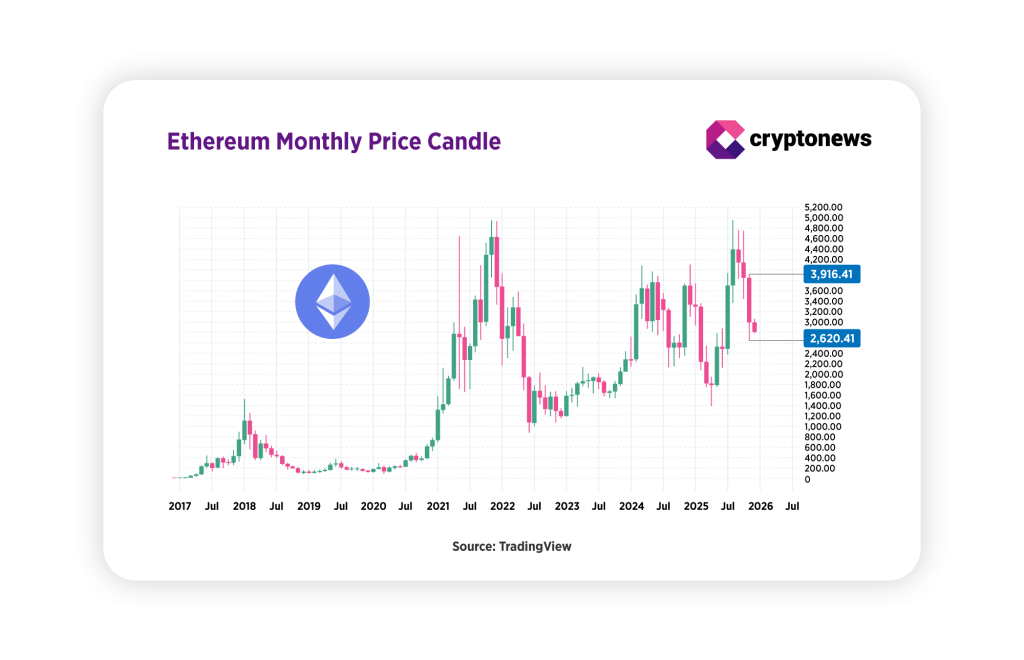
Looking at Ethereum’s performance since 2020, the December close has usually increased compared to the previous year. The only exception was the 2021–2022 period. During that time, ETH collapsed by nearly 67.5%. Since then, the trend has turned positive again.
- From 2022 to 2023, Ethereum gained 90.7%.
- From 2023 to 2024, it added another 46.1%.
December 2025, however, is shaping up to be far less straightforward. The current ETH price remains below the December 2024 close of $3,332. Market signals are mixed, and uncertainty is growing.
In this monthly Cryptonews report, we spoke with experts to understand what Ethereum and the broader altcoin market might face this December. We also look at whether a repeat of the 2021–2022 scenario, when the price dropped by more than 67%, is still on the table.
Ethereum Price Enters December in a ‘Not Bullish, Not Bearish’ State
November 2025 was difficult for Ethereum, just as it was for Bitcoin and the broader crypto market. Even with negative pressure from crypto and global macro, ETH managed to close the month near $3,000. But the wick down to $2,620 looks unsettling. It wasn’t random — the market was clearly testing lower levels.
Cais Manai, Co-Founder and Head of Product at TEN Protocol, told Cryptonews that Ethereum is showing weakness, but this doesn’t mean bears are in control:
Speaking with Cryptonews, he also noted that one of the main issues right now is the lack of liquidity. According to him, the monthly close near $3,000 shows the market is at a turning point:
Eneko Knorr, CEO and founder of Stabolut, explained to Cryptonews that Ethereum still holds a major advantage. He believes the Fusaka upgrade could become the key driver for ETH at the end of 2025. Another catalyst is the expected approval of a US Ethereum ETF in early 2026, which may attract more institutional demand:
However, these same factors could create a bearish outcome if something goes wrong. Knorr notes that ETH could revisit lower levels under several conditions:
Manai also highlights the importance of the $2,800 area. If ETH fails to hold it and regain $3,000, the price may slide toward lower supports. But even this scenario wouldn’t break the larger structure:
Stablecoin Growth Sparks a New Debate: Bullish or Bearish for Crypto?
One of the key factors shaping Ethereum’s price and the broader altcoin market right now remains liquidity. And this brings attention to stablecoin dynamics. According to Artemis, the combined stablecoin supply (by token) has stayed above 300 billion for two consecutive months.
This is a notable increase compared to the beginning of the year. Stablecoins play a critical role in market structure. They provide liquidity, enable fast entries and exits, and act as fuel for any major market move.
Many traders read this stablecoins expansion as a bullish signal. The “printing press” hasn’t slowed down, which could suggest the market is preparing for a more active phase. But stablecoins also accumulate during downturns. They can be used for short positions or kept on the sidelines for future dip-buying. The question is whether the next drop becomes a bottom with a reversal or only the beginning of a deeper move.

Stablecoin growth looks bullish at first glance, but it isn’t always that simple. Frank Combay, COO of Next Generation NGPES, told Cryptonews that rising stablecoins supply reflects much more complex market behavior than straightforward optimism. He notes that stablecoins are used not only in bullish phases but also during corrections, both for protection and for more aggressive trading:
According to Combay, the consistent demand for stablecoins is tied more to market infrastructure than emotion. Functionality, not sentiment, is what sustains stablecoin capitalization:
Even so, Combay cautions that stablecoin growth alone does not give the market a clear direction:
Not All Tokens Fell: The Narratives That Stayed Strong in November
Despite the broader market correction, several segments showed unexpected strength in November. Among the top 100 assets by market capitalization, the best performer was Rain (RAIN), a new token from the decentralized prediction markets sector.
This can offer clues about which narratives remain resilient. Still, it is important to note that a single outperformer does not always represent the true state of an entire sector. Often, one token can push a category higher on its own.
Interest in prediction markets remains noticeable, and some industry participants see more room for growth. Paul Thomas, Founder of Somnia, told Cryptonews that technological progress and more efficient on-chain models could make prediction markets significantly more mainstream:
He adds that as prediction markets migrate away from centralized elements and move fully on-chain, new use cases will emerge:
The second-strongest token in November was Monero (XMR), a token from the privacy payments sector. Interest in privacy surged after a sharp rally in Zcash (ZEC), with some in the crypto community arguing that the industry is “returning to its roots.” The narrative may continue to develop, but these assets remain high risk. The recent moves were sharp, and markets often enter a correction after such spikes.
Another asset worth noting is Internet Computer (ICP), which ranked fifth for November performance. The token is linked to the AI narrative, and its rise likely reflects the broader enthusiasm around artificial intelligence. This suggests the sector remains promising, although not all AI tokens will benefit equally. ICP was the only AI-linked asset among top performers, but the category overlaps with other narratives that could gain momentum as AI adoption grows.
One of those narratives is Zero Knowledge (ZK) technology. Terence Kwok, CEO and Founder of Humanity Protocol, told Cryptonews that ZK systems are becoming increasingly practical and may see new demand in 2026:
There is visible activity in the sector, including Starknet (STRK). However, ZK tokens remain risky, and many are still deep in drawdown. It is unclear whether AI-driven momentum can meaningfully revive them.
Kwok also notes that the rise of artificial intelligence creates a new structural problem. This is where AI and ZK narratives intersect:
The idea that AI and ZK can reinforce each other is compelling, even if both narratives remain high risk for investors.
Conclusion
Gold-pegged stablecoins were also among November’s top performers, which is especially notable given Bitcoin’s absence from the list despite its “digital gold” reputation. This suggests that investors are taking a cautious approach. Bitcoin’s uncertain trajectory continues to weigh on Ethereum and the broader altcoin market. If BTC remains weak, the rest of the market will likely struggle as well.
At the same time, the data shows that some narratives and tokens continue to perform. Growth has become more selective, and traders now need to identify these pockets of strength rather than rely on broad market momentum. December will be an important month for both crypto and traditional markets. Volatility is likely to stay high, making caution and precision essential.
   Key Crypto Events to Watch in December 2025
   December 3
   • Ethereum (ETH) Fusaka upgrade
   December 4
   • Stellar (XLM) House Miami panel
   December 5
   • Renzo (REZ) token burn
   December 13
   • Bittensor (TAO) halving
   December 15
   • Starknet (STK) 127M token unlock
   • Sei (SEI) 55.56M token unlock
Disclaimer: Crypto is a high-risk asset class. This article is provided for informational purposes and does not constitute investment advice.


You May Also Like
Solana Price at Risk as Key Network Metrics Wane and ETF Inflows Lag

VanEck Flags Semiconductor Stocks as Key AI Infrastructure Plays for 2026




