the heldTron has emerged as one of the strongest performers during the latest market downturn, showing a level of resilience rarely seen among major altcoins. While most large-cap cryptocurrencies have suffered drawdowns of 40% or more since August, Tron has limited its losses to just 24%, outperforming nearly the entire altcoin sector. This relative strength highlights the network’s unique positioning and the steady demand it continues to attract despite broader market weakness. Related Reading: Bitcoin Liquidation Dominance Hits Multi-Year High: The Real Cause Behind BTC’s Breakdown A major factor behind this resilience is Tron’s growing dominance in the stablecoin ecosystem. According to data from Tronscan, shared by Lookonchain, Tether minted another 1 billion USDT on Tron, signaling continued confidence in the network’s ability to handle large-scale stablecoin issuance. This new mint has pushed Tron’s stablecoin market cap above $80.2 billion, solidifying its role as the leading chain for USDT circulation. As capital rotates defensively into stablecoins, Tron tends to benefit disproportionately. Its ability to maintain relative stability while the rest of the market capitulates reinforces the idea that Tron’s utility-driven demand remains intact—and may continue to offer support even if volatility persists. Tron Strengthens Its Position as the Second-Largest Stablecoin Network Tron has become a central pillar of the global stablecoin ecosystem, securing its position as the second-largest blockchain for stablecoin activity. Its appeal comes from fast settlement times, extremely low transaction fees, and deep liquidity—features that make it the preferred network for high-volume USDT transfers, especially across exchanges, OTC desks, and remittance corridors. This infrastructure has allowed Tron to attract massive stablecoin flows, with its total stablecoin market cap now exceeding $80.2 billion, largely driven by Tether’s continual issuance on the network. However, despite Tron’s remarkable growth, Ethereum still dominates the stablecoin landscape, maintaining a market cap of roughly $166 billion, which is nearly double that of Tron. Ethereum’s dominance is supported by its broader DeFi ecosystem, institutional presence, and the higher-value activity that takes place through smart contracts, lending protocols, and on-chain financial applications. Stablecoins on Ethereum often serve as liquidity for sophisticated trading and yield strategies, whereas on Tron, they are primarily used for settlement, payments, and exchange flows. The two ecosystems complement different market needs. Ethereum anchors the institutional and DeFi-driven segment of stablecoin usage, while Tron leads in high-throughput, cost-efficient transactions. As stablecoin demand grows globally, both networks continue to reinforce their positions. One through scalability and speed, the other through DeFi depth and capital concentration. Related Reading: Ethereum Open Interest Cut In Half As $6.4B In Positions Vanish: Market Reset Accelerates TRX Holds Strong Weekly Structure Despite Volatility Tron’s weekly chart shows a notable level of resilience compared to broader market conditions. While many altcoins have experienced far deeper drawdowns, TRX has held above the $0.27–$0.28 support zone. Maintaining a strong higher-timeframe structure. The recent correction pulled the price down from the $0.36 region, but TRX continues to trade comfortably above the 50-week SMA. Which now sits around $0.28 and acts as immediate dynamic support. This strength is significant. Throughout 2025, TRX has respected its rising moving averages. The 50-week SMA in particular has provided consistent support during each market pullback. The 100-week and 200-week SMAs, positioned well below the current price, show a broad, healthy long-term uptrend that remains intact. Related Reading: Massive Ethereum Distribution Continues: Whale Sends Another 5,000 ETH To Binance For Tron to regain bullish momentum, it must reclaim the $0.30–$0.32 region. Which served as support during the previous uptrend and now acts as resistance. A strong weekly close above this zone could open the door for a retest of the $0.34–$0.36 highs. Until then, TRX remains one of the market’s more stable performers, showing controlled downside and structural strength. Featured image from ChatGPT, chart from TradingView.comthe heldTron has emerged as one of the strongest performers during the latest market downturn, showing a level of resilience rarely seen among major altcoins. While most large-cap cryptocurrencies have suffered drawdowns of 40% or more since August, Tron has limited its losses to just 24%, outperforming nearly the entire altcoin sector. This relative strength highlights the network’s unique positioning and the steady demand it continues to attract despite broader market weakness. Related Reading: Bitcoin Liquidation Dominance Hits Multi-Year High: The Real Cause Behind BTC’s Breakdown A major factor behind this resilience is Tron’s growing dominance in the stablecoin ecosystem. According to data from Tronscan, shared by Lookonchain, Tether minted another 1 billion USDT on Tron, signaling continued confidence in the network’s ability to handle large-scale stablecoin issuance. This new mint has pushed Tron’s stablecoin market cap above $80.2 billion, solidifying its role as the leading chain for USDT circulation. As capital rotates defensively into stablecoins, Tron tends to benefit disproportionately. Its ability to maintain relative stability while the rest of the market capitulates reinforces the idea that Tron’s utility-driven demand remains intact—and may continue to offer support even if volatility persists. Tron Strengthens Its Position as the Second-Largest Stablecoin Network Tron has become a central pillar of the global stablecoin ecosystem, securing its position as the second-largest blockchain for stablecoin activity. Its appeal comes from fast settlement times, extremely low transaction fees, and deep liquidity—features that make it the preferred network for high-volume USDT transfers, especially across exchanges, OTC desks, and remittance corridors. This infrastructure has allowed Tron to attract massive stablecoin flows, with its total stablecoin market cap now exceeding $80.2 billion, largely driven by Tether’s continual issuance on the network. However, despite Tron’s remarkable growth, Ethereum still dominates the stablecoin landscape, maintaining a market cap of roughly $166 billion, which is nearly double that of Tron. Ethereum’s dominance is supported by its broader DeFi ecosystem, institutional presence, and the higher-value activity that takes place through smart contracts, lending protocols, and on-chain financial applications. Stablecoins on Ethereum often serve as liquidity for sophisticated trading and yield strategies, whereas on Tron, they are primarily used for settlement, payments, and exchange flows. The two ecosystems complement different market needs. Ethereum anchors the institutional and DeFi-driven segment of stablecoin usage, while Tron leads in high-throughput, cost-efficient transactions. As stablecoin demand grows globally, both networks continue to reinforce their positions. One through scalability and speed, the other through DeFi depth and capital concentration. Related Reading: Ethereum Open Interest Cut In Half As $6.4B In Positions Vanish: Market Reset Accelerates TRX Holds Strong Weekly Structure Despite Volatility Tron’s weekly chart shows a notable level of resilience compared to broader market conditions. While many altcoins have experienced far deeper drawdowns, TRX has held above the $0.27–$0.28 support zone. Maintaining a strong higher-timeframe structure. The recent correction pulled the price down from the $0.36 region, but TRX continues to trade comfortably above the 50-week SMA. Which now sits around $0.28 and acts as immediate dynamic support. This strength is significant. Throughout 2025, TRX has respected its rising moving averages. The 50-week SMA in particular has provided consistent support during each market pullback. The 100-week and 200-week SMAs, positioned well below the current price, show a broad, healthy long-term uptrend that remains intact. Related Reading: Massive Ethereum Distribution Continues: Whale Sends Another 5,000 ETH To Binance For Tron to regain bullish momentum, it must reclaim the $0.30–$0.32 region. Which served as support during the previous uptrend and now acts as resistance. A strong weekly close above this zone could open the door for a retest of the $0.34–$0.36 highs. Until then, TRX remains one of the market’s more stable performers, showing controlled downside and structural strength. Featured image from ChatGPT, chart from TradingView.com

Tron Hits $80.2B Stablecoin Milestone After Tether Mints 1B USDT On The Network

2025/12/04 05:00

the heldTron has emerged as one of the strongest performers during the latest market downturn, showing a level of resilience rarely seen among major altcoins. While most large-cap cryptocurrencies have suffered drawdowns of 40% or more since August, Tron has limited its losses to just 24%, outperforming nearly the entire altcoin sector. This relative strength highlights the network’s unique positioning and the steady demand it continues to attract despite broader market weakness.

A major factor behind this resilience is Tron’s growing dominance in the stablecoin ecosystem. According to data from Tronscan, shared by Lookonchain, Tether minted another 1 billion USDT on Tron, signaling continued confidence in the network’s ability to handle large-scale stablecoin issuance. This new mint has pushed Tron’s stablecoin market cap above $80.2 billion, solidifying its role as the leading chain for USDT circulation.
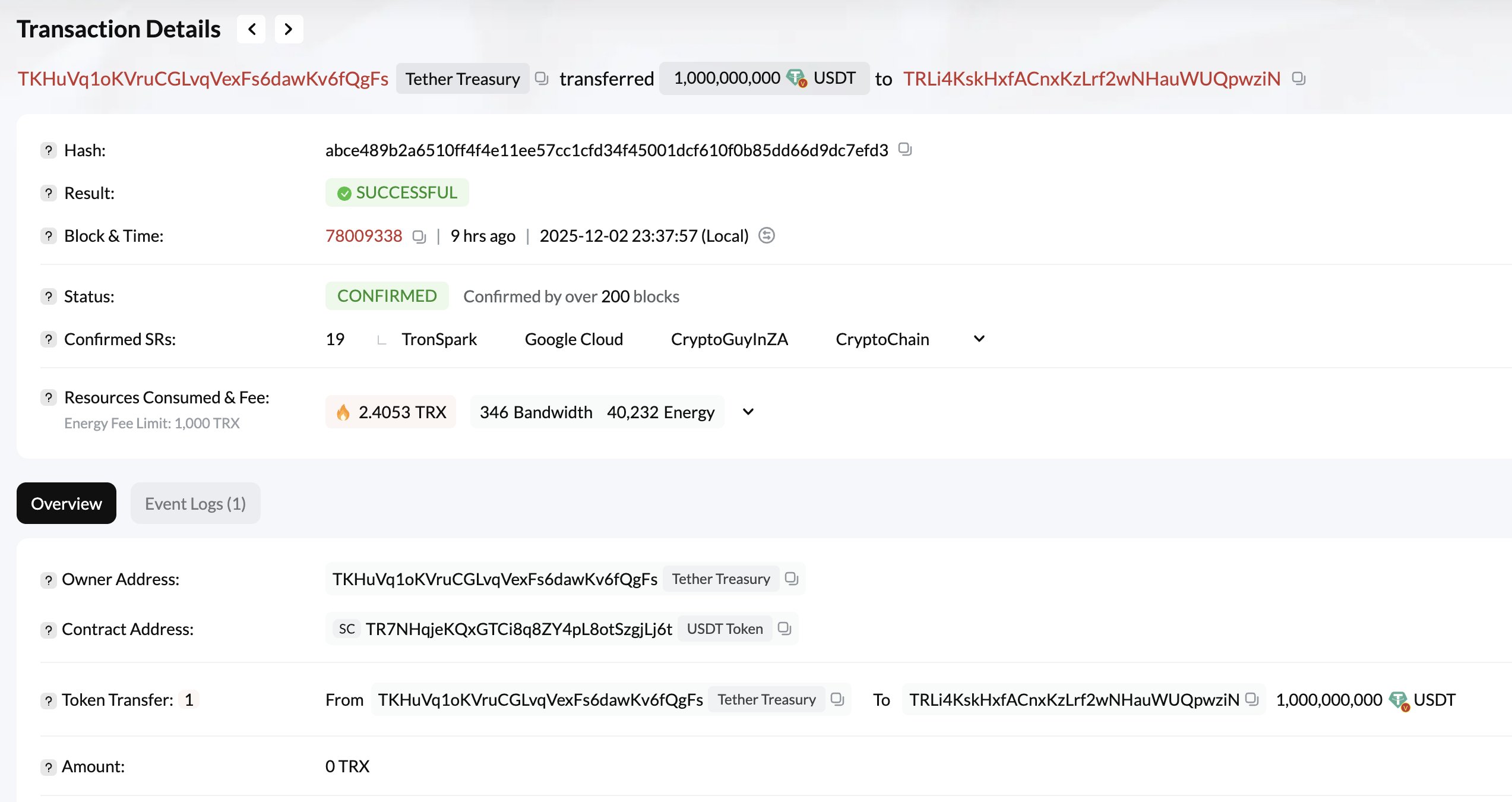
Tether 1B USDT mint on Tron | Source: Tronscan

As capital rotates defensively into stablecoins, Tron tends to benefit disproportionately. Its ability to maintain relative stability while the rest of the market capitulates reinforces the idea that Tron’s utility-driven demand remains intact—and may continue to offer support even if volatility persists.

Tron Strengthens Its Position as the Second-Largest Stablecoin Network

Tron has become a central pillar of the global stablecoin ecosystem, securing its position as the second-largest blockchain for stablecoin activity. Its appeal comes from fast settlement times, extremely low transaction fees, and deep liquidity—features that make it the preferred network for high-volume USDT transfers, especially across exchanges, OTC desks, and remittance corridors.

This infrastructure has allowed Tron to attract massive stablecoin flows, with its total stablecoin market cap now exceeding $80.2 billion, largely driven by Tether’s continual issuance on the network.
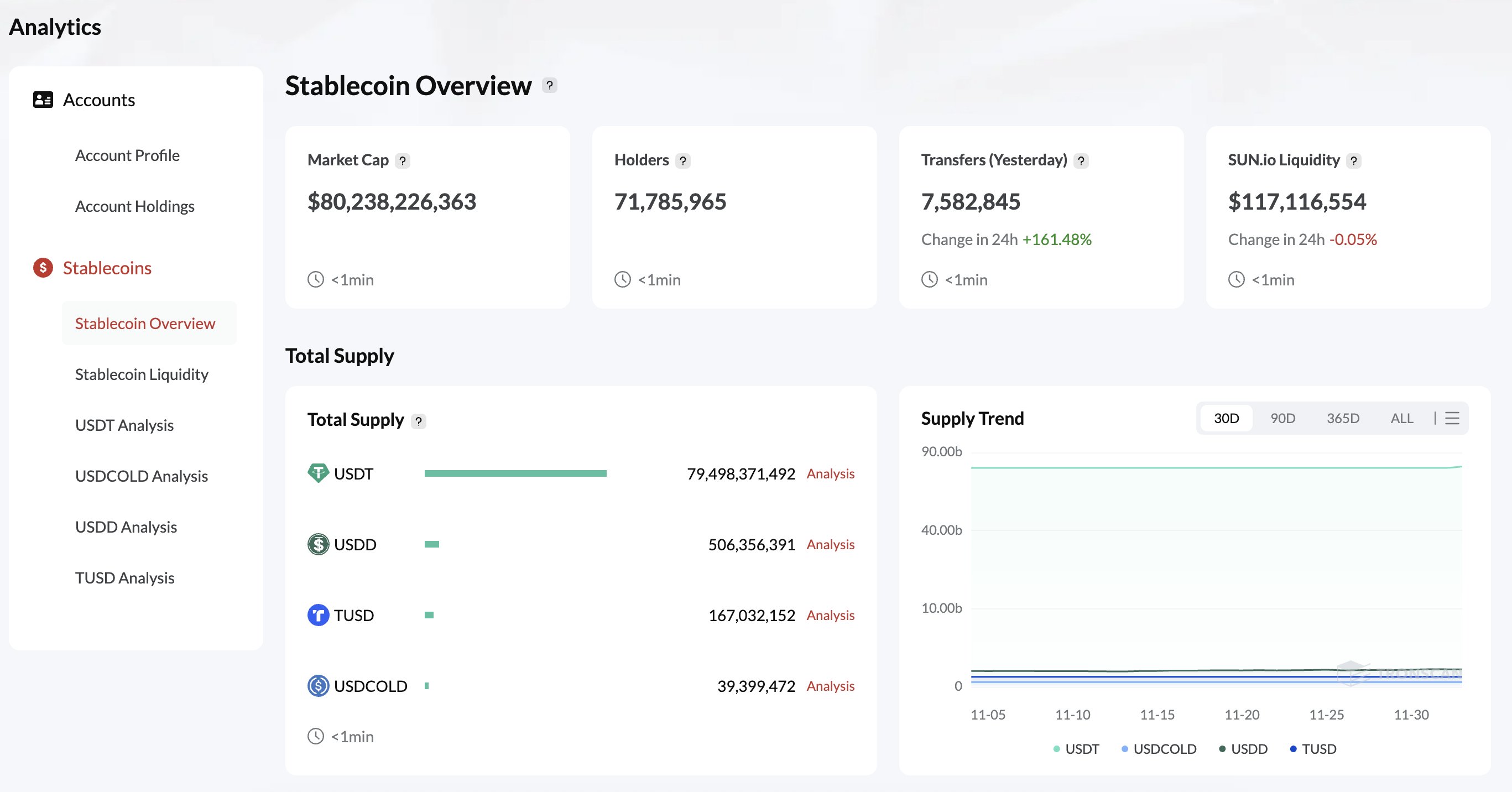
Tron Stablecoin Market Cap | Source: Tronscan

However, despite Tron’s remarkable growth, Ethereum still dominates the stablecoin landscape, maintaining a market cap of roughly $166 billion, which is nearly double that of Tron. Ethereum’s dominance is supported by its broader DeFi ecosystem, institutional presence, and the higher-value activity that takes place through smart contracts, lending protocols, and on-chain financial applications.

Stablecoins on Ethereum often serve as liquidity for sophisticated trading and yield strategies, whereas on Tron, they are primarily used for settlement, payments, and exchange flows.

The two ecosystems complement different market needs. Ethereum anchors the institutional and DeFi-driven segment of stablecoin usage, while Tron leads in high-throughput, cost-efficient transactions. As stablecoin demand grows globally, both networks continue to reinforce their positions. One through scalability and speed, the other through DeFi depth and capital concentration.

TRX Holds Strong Weekly Structure Despite Volatility

Tron’s weekly chart shows a notable level of resilience compared to broader market conditions. While many altcoins have experienced far deeper drawdowns, TRX has held above the $0.27–$0.28 support zone. Maintaining a strong higher-timeframe structure. The recent correction pulled the price down from the $0.36 region, but TRX continues to trade comfortably above the 50-week SMA. Which now sits around $0.28 and acts as immediate dynamic support.
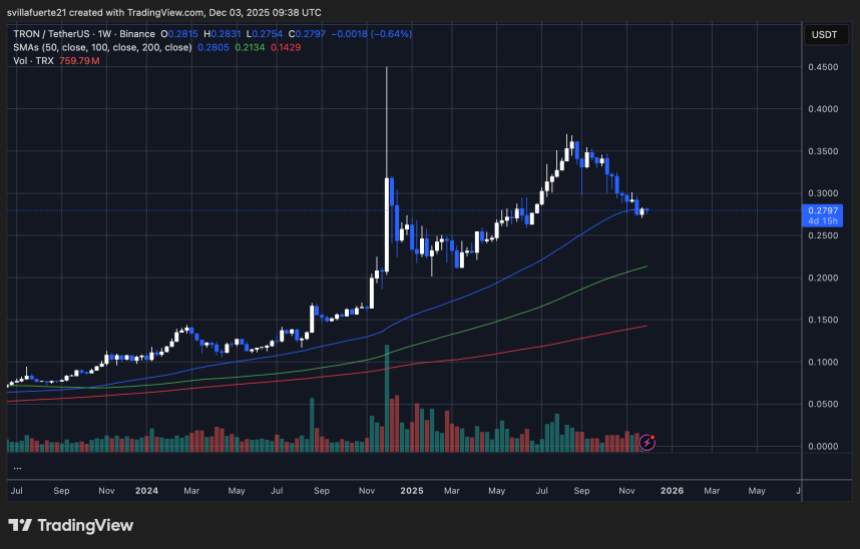
TRX consolidates around key support | Source: TRXUSDT chart on TradingView

This strength is significant. Throughout 2025, TRX has respected its rising moving averages. The 50-week SMA in particular has provided consistent support during each market pullback. The 100-week and 200-week SMAs, positioned well below the current price, show a broad, healthy long-term uptrend that remains intact.

For Tron to regain bullish momentum, it must reclaim the $0.30–$0.32 region. Which served as support during the previous uptrend and now acts as resistance. A strong weekly close above this zone could open the door for a retest of the $0.34–$0.36 highs. Until then, TRX remains one of the market’s more stable performers, showing controlled downside and structural strength.

Featured image from ChatGPT, chart from TradingView.com

Market Opportunity
Major Logo
Major Price(MAJOR)
$0.12801
$0.12801$0.12801
+3.51%
USD
Major (MAJOR) Live Price Chart
Disclaimer: The articles reposted on this site are sourced from public platforms and are provided for informational purposes only. They do not necessarily reflect the views of MEXC. All rights remain with the original authors. If you believe any content infringes on third-party rights, please contact [email protected] for removal. MEXC makes no guarantees regarding the accuracy, completeness, or timeliness of the content and is not responsible for any actions taken based on the information provided. The content does not constitute financial, legal, or other professional advice, nor should it be considered a recommendation or endorsement by MEXC.

You May Also Like

Strive Finalizes Semler Deal, Expands Its Corporate Bitcoin Treasury

Strive Finalizes Semler Deal, Expands Its Corporate Bitcoin Treasury

Strive had finalized its acquisition of Semler scientific after securing the approval of shareholders earlier in the week. The final deal brought both firms’ Bitcoin
Share
Tronweekly2026/01/17 12:30
Why 2026 Is The Year That Caribbean Mixology Will Finally Get Its Time In The Sun

Why 2026 Is The Year That Caribbean Mixology Will Finally Get Its Time In The Sun

The post Why 2026 Is The Year That Caribbean Mixology Will Finally Get Its Time In The Sun appeared on BitcoinEthereumNews.com. San Juan, Puerto Rico’s La Factoría
Share
BitcoinEthereumNews2026/01/17 12:24
EUR/CHF slides as Euro struggles post-inflation data

EUR/CHF slides as Euro struggles post-inflation data

The post EUR/CHF slides as Euro struggles post-inflation data appeared on BitcoinEthereumNews.com. EUR/CHF weakens for a second straight session as the euro struggles to recover post-Eurozone inflation data. Eurozone core inflation steady at 2.3%, headline CPI eases to 2.0% in August. SNB maintains a flexible policy outlook ahead of its September 25 decision, with no immediate need for easing. The Euro (EUR) trades under pressure against the Swiss Franc (CHF) on Wednesday, with EUR/CHF extending losses for the second straight session as the common currency struggles to gain traction following Eurozone inflation data. At the time of writing, the cross is trading around 0.9320 during the American session. The latest inflation data from Eurostat showed that Eurozone price growth remained broadly stable in August, reinforcing the European Central Bank’s (ECB) cautious stance on monetary policy. The Core Harmonized Index of Consumer Prices (HICP), which excludes volatile items such as food and energy, rose 2.3% YoY, in line with both forecasts and the previous month’s reading. On a monthly basis, core inflation increased by 0.3%, unchanged from July, highlighting persistent underlying price pressures in the bloc. Meanwhile, headline inflation eased to 2.0% YoY in August, down from 2.1% in July and slightly below expectations. On a monthly basis, prices rose just 0.1%, missing forecasts for a 0.2% increase and decelerating from July’s 0.2% rise. The inflation release follows last week’s ECB policy decision, where the central bank kept all three key interest rates unchanged and signaled that policy is likely at its terminal level. While officials acknowledged progress in bringing inflation down, they reiterated a cautious, data-dependent approach going forward, emphasizing the need to maintain restrictive conditions for an extended period to ensure price stability. On the Swiss side, disinflation appears to be deepening. The Producer and Import Price Index dropped 0.6% in August, marking a sharp 1.8% annual decline. Broader inflation remains…
Share
BitcoinEthereumNews2025/09/18 03:08