The article explains how OTFS leverages the slow-varying nature of the delay-Doppler domain to interpolate and extrapolate channel states, enabling accurate tracking, lower pilot overhead, and reduced processing delay even in high-mobility, doubly-dispersive environments.The article explains how OTFS leverages the slow-varying nature of the delay-Doppler domain to interpolate and extrapolate channel states, enabling accurate tracking, lower pilot overhead, and reduced processing delay even in high-mobility, doubly-dispersive environments.

Why OTFS Outperforms OFDM in High-Mobility Scenarios

  • I. Abstract and Introduction
  • II. Related Work
  • III. Modeling of Mobile Channels
  • IV. Channel Discretization
  • V. Channel Interpolation and Extrapolation
  • VI. Numerical Evaluations
  • VII. Conclusions, Appendix, and References

V. CHANNEL INTERPOLATION AND EXTRAPOLATION

Motivated by the fact that the channel changes much slower and thus more predictable in the D-D domain, we will in this section investigate how we can exploit the predictability for channel interpolation and extrapolation, so that the channel training overhead can be reduced.

\ A. Channel Interpolation with SFT

\ By assuming bi-orthogonality (or ignoring the ISCI, equivalently), the signal model can be simplified as

\
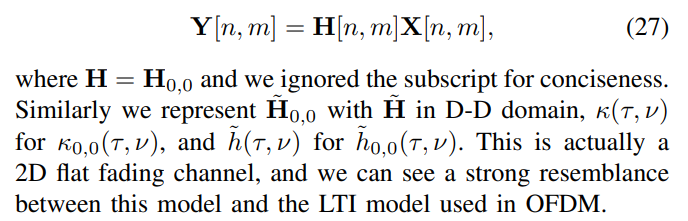
\ Consider a vehicular speed at 100 m/s, and the WSSUS channel model, Fig. 4 shows one realization of the wireless channel in T-F domain. In Fig. 4, the carrier frequency is

\ Fig. 4: Demonstration of the doubly-selective fading channel in time-frequency domain, with bi-orthogonality.
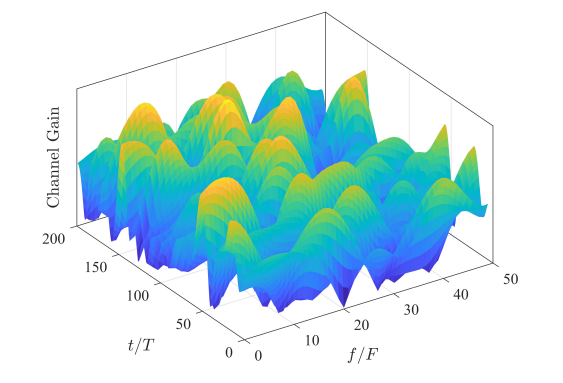
\ 30 GHz, with a sub-carrier spacing of 200 kHz, total bandwidth of 10 MHz, and 1 ms frame length (or 200 symbols). As we can see, the channel changes very fast over both time and frequency, and the channel gains can be significantly different even between adjacent T-F slots. This example demonstrates the necessity of OTFS in highly dynamic channels.

\
\
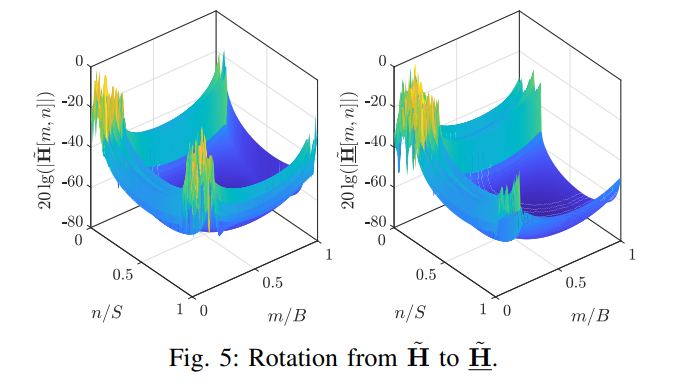
\
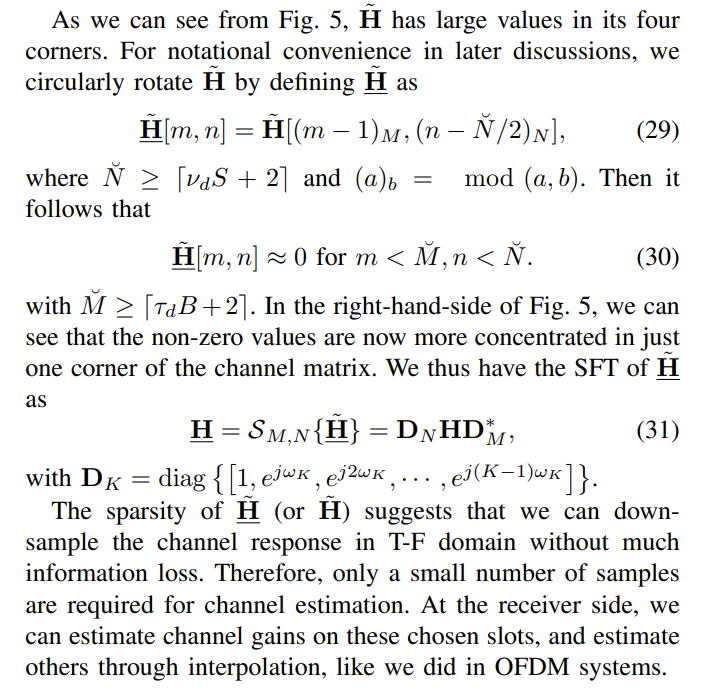
\
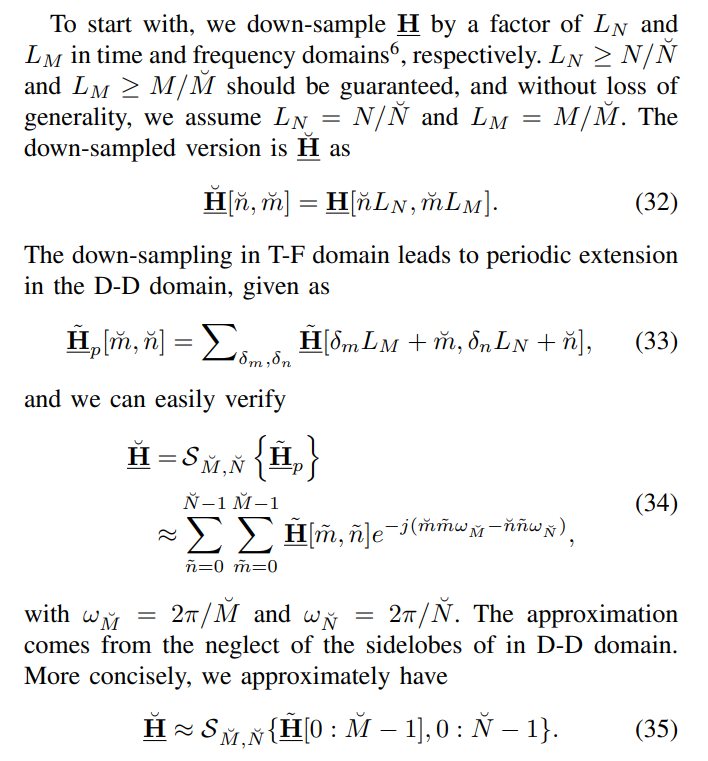
\
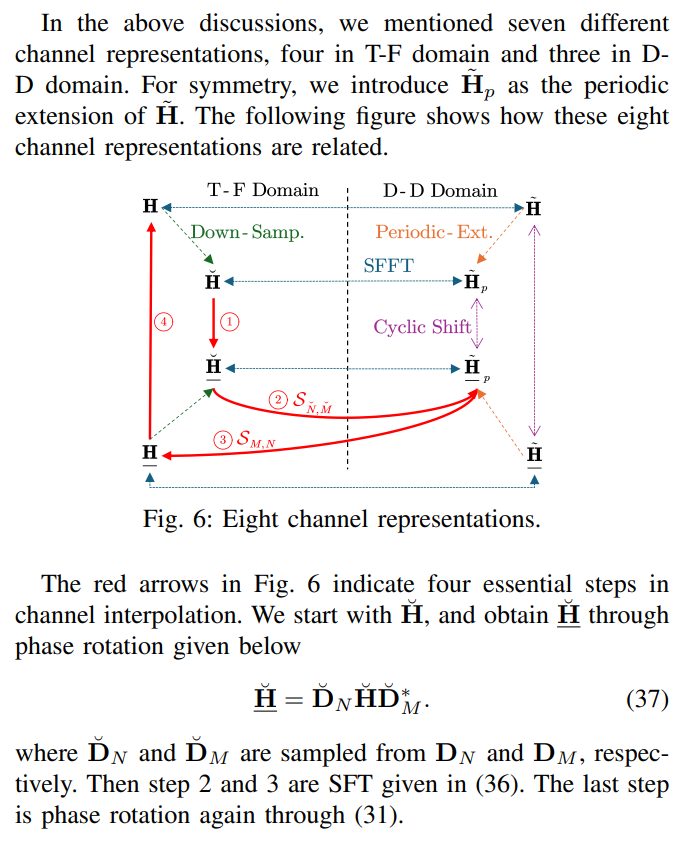
\
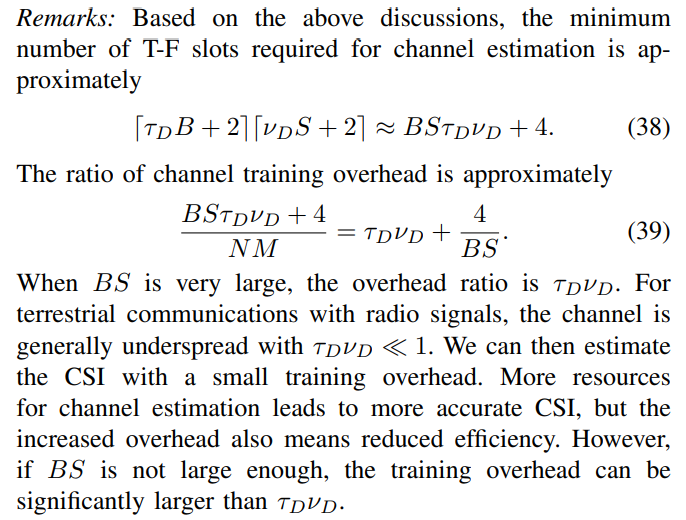
\ Remarks: The above discussions hold for both discrete and continuous D-D profiles. For discrete D-D channel model, these discussions hold even when the Doppler shifts and delays of different paths are not exactly on the D-D grids in general.

\ B. A Pipelined Implementation

\
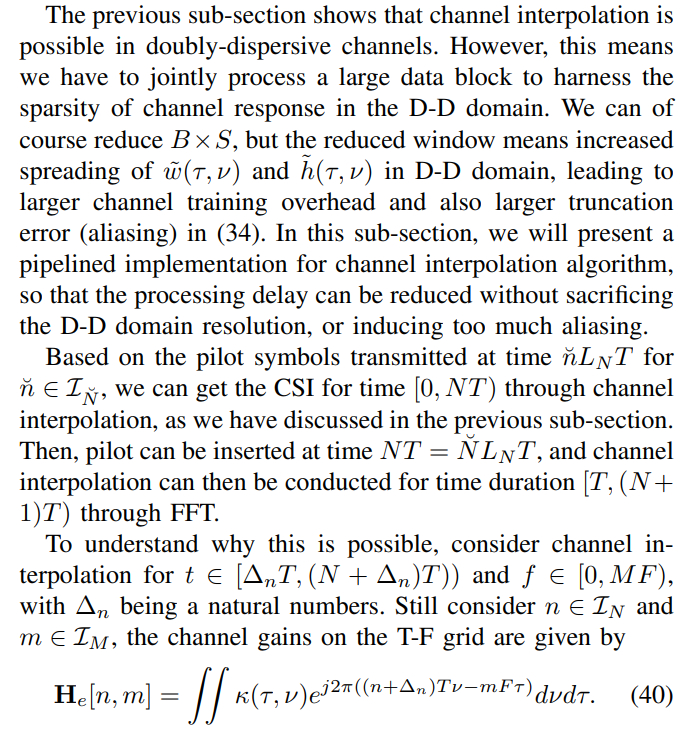
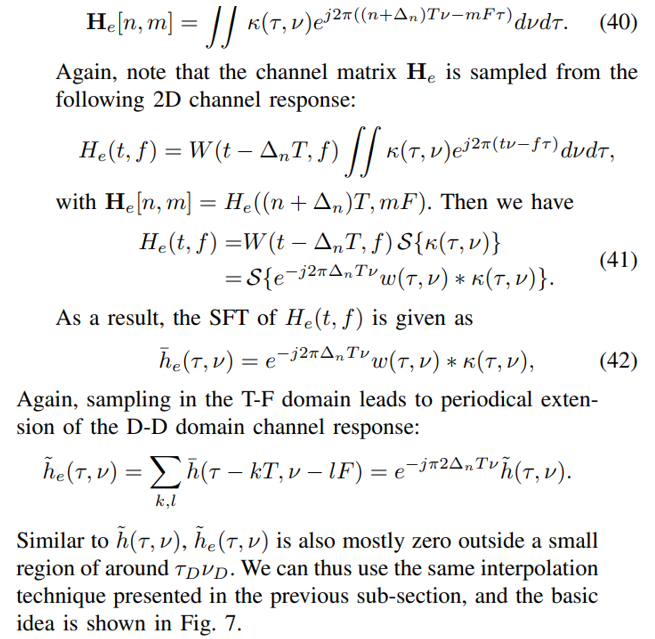
\
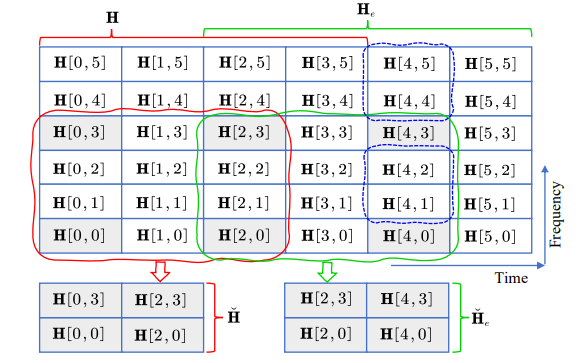
\ Fig. 7: Illustration of pipeline implementation of the channel interpolation, with N = 4, M = 6, LN = 2, LM = 3.
\

\ C. Channel Extrapolation and Tracking

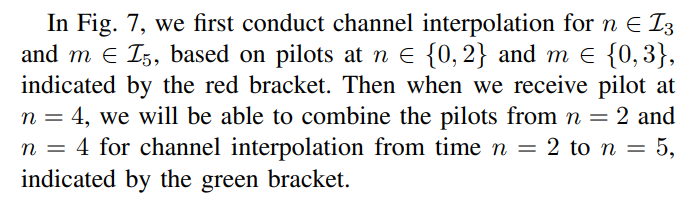
\ In Fig. 7, note that the data received at n = 4, i.e., encircled by the blue curves, cannot be demodulated immediately, because they have to wait for the pilot at time 4. However, based on the previous discussions, we should be able to use the previously estimated CSI for channel prediction. Specifically, we can employ the estimated CSI from time 1 and 3 for channel interpolation for time 1 to 4. From a different point of view, this is extrapolation. This also implies the possibility of channel tracking, and we further reduce the channel training overhead by inserting pilot less frequently. The idea is illustrated in Fig. 8.

\ Fig. 8: Data-aided channel extrapolation.
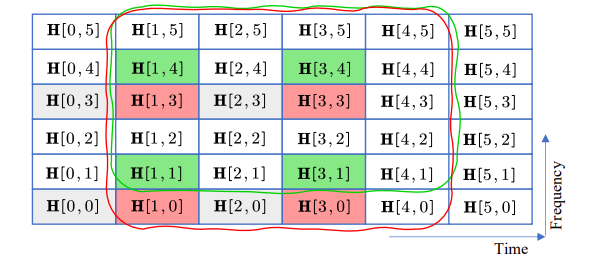
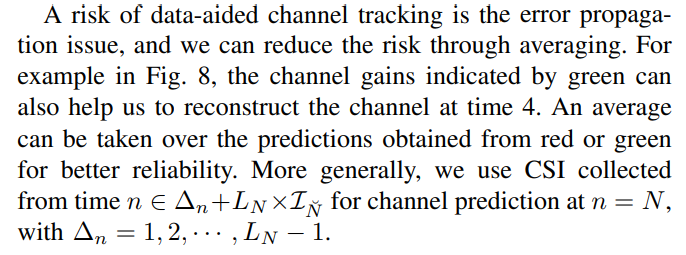
\ With pilot transmitted at time n = 0 and 2, frequency m = 0 and 3, channel interpolation can be conducted for time 0 ≤ n ≤ 3 and frequency 0 ≤ m ≤ 5. Then, we can use channel gains at n ∈ {1, 3}, m ∈ {0, 3}, i.e., the slots indexed by red, for channel interpolation between n = 1 and 4, encircled by red. We can thus estimate the channel gains at time 4 and 5, without waiting for the pilot. The processing delay can thus be further reduced to one symbol duration.

\
\

\ D. Error Analysis

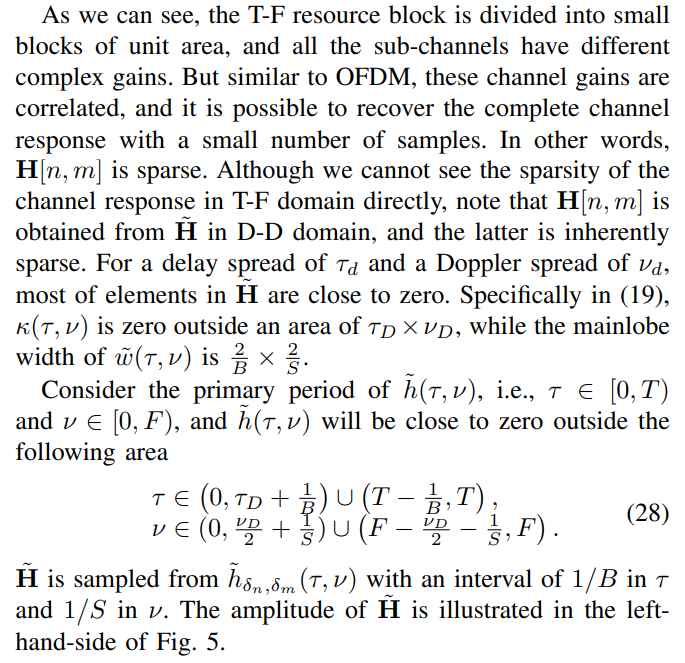
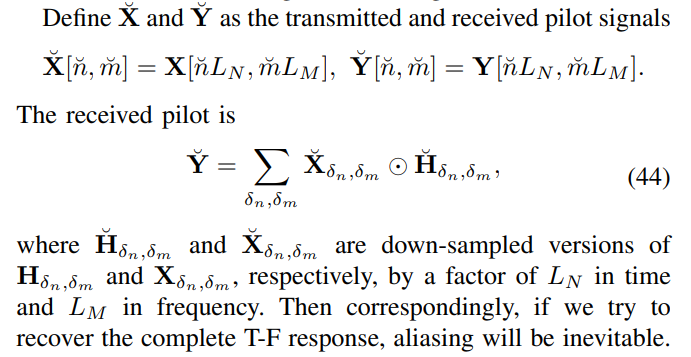
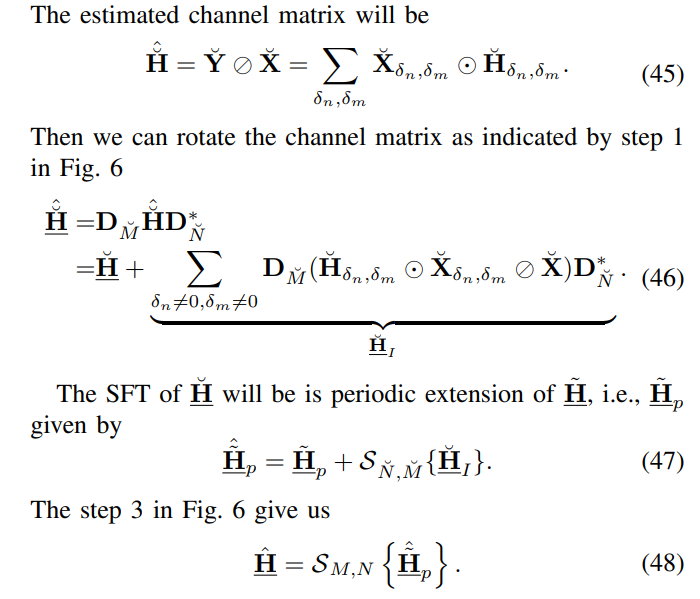
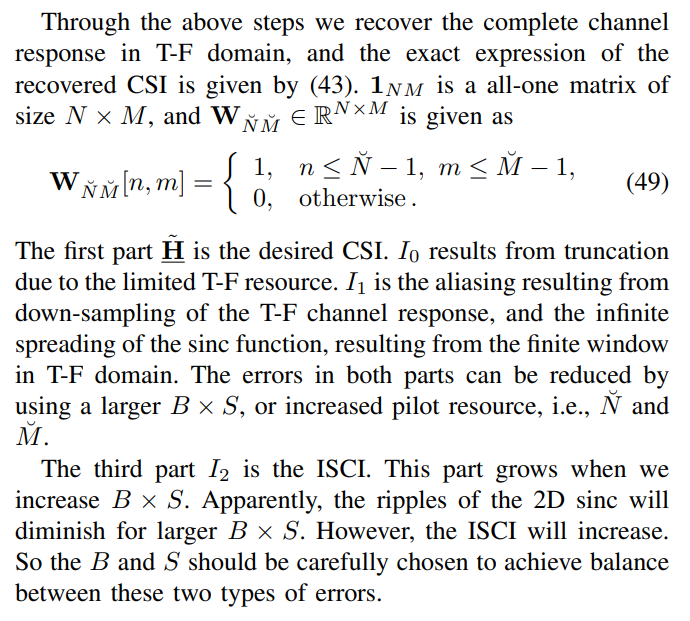
\ The interpolation inevitably leads to error, because the D-D domain channel has infinitely large spread due to the finite support in T-F domain, manifested by the 2D sinc function in D-D domain. Besides, the bi-orthogonality of the signal no longer holds after going through the doubly-dispersive channel. In this sub-section, we will try to quantify the channel estimation errors resulting from aliasing and ISCI

\
\
\
\

:::info Authors:

(1) Zijun Gong, Member, IEEE;

(2) Fan Jiang, Member, IEEE;

(3) Yuhui Song, Student Member, IEEE;

(4) Cheng Li, Senior Member, IEEE;

(5) Xiaofeng Tao, Senior Member, IEEE.

:::


:::info This paper is available on arxiv under CC BY-NC-ND 4.0 license.

:::

[6] Without loss of generality, we assume that M/LM and N/LN are integers. This can be guaranteed by choosing T and F properly.

Disclaimer: The articles reposted on this site are sourced from public platforms and are provided for informational purposes only. They do not necessarily reflect the views of MEXC. All rights remain with the original authors. If you believe any content infringes on third-party rights, please contact [email protected] for removal. MEXC makes no guarantees regarding the accuracy, completeness, or timeliness of the content and is not responsible for any actions taken based on the information provided. The content does not constitute financial, legal, or other professional advice, nor should it be considered a recommendation or endorsement by MEXC.

You May Also Like

Ripple (XRP) Pushes Upwards While One New Crypto Explodes in Popularity

Ripple (XRP) Pushes Upwards While One New Crypto Explodes in Popularity

The post Ripple (XRP) Pushes Upwards While One New Crypto Explodes in Popularity appeared on BitcoinEthereumNews.com. As Ripple (XRP) is slowly recovering through
Share
BitcoinEthereumNews2026/01/18 02:41
Polygon Tops RWA Rankings With $1.1B in Tokenized Assets

Polygon Tops RWA Rankings With $1.1B in Tokenized Assets

The post Polygon Tops RWA Rankings With $1.1B in Tokenized Assets appeared on BitcoinEthereumNews.com. Key Notes A new report from Dune and RWA.xyz highlights Polygon’s role in the growing RWA sector. Polygon PoS currently holds $1.13 billion in RWA Total Value Locked (TVL) across 269 assets. The network holds a 62% market share of tokenized global bonds, driven by European money market funds. The Polygon POL $0.25 24h volatility: 1.4% Market cap: $2.64 B Vol. 24h: $106.17 M network is securing a significant position in the rapidly growing tokenization space, now holding over $1.13 billion in total value locked (TVL) from Real World Assets (RWAs). This development comes as the network continues to evolve, recently deploying its major “Rio” upgrade on the Amoy testnet to enhance future scaling capabilities. This information comes from a new joint report on the state of the RWA market published on Sept. 17 by blockchain analytics firm Dune and data platform RWA.xyz. The focus on RWAs is intensifying across the industry, coinciding with events like the ongoing Real-World Asset Summit in New York. Sandeep Nailwal, CEO of the Polygon Foundation, highlighted the findings via a post on X, noting that the TVL is spread across 269 assets and 2,900 holders on the Polygon PoS chain. The Dune and https://t.co/W6WSFlHoQF report on RWA is out and it shows that RWA is happening on Polygon. Here are a few highlights: – Leading in Global Bonds: Polygon holds 62% share of tokenized global bonds (driven by Spiko’s euro MMF and Cashlink euro issues) – Spiko U.S.… — Sandeep | CEO, Polygon Foundation (※,※) (@sandeepnailwal) September 17, 2025 Key Trends From the 2025 RWA Report The joint publication, titled “RWA REPORT 2025,” offers a comprehensive look into the tokenized asset landscape, which it states has grown 224% since the start of 2024. The report identifies several key trends driving this expansion. According to…
Share
BitcoinEthereumNews2025/09/18 00:40
XRPL Validator Reveals Why He Just Vetoed New Amendment

XRPL Validator Reveals Why He Just Vetoed New Amendment

Vet has explained that he has decided to veto the Token Escrow amendment to prevent breaking things
Share
Coinstats2025/09/18 00:28