Ether aims at 3,400 as the liquidation of 2B approaches 3,000. Vitalik Buterin certifies the sharding milestone by way of PeerDAS implementation in the Fusaka upgrade. Ether is trading in a critical price area. The second-largest cryptocurrency in terms of market cap aims at the $3,300-3,400 resistance point. Breakouts will lead to powerful moves in […] The post Ethereum’s $3,400 Rally Faces $2B Liquidation Risk appeared first on Live Bitcoin News.Ether aims at 3,400 as the liquidation of 2B approaches 3,000. Vitalik Buterin certifies the sharding milestone by way of PeerDAS implementation in the Fusaka upgrade. Ether is trading in a critical price area. The second-largest cryptocurrency in terms of market cap aims at the $3,300-3,400 resistance point. Breakouts will lead to powerful moves in […] The post Ethereum’s $3,400 Rally Faces $2B Liquidation Risk appeared first on Live Bitcoin News.

Ethereum’s $3,400 Rally Faces $2B Liquidation Risk

2025/12/05 06:00

Ether aims at 3,400 as the liquidation of 2B approaches 3,000. Vitalik Buterin certifies the sharding milestone by way of PeerDAS implementation in the Fusaka upgrade.

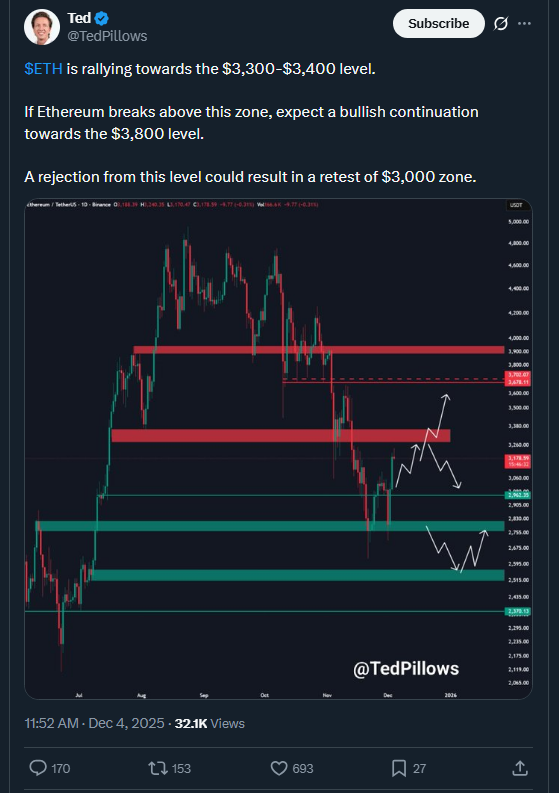
Ether is trading in a critical price area. The second-largest cryptocurrency in terms of market cap aims at the $3,300-3,400 resistance point. Breakouts will lead to powerful moves in the market.

Ted Pillows on X says that ETH is heading toward this critical range. The trader indicated that a breakout would result in bullish continuation. The subsequent target is at 3,800 in case the momentum prevails.
Ethereum's $3,400 Rally Faces $2B Liquidation Risk

Source:Ted Pillows on X 

Massive Liquidation Zone Threatens Market Stability

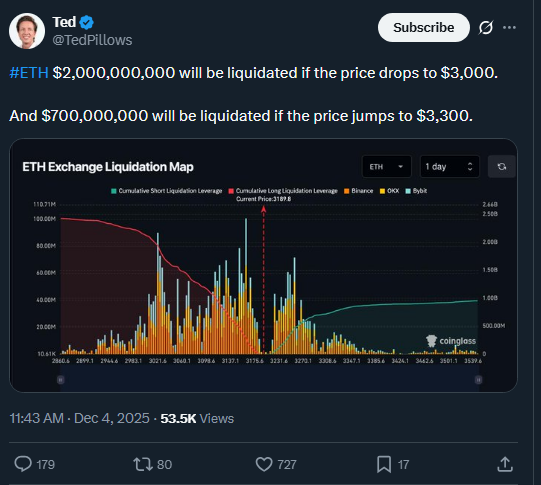
The stakes involved are unusually high for leveraged traders. On X, Ted Pillows disclosed that positions to the amount of $2 billion are being liquidated at $3,000. At $3,300, an extra 700 million would be erased.
Ethereum's $3,400 Rally Faces $2B Liquidation Risk

Source:  On X, Ted Pillows

These clusters of liquidation bring about volatile conditions. Either way, price action would be followed by cascading liquidations. These are the key levels that traders are following closely.

Any rejection of the $3,300-3,400 zone will take ETH back to $3,000. This retest would trigger the bigger liquidation event. The market players are getting ready to be more volatile.

You might also like: Ethereum News: Ethereum Whale Wakes: $120M Staked After 10 Years

Ethereum Achieves Decade-Long Sharding Dream

Vitalik Buterin made a radical announcement on X. The co-founder of Ethereum affirmed that PeerDAS in Fusaka is a real sharding implementation. This is the fulfilment of a dream that was set in 2015.

PeerDAS in Fusaka is notable in the sense that it is literally sharding, but Buterin said on X. Ethereum has achieved consensus on blocks without having individual nodes process whole datasets. Client-side probabilistic verification makes the system resistant against 51% attacks.

The data availability sampling process has been under development since 2017. A technology is eventually brought to the manufacturing stage after several years of research. This breakthrough was a fundamental blockchain design made by Ethereum researchers and core developers.

You might also like: Ethereum Sheds $6.4B in Leverage as Whales Buy Big

Three Gaps Remain in Sharding Implementation

Buterin described unfinished details of the existing sharding solution. The Ethereum L1 is currently not capable of executing O(c 2) transactions as Layer 2 solutions can. Mature ZK-EVMs are also required to implement scaling benefits to the base layer.

The proposer-builder bottleneck remains as a constraint. Builders now need to handle entire datasets and build complete blocks. This centralisation issue would be solved through distributed block building.

Ether has no sharded mempool yet. This aspect is still on the development pathway. The following two years will be devoted to the development of PeerDAS mechanisms.

Buterin further highlighted the importance regardless of such constraints. The system will grow gradually but in a stable manner. The upgrade will be an instant benefit to Layer 2 solutions. The technology will increase Ethereum L1 gas capacity when ZK-EVMs grow up.

The meeting of price action and technical accomplishments forms an intriguing point. Ether is threatened with short-term liquidation but is providing long-term scale-up. Both developments are being monitored by the market participants as the ecosystem transforms.

The post Ethereum’s $3,400 Rally Faces $2B Liquidation Risk appeared first on Live Bitcoin News.

Disclaimer: The articles reposted on this site are sourced from public platforms and are provided for informational purposes only. They do not necessarily reflect the views of MEXC. All rights remain with the original authors. If you believe any content infringes on third-party rights, please contact [email protected] for removal. MEXC makes no guarantees regarding the accuracy, completeness, or timeliness of the content and is not responsible for any actions taken based on the information provided. The content does not constitute financial, legal, or other professional advice, nor should it be considered a recommendation or endorsement by MEXC.

You May Also Like

New Viral Presale on XRPL: DeXRP Surpassed $6.4 Million

New Viral Presale on XRPL: DeXRP Surpassed $6.4 Million

The post New Viral Presale on XRPL: DeXRP Surpassed $6.4 Million  appeared on BitcoinEthereumNews.com. One of the most talked-about ecosystems in the cryptocurrency space is the XRP Ledger (XRPL), and DeXRP, the first Presale on XRPL, recently made headlines for its growth story. Attracting over 9,300 investors globally, the project has now raised over $6.4 million and is rapidly emerging as one of the most viral cryptocurrency launches of 2025. By integrating AMM and Order Book trading with a cutting-edge LP system and an open voting process for holders, DeXRP hopes to establish itself as the preferred trading destination for the XRPL community. What is DeXRP?  As the first decentralized exchange (DEX) based on XRPL, DeXRP is taking center stage as XRP continues to solidify its place in the global market. Massive expectation has been generated by the combination of DeXRP’s ambition for an advanced trading platform and XRPL’s established infrastructure, which is renowned for its quick transactions, cheap fees, and institutional-ready capabilities. In contrast to a lot of speculative presales, DeXRP’s development shows both institutional interest and community-driven momentum. Its early achievement of the $6.4 million milestone demonstrates how rapidly investors are realizing its potential. DeXRP Presale Success More than 9,300 distinct wallets have already joined the DeXRP presale, indicating a high level of interest from around the world. A crucial aspect is highlighted by the volume and variety of participation: DeXRP is not merely a niche project; rather, it is emerging as a major force in the XRPL ecosystem. DeXRP’s recent collaborations with WOW Earn and Micro3, as well as its sponsorship of the WOW Summit in Hong Kong, are also contributing factors to this uptick in investor confidence. These actions are blatant attempts to increase the company’s awareness among institutional players and crypto-native groups. The Forbes article summed it up: DeXRP is embedding credibility where others chase hype, marking it as…
Share
BitcoinEthereumNews2025/09/18 20:14
Headwind Helps Best Wallet Token

Headwind Helps Best Wallet Token

The post Headwind Helps Best Wallet Token appeared on BitcoinEthereumNews.com. Google has announced the launch of a new open-source protocol called Agent Payments Protocol (AP2) in partnership with Coinbase, the Ethereum Foundation, and 60 other organizations. This allows AI agents to make payments on behalf of users using various methods such as real-time bank transfers, credit and debit cards, and, most importantly, stablecoins. Let’s explore in detail what this could mean for the broader cryptocurrency markets, and also highlight a presale crypto (Best Wallet Token) that could explode as a result of this development. Google’s Push for Stablecoins Agent Payments Protocol (AP2) uses digital contracts known as ‘Intent Mandates’ and ‘Verifiable Credentials’ to ensure that AI agents undertake only those payments authorized by the user. Mandates, by the way, are cryptographically signed, tamper-proof digital contracts that act as verifiable proof of a user’s instruction. For example, let’s say you instruct an AI agent to never spend more than $200 in a single transaction. This instruction is written into an Intent Mandate, which serves as a digital contract. Now, whenever the AI agent tries to make a payment, it must present this mandate as proof of authorization, which will then be verified via the AP2 protocol. Alongside this, Google has also launched the A2A x402 extension to accelerate support for the Web3 ecosystem. This production-ready solution enables agent-based crypto payments and will help reshape the growth of cryptocurrency integration within the AP2 protocol. Google’s inclusion of stablecoins in AP2 is a massive vote of confidence in dollar-pegged cryptocurrencies and a huge step toward making them a mainstream payment option. This widens stablecoin usage beyond trading and speculation, positioning them at the center of the consumption economy. The recent enactment of the GENIUS Act in the U.S. gives stablecoins more structure and legal support. Imagine paying for things like data crawls, per-task…
Share
BitcoinEthereumNews2025/09/18 01:27