Spot XRP ETFs attracted $12.84M in a day while Bitcoin and Ethereum ETFs recorded net outflows. 21Shares’ TOXR fund began trading, adding a new U.S. spot XRP vehicle to existing BTC and ETH products. Spot XRP exchange-traded funds booked a combined daily net inflow of $12.84 million on Dec. 4, according to data from SoSoValue. [...]]]>Spot XRP ETFs attracted $12.84M in a day while Bitcoin and Ethereum ETFs recorded net outflows. 21Shares’ TOXR fund began trading, adding a new U.S. spot XRP vehicle to existing BTC and ETH products. Spot XRP exchange-traded funds booked a combined daily net inflow of $12.84 million on Dec. 4, according to data from SoSoValue. [...]]]>

XRP ETF Inflows Beat BTC and ETH ETFs, Signaling Rising Institutional Trust

2025/12/05 21:43
  • Spot XRP ETFs attracted $12.84M in a day while Bitcoin and Ethereum ETFs recorded net outflows.
  • 21Shares’ TOXR fund began trading, adding a new U.S. spot XRP vehicle to existing BTC and ETH products.

Spot XRP exchange-traded funds booked a combined daily net inflow of $12.84 million on Dec. 4, according to data from SoSoValue. The flows came as total net assets in the products reached about $881.25 million, with XRP trading near $2.11 that day.

Franklin Templeton’s XRPZ ETF led the net inflows, adding about $5.70 million. Bitwise’s spot XRP ETF followed with $3.76 million, while the remaining inflow split across smaller issuers, the data shows. The figures point to steady demand for XRP exposure through regulated fund vehicles rather than direct token purchases.

XRP ETF Daily Net Inflows Chart. Source: SoSoValueXRP ETF Daily Net Inflows Chart. Source: SoSoValue

Trading activity was also strong across the main XRP funds, based on numbers from XRP Insights. Bitwise’s XRP ETF recorded about $10.10 million in daily volume, while Canary’s ETF turned over $6.86 million. Franklin Templeton’s XRPZ product traded roughly $5.60 million, REX-Osprey’s ETF saw $3.67 million, and the Grayscale XRP fund reported $2.57 million, bringing total daily volume to $28.80 million.

Taken together, the inflow and volume data show that spot XRP ETFs are attracting fresh capital and active trading interest in the early phase of their launch.

Bitcoin and Ethereum ETF Flows Show Weakness as XRP ETFs Post Gains

Bitcoin and Ethereum ETF flows turned negative on Dec. 4, underscoring a sharp contrast with the positive inflows recorded by newly launched spot XRP products. The day’s data shows outflows across several major BTC and ETH issuers, even as XRP ETFs drew $12.84 million in net inflows.

Bitcoin ETFs recorded a combined outflow of about $194.6 million on Dec. 4. BlackRock’s IBIT added $113 million, yet the gains were outweighed by sizable redemptions from Fidelity’s FBTC, which saw $54.2 million in outflows, and Grayscale’s GBTC, which lost $10.1 million. The broader BTC group ended the session in negative territory, continuing a multi-day pattern of uneven demand.
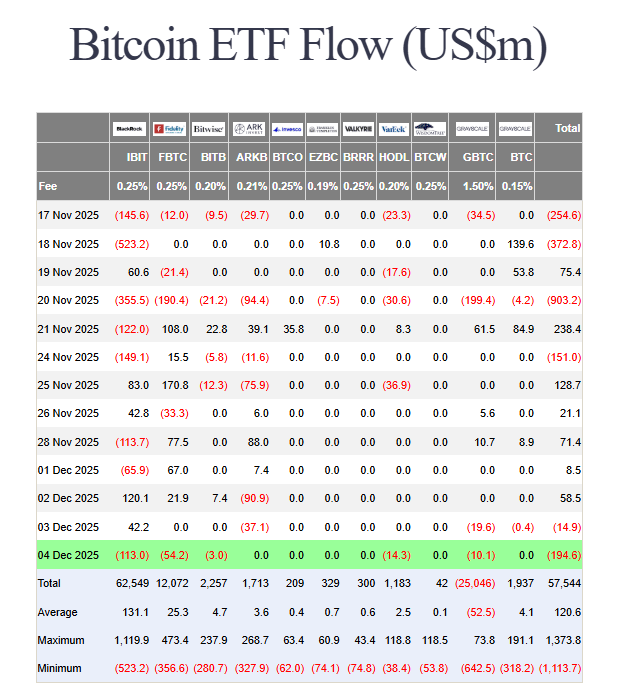
Bitcoin ETF Daily Flows Table. Source: Farside InvestorsBitcoin ETF Daily Flows Table. Source: Farside Investors

Ethereum ETFs followed the same direction. The category reported a total outflow of $41.5 million on Dec. 4, led by redemptions from Fidelity’s FETH fund, which saw $17.9 million leave. Grayscale’s ETHE and EZET also posted withdrawals of $31.0 million and $21.0 million, respectively. Even with modest inflows into smaller issuers, the group remained net negative for the day.

Ethereum ETF Daily Flows Table. Source: Farside InvestorsEthereum ETF Daily Flows Table. Source: Farside Investors

Against this backdrop, XRP ETFs stood out with clear net inflows and consistent early trading volume. The figures highlight a shift in investor flows across the three largest digital asset ETF categories, with XRP products gaining momentum while Bitcoin and Ethereum ETFs experienced renewed pressure.

21Shares U.S. Spot XRP ETF Debuted After SEC Green Light

21Shares’ U.S. spot XRP ETF began trading on Monday after the SEC cleared its 8-A filing dated Nov. 7, as previously mentioned in our report, which became effective following the standard review period. The fund, listed under the ticker TOXR, carried a 0.50% management fee and targeted $500,000 in initial capital.

It tracked the CME CF XRP–Dollar Reference Rate (XRPUSD_NY), calculated by a regulated benchmark provider, so investors gained direct exposure to XRP’s spot price through regular brokerage accounts.

]]>
Disclaimer: The articles reposted on this site are sourced from public platforms and are provided for informational purposes only. They do not necessarily reflect the views of MEXC. All rights remain with the original authors. If you believe any content infringes on third-party rights, please contact [email protected] for removal. MEXC makes no guarantees regarding the accuracy, completeness, or timeliness of the content and is not responsible for any actions taken based on the information provided. The content does not constitute financial, legal, or other professional advice, nor should it be considered a recommendation or endorsement by MEXC.

You May Also Like

Here’s How Consumers May Benefit From Lower Interest Rates

Here’s How Consumers May Benefit From Lower Interest Rates

The post Here’s How Consumers May Benefit From Lower Interest Rates appeared on BitcoinEthereumNews.com. Topline The Federal Reserve on Wednesday opted to ease interest rates for the first time in months, leading the way for potentially lower mortgage rates, bond yields and a likely boost to cryptocurrency over the coming weeks. Average long-term mortgage rates dropped to their lowest levels in months ahead of the central bank’s policy shift. Copyright{2018} The Associated Press. All rights reserved. Key Facts The central bank’s policymaking panel voted this week to lower interest rates, which have sat between 4.25% and 4.5% since December, to a new range of 4% and 4.25%. How Will Lower Interest Rates Impact Mortgage Rates? Mortgage rates tend to fall before and during a period of interest rate cuts: The average 30-year fixed-rate mortgage dropped to 6.35% from 6.5% last week, the lowest level since October 2024, mortgage buyer Freddie Mac reported. Borrowing costs on 15-year fixed-rate mortgages also dropped to 5.5% from 5.6% as they neared the year-ago rate of 5.27%. When the Federal Reserve lowered the funds rate to between 0% and 0.25% during the pandemic, 30-year mortgage rates hit record lows between 2.7% and 3% by the end of 2020, according to data published by Freddie Mac. Consumers who refinanced their mortgages in 2020 saved about $5.3 billion annually as rates dropped, according to the Consumer Financial Protection Bureau. Similarly, mortgage rates spiked around 7% as interest rates were hiked in 2022 and 2023, though mortgage rates appeared to react within weeks of the Fed opting to cut or raise rates. How Do Treasury Bonds Respond To Lower Interest Rates? Long-term Treasury yields are more directly influenced by interest rates, as lower rates tend to result in lower yields. When the Fed pushed rates to near zero during the pandemic, 10-year Treasury yields fell to an all-time low of 0.5%. As…
Share
BitcoinEthereumNews2025/09/18 05:59
The GENIUS Act Is Already Law. Banks Shouldn’t Try to Rewrite It Now

The GENIUS Act Is Already Law. Banks Shouldn’t Try to Rewrite It Now

The post The GENIUS Act Is Already Law. Banks Shouldn’t Try to Rewrite It Now appeared on BitcoinEthereumNews.com. Healthy competition drives innovation and better products for consumers; it is at the center of American economic leadership. Unfortunately, now that the bipartisan GENIUS Act has been signed into law, major legacy financial institutions seem to be having second thoughts about the innovations that stablecoins can bring to financial markets. Bank lobbying groups and public affairs teams have been peppering Congress with complaints about the law, urging members to reopen debate and introduce changes to the legislation that will ensure the stablecoin market doesn’t grow too quickly, protecting banks’ profits and stifling consumer choice. This reactionary response is both overblown and unnecessary. What legacy financial firms should do instead is embrace competition and offer exciting new products and services that consumers want, not try to kneecap emerging players through anti-innovation rules and regulations. The GENIUS Act was carefully designed with a thorough bipartisan process to strengthen consumer safeguards, ensure regulatory oversight, and preserve financial stability. Efforts to roll back its provisions are less about protecting families and more about protecting entrenched banking interests from the competition that helps ensure the U.S. banking system stays the strongest and most innovative in the world. Critics warn that allowing stablecoins to provide rewards could lead to massive deposit outflows from community banks, with figures as high as $6.6 trillion cited. But closer examination shows this fear is unfounded. A July 2025 analysis by consulting firm Charles River Associates found no statistically significant relationship between stablecoin adoption and community bank deposit outflows. In fact, the overwhelming majority of stablecoin reserves remain in the traditional financial system — either in commercial bank accounts or in short-term Treasuries — where they continue to support liquidity and credit in the broader U.S. economy. The dire estimates rely on unrealistic assumptions that every dollar of stablecoin issuance permanently…
Share
BitcoinEthereumNews2025/09/18 09:39