NEAR Protocol partners with ADI Chain to debut TravAI, where AI agents handle complete travel booking workflows from search to payment using crypto. The post NEAR, ADI Launch TravAI, an AI-Based Travel Booking Platform appeared first on Coinspeaker.NEAR Protocol partners with ADI Chain to debut TravAI, where AI agents handle complete travel booking workflows from search to payment using crypto. The post NEAR, ADI Launch TravAI, an AI-Based Travel Booking Platform appeared first on Coinspeaker.

NEAR, ADI Launch TravAI, an AI-Based Travel Booking Platform

2025/12/06 03:02

NEAR Protocol and ADI Chain have partnered to launch TravAI, a travel booking platform powered by AI agents and intent-based operations. The platform lets users tell an AI concierge where they want to go and when—the agent then searches providers, builds the itinerary, books everything, and completes payments without manual steps.

All transactions settle on ADI Chain, an enterprise-focused layer-2 blockchain. Users can pay with Bitcoin BTC $89 517 24h volatility: 2.6% Market cap: $1.79 T Vol. 24h: $49.53 B , Ethereum ETH $3 028 24h volatility: 2.9% Market cap: $365.48 B Vol. 24h: $28.05 B , Solana SOL $132.4 24h volatility: 5.1% Market cap: $74.11 B Vol. 24h: $5.04 B , or any other major token supported by NEAR Intents. The chain abstraction, intent-based protocol powered by the NEAR stack handles the cross-chain conversion behind the scenes, according to the official announcement on the NEAR blog published on December 5.

TravAI is developed and operated by Datrics, while ADI Chain comes from Sirius International, the digital arm of UAE-listed IHC. The partnership targets both corporate travel teams and frequent individual travelers looking for faster, auditable booking flows.

NEAR co-founder Illia Polosukhin called the launch the arrival of “agentic commerce” that solves real-world problems. He highlighted fully automated planning-to-payment workflow in a post on X on the same day of the launch.

NEAR AI Initiatives and Price Analysis

The release follows NEAR’s recent push into AI tools. On December 3, the NEAR Foundation rolled out AI Cloud and Private Chat features with hardware-backed privacy, already adopted by projects reaching over 100 million users, according to Coinspeaker.

NEAR Intents, the cross-chain engine powering TravAI payments, has processed more than $7 billion in volume since launch, data showed earlier this week.

Nevertheless, NEAR NEAR $1.69 24h volatility: 5.3% Market cap: $2.16 B Vol. 24h: $198.77 M price remains in bearish territory, presenting a significant divergence from all the recent bullish news and fundamentals. To mention NEAR’s partnership with Brave, the leading privacy-focused web browser, and Kalshi, the leading US-based prediction market that started supporting NEAR payments.

As of this writing, the digital asset is trading outside a year-long price range, below this range’s support at $1.67 per token.
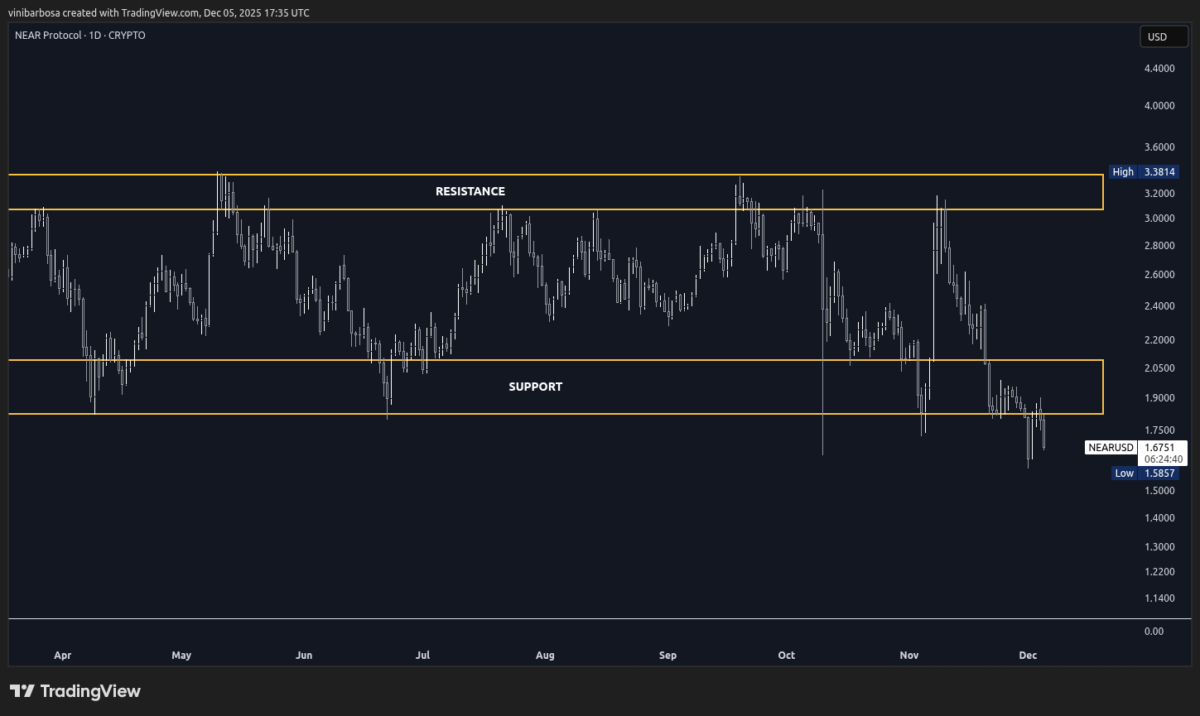
NEAR price chart (1D), as of December 5, 2025 | Source: TradingView

NEAR price chart (1D), as of December 5, 2025 | Source: TradingView

TravAI is currently inviting users to join the waitlist, with enterprise solutions also available.

next

The post NEAR, ADI Launch TravAI, an AI-Based Travel Booking Platform appeared first on Coinspeaker.

Disclaimer: The articles reposted on this site are sourced from public platforms and are provided for informational purposes only. They do not necessarily reflect the views of MEXC. All rights remain with the original authors. If you believe any content infringes on third-party rights, please contact [email protected] for removal. MEXC makes no guarantees regarding the accuracy, completeness, or timeliness of the content and is not responsible for any actions taken based on the information provided. The content does not constitute financial, legal, or other professional advice, nor should it be considered a recommendation or endorsement by MEXC.

You May Also Like

Maryland Man Sentenced for Allegedly Aiding North Korea’s US Company Infiltration and Sensitive Data Access

Maryland Man Sentenced for Allegedly Aiding North Korea’s US Company Infiltration and Sensitive Data Access

The post Maryland Man Sentenced for Allegedly Aiding North Korea’s US Company Infiltration and Sensitive Data Access appeared on BitcoinEthereumNews.com. North Korea’s IT workers infiltrated US companies through a Maryland man’s scheme, earning over $970,000 while enabling access to sensitive government systems. This operation supported the regime’s cyber activities, including crypto hacks that stole $2 billion in 2025, funding nuclear programs. Minh Phuong Ngoc Vong sentenced to 15 months in prison for aiding North Korean infiltration. He used fake credentials to secure jobs at 13 US firms, passing work to overseas conspirators. North Korea stole $2 billion in crypto in 2025 via hacks, totaling over $6 billion recently, per blockchain analytics firm Elliptic. Discover how North Korea’s IT infiltration and crypto hacking schemes threaten US security. Learn the details of the Maryland case and regime’s $6B theft. Stay informed on cybersecurity risks today. What is North Korea’s IT Infiltration Scheme in US Companies? North Korea’s IT infiltration scheme involves covertly placing regime-affiliated workers into US companies using fake identities to generate revenue and access sensitive systems. In a recent Maryland case, Minh Phuong Ngoc Vong was sentenced to 15 months in prison and three years of supervised release for facilitating this for three years across 13 companies. The operation netted over $970,000, much of which funded North Korea’s weapons programs through software work performed by overseas actors, including those in China near the border. How Does North Korea Use Crypto Hacking to Fund Its Programs? North Korea employs sophisticated cyber groups to target cryptocurrency exchanges and wallets, stealing digital assets that convert to fiat for regime funding. According to blockchain analytics firm Elliptic, these groups pilfered approximately $2 billion in cryptocurrencies in 2025 alone, contributing to a total exceeding $6 billion in recent years from hacks on platforms like Bybit and Upbit. This influx directly supports nuclear and missile development, as confirmed by US intelligence assessments. Experts note the regime’s…
Share
BitcoinEthereumNews2025/12/06 09:12