US National Security Strategy Omits Cryptocurrency Focus Amid Growing Industry Ties The recent US national security strategy unveiled under the Trump administration notably excludes any direct references to cryptocurrency or blockchain technology, despite the industry’s increasingly significant role in global finance and the administration’s concerns about international competition. Instead, the strategy emphasizes advancements in artificial [...]US National Security Strategy Omits Cryptocurrency Focus Amid Growing Industry Ties The recent US national security strategy unveiled under the Trump administration notably excludes any direct references to cryptocurrency or blockchain technology, despite the industry’s increasingly significant role in global finance and the administration’s concerns about international competition. Instead, the strategy emphasizes advancements in artificial [...]

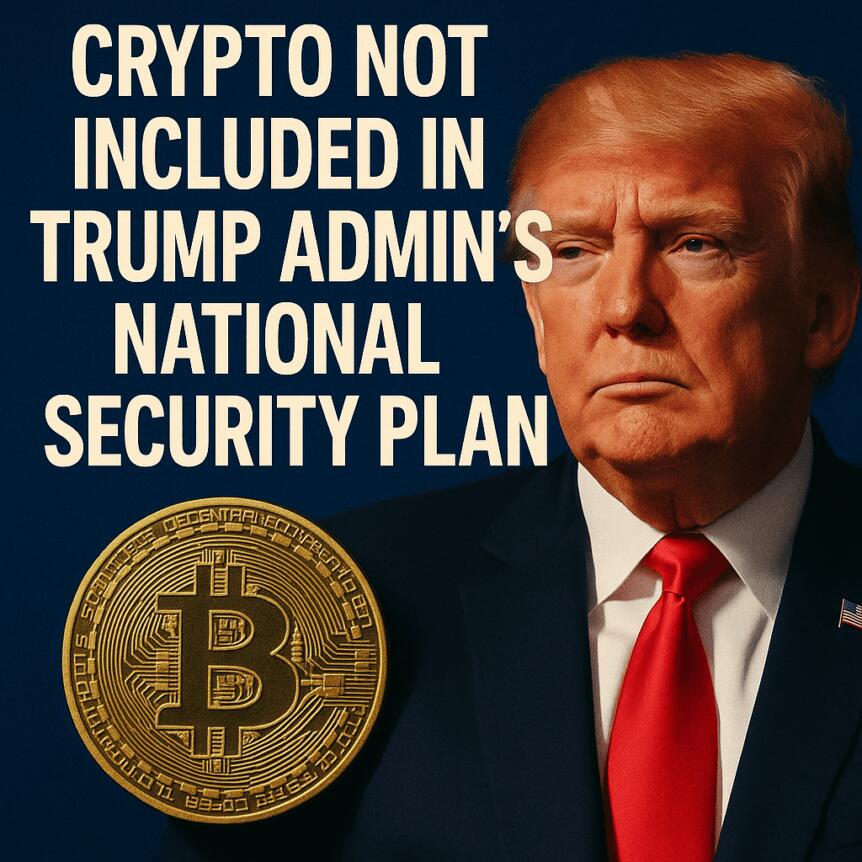
Crypto Not Included in Trump Admin’s National Security Plan
2025/12/08 11:15
Crypto Not Included In Trump Admin’s National Security Plan

US National Security Strategy Omits Cryptocurrency Focus Amid Growing Industry Ties

The recent US national security strategy unveiled under the Trump administration notably excludes any direct references to cryptocurrency or blockchain technology, despite the industry’s increasingly significant role in global finance and the administration’s concerns about international competition. Instead, the strategy emphasizes advancements in artificial intelligence and quantum computing as the nation’s primary technological priorities.

The document states that the United States intends to leverage its leadership in AI, biotech, and quantum information sciences to drive global innovation. While crypto is absent from the main script, a notable mention hints at potential future initiatives related to the country’s financial sector.

Despite the strategic silence on crypto, former President Trump publicly articulated a desire to position the US as a leader in digital assets. Last month, in an interview with CBS’ 60 Minutes, Trump expressed a preference to prevent China from dominating the cryptocurrency space and advocated for Bitcoin mining to be confined within U.S. borders. Similarly, CIA deputy director Michael Ellis highlighted the importance of technological competition with China in the crypto realm during a May interview.

Interestingly, the strategy document alludes to preserving and expanding America’s dominance in the financial sector, emphasizing leadership in digital finance and innovation to ensure market liquidity and security. An excerpt from the document, highlighted in a whitehouse.gov publication, states, “We want to ensure that U.S. technology and U.S. standards… drive the world forward,” which could be interpreted as a subtle nod toward the potential prioritization of crypto and digital finance initiatives.

A highlighted excerpt of the document indicates the US aims to grow its “financial sector dominance.” Source: The White House

Trump Administration Advances Cryptocurrency Policies

This year, the Trump administration has demonstrated a proactive stance toward cryptocurrency regulation, implementing policies to boost its adoption within the financial ecosystem. Notably, it played a key role in passing the GENIUS Act—focusing on stablecoin regulation—and signed executive orders to establish a crypto task force, while explicitly opposing a central bank digital currency (CBDC). Federal agencies under his leadership have also shifted away from enforcement actions that previously targeted crypto firms.

Government holdings of digital assets have increased, with the establishment of a Bitcoin reserve comprising forfeited digital assets. Efforts are underway to explore “budget-neutral” strategies to expand these reserves further. The market responded to the release of the national security strategy with Bitcoin prices dipping below $90,000, amid broader geopolitical calls for increased defense spending by US allies and NATO nations, potentially impacting inflation and monetary policy.

Crypto markets continue to be influenced by the Federal Reserve’s interest rate decisions, with market participants betting heavily on a rate cut during the upcoming meetings. The consensus anticipates a 25 basis point reduction, which historically encourages investors to increase risk exposure, benefiting cryptocurrency prices.

As the macroeconomic environment remains uncertain, the interplay between geopolitics, fiscal policy, and digital assets continues to shape the evolving landscape—highlighting the complex relationship between national security and the crypto industry.

This article was originally published as Crypto Not Included in Trump Admin’s National Security Plan on Crypto Breaking News – your trusted source for crypto news, Bitcoin news, and blockchain updates.

Disclaimer: The articles reposted on this site are sourced from public platforms and are provided for informational purposes only. They do not necessarily reflect the views of MEXC. All rights remain with the original authors. If you believe any content infringes on third-party rights, please contact [email protected] for removal. MEXC makes no guarantees regarding the accuracy, completeness, or timeliness of the content and is not responsible for any actions taken based on the information provided. The content does not constitute financial, legal, or other professional advice, nor should it be considered a recommendation or endorsement by MEXC.

You May Also Like

CME Group to launch options on XRP and SOL futures

CME Group to launch options on XRP and SOL futures

The post CME Group to launch options on XRP and SOL futures appeared on BitcoinEthereumNews.com. CME Group will offer options based on the derivative markets on Solana (SOL) and XRP. The new markets will open on October 13, after regulatory approval.  CME Group will expand its crypto products with options on the futures markets of Solana (SOL) and XRP. The futures market will start on October 13, after regulatory review and approval.  The options will allow the trading of MicroSol, XRP, and MicroXRP futures, with expiry dates available every business day, monthly, and quarterly. The new products will be added to the existing BTC and ETH options markets. ‘The launch of these options contracts builds on the significant growth and increasing liquidity we have seen across our suite of Solana and XRP futures,’ said Giovanni Vicioso, CME Group Global Head of Cryptocurrency Products. The options contracts will have two main sizes, tracking the futures contracts. The new market will be suitable for sophisticated institutional traders, as well as active individual traders. The addition of options markets singles out XRP and SOL as liquid enough to offer the potential to bet on a market direction.  The options on futures arrive a few months after the launch of SOL futures. Both SOL and XRP had peak volumes in August, though XRP activity has slowed down in September. XRP and SOL options to tap both institutions and active traders Crypto options are one of the indicators of market attitudes, with XRP and SOL receiving a new way to gauge sentiment. The contracts will be supported by the Cumberland team.  ‘As one of the biggest liquidity providers in the ecosystem, the Cumberland team is excited to support CME Group’s continued expansion of crypto offerings,’ said Roman Makarov, Head of Cumberland Options Trading at DRW. ‘The launch of options on Solana and XRP futures is the latest example of the…
Share
BitcoinEthereumNews2025/09/18 00:56
SEC Approves Decision Concerning Bitcoin and 9 Altcoins – The Dow Jones of Cryptocurrencies May Have Arrived

SEC Approves Decision Concerning Bitcoin and 9 Altcoins – The Dow Jones of Cryptocurrencies May Have Arrived

The post SEC Approves Decision Concerning Bitcoin and 9 Altcoins – The Dow Jones of Cryptocurrencies May Have Arrived appeared on BitcoinEthereumNews.com. While the cryptocurrency market doesn’t yet have a comprehensive index like the Dow Jones or S&P 500, Bitwise is one step closer to filling this void. The company’s new exchange-traded product, Bitwise 10 Crypto Index ETF (BITW), has begun trading, offering individual investors and financial advisors access to the 10 largest crypto assets in a single product. BITW’s portfolio includes the following digital assets: Bitcoin, Ethereum, XRP, Solana, Chainlink, Litecoin, Cardano, Avalanche, Sui, and Polkadot. Bitwise CEO and co-founder Hunter Horsley told CNBC that this conversion makes the company the first to include altcoins like Cardano, Avalanche, Sui, and Polkadot, which don’t currently have spot ETFs, in an ETF from a major asset manager. “This step significantly broadens the investor base that can access various crypto assets,” Horsley said. “This is particularly important for assets without a spot ETF.” According to the CEO, this ETF also provides significant accessibility for smaller investors who invest through individual retirement accounts (IRAs) or pension funds and are only able to access ETFs. BITW, previously an index fund containing the same assets, has been converted to an ETF and is now listed on the stock exchange with $1.5 billion in assets under management. The ETF structure provides additional benefits to investors by offering greater trading flexibility, tax advantages, and lower costs, along with broader trading permissions. This development follows an expanded wave of ETFs that followed the U.S. Securities and Exchange Commission (SEC) approval of spot Bitcoin ETFs in January 2024. Since then, asset managers have sought approval for a wider range of ETFs, from altcoins like Sui and Aptos to Trump-themed tokens and memecoins like Dogecoin. However, as the market matures, crypto assets are beginning to take on their own dynamics, suggesting that broad-based products like BITW could offer a diversification tool similar…
Share
BitcoinEthereumNews2025/12/10 06:40

