JPMorgan CEO Jamie Dimon Addresses Allegations of Debanking and Calls for Regulatory Reform Jamie Dimon, CEO of JPMorgan Chase, has firmly contested claims that the banking giant debanks customers based on their political or religious affiliations. In a recent interview, he emphasized ongoing efforts to reform the rules governing bank account closures, highlighting that the [...]JPMorgan CEO Jamie Dimon Addresses Allegations of Debanking and Calls for Regulatory Reform Jamie Dimon, CEO of JPMorgan Chase, has firmly contested claims that the banking giant debanks customers based on their political or religious affiliations. In a recent interview, he emphasized ongoing efforts to reform the rules governing bank account closures, highlighting that the [...]

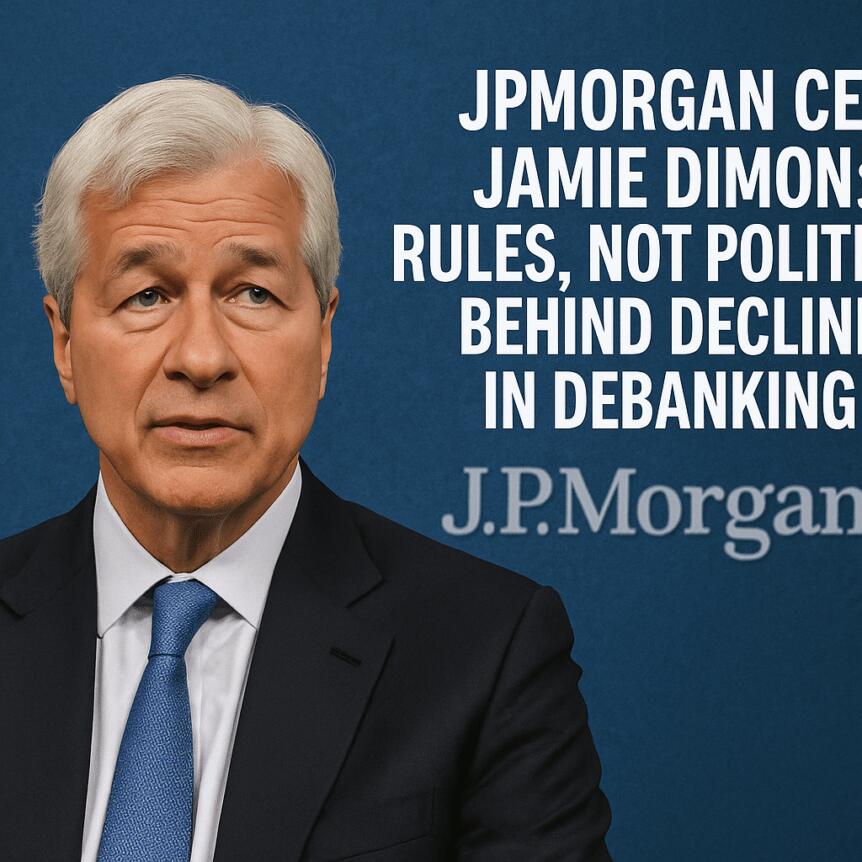
JPMorgan CEO Jamie Dimon: Rules, Not Politics, Behind Decline in Debanking
2025/12/08 13:16
Jpmorgan Ceo Jamie Dimon: Rules, Not Politics, Behind Decline In Debanking

JPMorgan CEO Jamie Dimon Addresses Allegations of Debanking and Calls for Regulatory Reform

Jamie Dimon, CEO of JPMorgan Chase, has firmly contested claims that the banking giant debanks customers based on their political or religious affiliations. In a recent interview, he emphasized ongoing efforts to reform the rules governing bank account closures, highlighting that the bank’s actions are driven by compliance and risk management rather than discrimination.

Key Takeaways

  • Dimon denies any political or religious bias in JPMorgan’s debanking practices.
  • Industry figures and political figures have raised concerns about politically motivated account closures.
  • Dimon calls for regulatory changes to address perceived overreach and improve transparency.
  • He criticizes both political parties for pressuring banks, emphasizing the need for balanced policies.

Tickers mentioned: None

Sentiment: Neutral

Price impact: Neutral, as the statements aim to clarify practices rather than influence market sentiment directly.

Trading idea (Not Financial Advice): Hold, as regulatory and industry concerns about debanking are likely to prompt policy discussions without immediate impact on banking stocks.

Market context: The broader financial sector is scrutinizing practices around account closures amid rising political and regulatory tensions, especially in the evolving crypto landscape.

JPMorgan CEO Clarifies Debanking Practices

During a Sunday interview with Fox News’ “Sunday Morning Futures,” Jamie Dimon addressed recent allegations of political and religious bias in JPMorgan Chase’s banking operations. The bank has been accused by various industry insiders and political figures of debanking individuals and organizations linked to certain political groups or religious backgrounds, often amid discussions surrounding free speech and political expression.

Dimon stated, “We do debank people, but it’s never for religious or political reasons. We have debanked individuals from both major parties and various faiths, but never because of their affiliations.” He emphasized that the bank’s actions are driven by compliance and risk considerations, not discrimination. “We cannot discuss specific accounts,” he added, “but our policies are not biased.”

Calls for Regulatory Reform

Dimon expressed support for legislative efforts aimed at reforming the rules surrounding bank account closures, citing the need for clearer regulations to prevent perceived overreach. “I’ve been advocating for rule changes for 15 years,” he remarked. “We should focus on making the system more customer-friendly and transparent.”

He also criticized the political pressures that can influence banking practices, noting, “Both Democratic and Republican administrations have pressured banks. It’s time for the government to step back and allow banks to operate without undue influence.”

Industry Concerns and Broader Implications

The debate over debanking is particularly relevant in the context of the cryptocurrency industry, which has faced ongoing challenges with account closures and service denials from traditional banks. Critics argue that these actions are part of a wider effort to suppress digital assets.

Furthermore, in August, President Donald Trump signed an executive order directing regulators to investigate claims of politically motivated banking decisions. Meanwhile, industry leaders like Jack Mallers, CEO of Strike, have reported unexplained closures of personal accounts, fueling fears of “Operation Chokepoint 2.0”—an alleged campaign to limit financial services for certain sectors.

Looking Ahead

As discussions about banking practices continue, JPMorgan’s stance and Dimon’s calls for regulatory reform underscore the growing tension between financial compliance and political independence. Industry observers suggest that future regulatory changes could reshape how banks address politically sensitive issues and account closures in the digital age.

This article was originally published as JPMorgan CEO Jamie Dimon: Rules, Not Politics, Behind Decline in Debanking on Crypto Breaking News – your trusted source for crypto news, Bitcoin news, and blockchain updates.

Disclaimer: The articles reposted on this site are sourced from public platforms and are provided for informational purposes only. They do not necessarily reflect the views of MEXC. All rights remain with the original authors. If you believe any content infringes on third-party rights, please contact [email protected] for removal. MEXC makes no guarantees regarding the accuracy, completeness, or timeliness of the content and is not responsible for any actions taken based on the information provided. The content does not constitute financial, legal, or other professional advice, nor should it be considered a recommendation or endorsement by MEXC.

You May Also Like

Headwind Helps Best Wallet Token

Headwind Helps Best Wallet Token

The post Headwind Helps Best Wallet Token appeared on BitcoinEthereumNews.com. Google has announced the launch of a new open-source protocol called Agent Payments Protocol (AP2) in partnership with Coinbase, the Ethereum Foundation, and 60 other organizations. This allows AI agents to make payments on behalf of users using various methods such as real-time bank transfers, credit and debit cards, and, most importantly, stablecoins. Let’s explore in detail what this could mean for the broader cryptocurrency markets, and also highlight a presale crypto (Best Wallet Token) that could explode as a result of this development. Google’s Push for Stablecoins Agent Payments Protocol (AP2) uses digital contracts known as ‘Intent Mandates’ and ‘Verifiable Credentials’ to ensure that AI agents undertake only those payments authorized by the user. Mandates, by the way, are cryptographically signed, tamper-proof digital contracts that act as verifiable proof of a user’s instruction. For example, let’s say you instruct an AI agent to never spend more than $200 in a single transaction. This instruction is written into an Intent Mandate, which serves as a digital contract. Now, whenever the AI agent tries to make a payment, it must present this mandate as proof of authorization, which will then be verified via the AP2 protocol. Alongside this, Google has also launched the A2A x402 extension to accelerate support for the Web3 ecosystem. This production-ready solution enables agent-based crypto payments and will help reshape the growth of cryptocurrency integration within the AP2 protocol. Google’s inclusion of stablecoins in AP2 is a massive vote of confidence in dollar-pegged cryptocurrencies and a huge step toward making them a mainstream payment option. This widens stablecoin usage beyond trading and speculation, positioning them at the center of the consumption economy. The recent enactment of the GENIUS Act in the U.S. gives stablecoins more structure and legal support. Imagine paying for things like data crawls, per-task…
Share
BitcoinEthereumNews2025/09/18 01:27
Bitcoin devs cheer block reconstruction stats, ignore security budget concerns

Bitcoin devs cheer block reconstruction stats, ignore security budget concerns

The post Bitcoin devs cheer block reconstruction stats, ignore security budget concerns appeared on BitcoinEthereumNews.com. This morning, Bitcoin Core developers celebrated improved block reconstruction statistics for node operators while conveniently ignoring the reason for these statistics — the downward trend in fees for Bitcoin’s security budget. Reacting with heart emojis and thumbs up to a green chart showing over 80% “successful compact block reconstructions without any requested transactions,” they conveniently omitted red trend lines of the fees that Bitcoin users pay for mining security which powered those green statistics. Block reconstructions occur when a node requests additional information about transactions within a compact block. Although compact blocks allow nodes to quickly relay valid bundles of transactions across the internet, the more frequently that nodes can reconstruct without extra, cumbersome transaction requests from their peers is a positive trend. Because so many nodes switched over in August to relay transactions bidding 0.1 sat/vB across their mempools, nodes now have to request less transaction data to reconstruct blocks containing sub-1 sat/vB transactions. After nodes switched over in August to accept and relay pending transactions bidding less than 1 sat/vB, disparate mempools became harmonized as most nodes had a better view of which transactions would likely join upcoming blocks. As a result, block reconstruction times improved, as nodes needed less information about these sub-1 sat/vB transactions. In July, several miners admitted that user demand for Bitcoin blockspace had persisted at such a low that they were willing to accept transaction fees of just 0.1 satoshi per virtual byte — 90% lower than their prior 1 sat/vB minimum. With so many blocks partially empty, they succumbed to the temptation to accept at least something — even 1 billionth of one bitcoin (BTC) — rather than $0 to fill up some of the excess blockspace. Read more: Bitcoin’s transaction fees have fallen to a multi-year low Green stats for block reconstruction after transaction fees crash After…
Share
BitcoinEthereumNews2025/09/18 04:07