A new a16z crypto research paper argues that apocalyptic narratives about quantum computers instantly killing Bitcoin are badly misaligned with reality, and that the real risk for blockchains lies in long, messy migrations rather than a sudden “Q-Day” collapse. The piece has already triggered a sharp rebuttal on X from investors who say the threat […]A new a16z crypto research paper argues that apocalyptic narratives about quantum computers instantly killing Bitcoin are badly misaligned with reality, and that the real risk for blockchains lies in long, messy migrations rather than a sudden “Q-Day” collapse. The piece has already triggered a sharp rebuttal on X from investors who say the threat […]

Bitcoin Quantum ‘Doomsday’ Fears Are Overblown, a16z Research Says

2025/12/08 15:00

A new a16z crypto research paper argues that apocalyptic narratives about quantum computers instantly killing Bitcoin are badly misaligned with reality, and that the real risk for blockchains lies in long, messy migrations rather than a sudden “Q-Day” collapse. The piece has already triggered a sharp rebuttal on X from investors who say the threat is closer and harder than a16z suggests.

Bitcoin Isn’t Doomed By Quantum Computing: a16z

In the article “Quantum computing and blockchains: Matching urgency to actual threats,” a16z research partner and Georgetown computer science professor Justin Thaler sets the tone early, writing that “Timelines to a cryptographically relevant quantum computer are frequently overstated — leading to calls for urgent, wholesale transitions to post-quantum cryptography.” He argues that this hype distorts cost–benefit analyses and distracts teams from more immediate risks such as implementation bugs.

Thaler defines a “cryptographically relevant quantum computer” (CRQC) as a fully error-corrected machine capable of running Shor’s algorithm at a scale where it can break RSA-2048 or elliptic-curve schemes like secp256k1 in roughly a month of runtime. In his assessment, a CRQC in the 2020s is “highly unlikely,” and public milestones do not justify claims that such a system is probable before 2030.

He stresses that across trapped-ion, superconducting and neutral-atom platforms, no device is close to the hundreds of thousands to millions of physical qubits, with the required error rates and circuit depth, that would be needed for cryptanalysis.

Instead, the a16z piece draws a sharp line between encryption and signatures. Thaler argues that harvest-now-decrypt-later (HNDL) attacks already make post-quantum encryption urgent for data that must remain confidential for decades, which is why large providers are rolling out hybrid post-quantum key establishment in TLS and messaging.

But he insists that signatures, including those securing Bitcoin and Ethereum, face a different calculus: they do not protect hidden data that can be retroactively decrypted, and once a CRQC exists, the attacker can only forge signatures going forward.

On that basis, the paper claims that “most non-privacy chains” are not exposed to HNDL-style quantum risk at the protocol level, because their ledgers are already public; the relevant attack is forging signatures to steal funds, not decrypting on-chain data.

Bitcoin-Specific Headaches

Thaler still flags Bitcoin as having “special headaches” due to slow governance, limited throughput and large pools of exposed, potentially abandoned coins whose public keys are already on-chain, but he frames the time window for a serious attack in terms of at least a decade, not a few years.

“Bitcoin changes slowly. Any contentious issues could trigger a damaging hard fork if the community cannot agree on the appropriate solution,” Thaler writes, adding “another concern is that Bitcoin’s switch to post-quantum signatures cannot be a passive migration: Owners must actively migrate their coins.”

Moreover, Thalen flags a “final issue specific to Bitcoin” which is its low transaction throughput. “Even once migration plans are finalized, migrating all quantum-vulnerable funds to post-quantum-secure addresses would take months at Bitcoin’s current transaction rate,” Thaler says.

He is equally skeptical of rushing into post-quantum signature schemes at the base-layer. Hash-based signatures are conservative but extremely large, often several kilobytes, while lattice-based schemes such as NIST’s ML-DSA and Falcon are compact but complex and have already produced multiple side-channel and fault-injection vulnerabilities in real-world implementations. Thaler warns that blockchains risk weakening their security if they jump too early into immature post-quantum primitives under headline pressure.

Industry Split On The Risk

The most forceful pushback has come from Castle Island Ventures co-founder Nic Carter and Project 11 CEO Alex Pruden. Carter summed up his view on X by saying the a16z work “wildly underestimates the nature of the threat and overestimates the time we have to prepare,” pointing followers to a long thread from Pruden.

Pruden begins by stressing respect for Thaler and the a16z team, but adds, “I disagree with the argument that quantum computing is not an urgent problem for blockchains. The threat is closer, the progress faster, and the fix harder than how he’s framing it & than most people realize.”

He argues that recent technical results, not marketing, should anchor the discussion. Citing neutral-atom systems that now support more than 6,000 physical qubits, Pruden points out that “we now have a non annealing system with more than 6000 physical qubits in the neutral atom architecture,” directly contradicting any implication that only non-scalable annealing architectures have reached that scale. He notes that work such as Caltech’s 6,100-qubit tweezer array shows large, coherent, room-temperature neutral-atom platforms are already a reality.

On error correction, Pruden writes that “surface code error correction was experimentally demonstrated last year, moving it from a research problem into an engineering problem,” and points to rapid advances in color codes and LDPC codes.

He highlights Google’s updated “Tracking the Cost of Quantum Factoring” estimates, which show that a quantum computer with about one million noisy physical qubits running for roughly a week could, in principle, break RSA-2048 — a twenty-fold reduction from Google’s own 2019 estimate of twenty million qubits. “Resource estimates for a CRQC running Shor’s algorithm have dropped by two orders of magnitude in six months,” he notes, concluding, “To say that this trajectory of progress might potentially deliver a quantum computer before 2030 is not an overstatement.”

Where Thaler emphasizes HNDL as an encryption problem, Pruden reframes blockchains as uniquely attractive quantum targets. He stresses that “public keys used in digital signatures are just as easy to harvest as encrypted messages,” but in blockchains those keys are directly tied to visible value. He points out that “these public keys are distributed & directly associated with value ($150B for Satoshi’s BTC alone),” and that once a quantum adversary can forge signatures, “If you can forge a signature, you can steal the asset regardless of when that original UTXO/account was created.”

For Pruden, this economic reality means “the economic incentives simply and clearly point to blockchains as being the first cryptographically relevant quantum use case,” even if other sectors also face HNDL risks. He adds that “blockchains will be far slower to migrate than centralized systems. A bank can upgrade its stack. Blockchains must reach global consensus, absorb performance trade-offs from PQ signatures, and coordinate millions of users to migrate their keys.”

Invoking Ethereum’s multi-year shift from proof of work to proof of stake, he writes, “The closest thing was the ETH 1.0 to 2.0 transition which took years, and as complex as that was, a PQ migration is much harder. Anyone who thinks this is a matter of swapping a few lines of signature code has simply never shipped, deployed, or maintained a production blockchain.”

Pruden agrees with Thaler that panic is dangerous, but flips the conclusion: “I agree that rushing is dangerous. But that is exactly why work must begin now. The most likely failure mode is that the industry waits too long, and then a major QC milestone triggers a panic.” He closes by saying he disagrees that “quantum computing is progressing slowly,” that “blockchains are less vulnerable than systems exposed to HNDL risk,” or that “the industry has years of slack before action is needed,” arguing that “All three assumptions are at odds with reality.”

At press time, Bitcoin stood at $91,616.
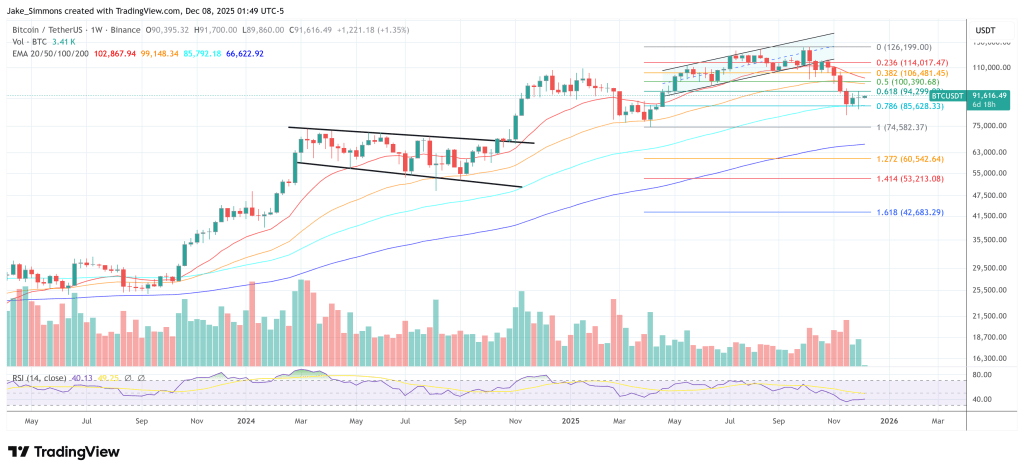
Bitcoin price
Disclaimer: The articles reposted on this site are sourced from public platforms and are provided for informational purposes only. They do not necessarily reflect the views of MEXC. All rights remain with the original authors. If you believe any content infringes on third-party rights, please contact [email protected] for removal. MEXC makes no guarantees regarding the accuracy, completeness, or timeliness of the content and is not responsible for any actions taken based on the information provided. The content does not constitute financial, legal, or other professional advice, nor should it be considered a recommendation or endorsement by MEXC.

You May Also Like

the new NFT collection on Soneium with high gain potential

the new NFT collection on Soneium with high gain potential

The post the new NFT collection on Soneium with high gain potential appeared on BitcoinEthereumNews.com. Morning Ville is emerging as one of the most intriguing NFT initiatives within the Soneium ecosystem, blending digital identity, creators, builders and Web3 gamification.  What is Morning Ville Morning Ville is meant to be a modern society, and a playground designed for creators and community on Soneium. It’s is emerging as a next-generation character IP built for the long run, blending digital identity, creator tools, gamified experiences, real-world culture, and rich cross-media storytelling into a unified universe. A few days ago, the team officially announced the introduction of Morning City, the first piece of the Morning Ville creation. It will probably be ready after the NFT collection launch. Our first major product: Morning City Morning City is the map directory for all Soneium apps. Your starting point to explore, discover, and get onboarded smoothly. Coming soon here: https://t.co/vutG3mm33J 3/🧵 pic.twitter.com/2cnKMo2HO6 — Morning Ville 💿 (@morningvillexyz) December 1, 2025 For some aspects, it remembers the idea behind Good Vibes Club’s Vibes Town, but with faster development and bigger community engagement. On the landing page, they philosophically recite: “Morning Ville was born from a wish for something gentler. A town built on warmth, patience, and belonging. Where art breathes slowly, stories unfold naturally, and every sunrise feels like a new beginning. Here, every version of you belongs.” Morning Ville: NFTs minting announced On December 2nd, Morning Ville announced on X its NFT collection with few but important details: Limited supply at 3000 NFTs; Mint price at 0.01 ETH, which guarantee community inclusivity; Mint date: TBA. Morning Ville Mint Official Information 💿 Morning is a little child waking from a dream. • Supply: 3000 • Mint Price: 0.01 ETH • Mint Date & Launchpad: To be announced after final confirmation with our launch partner. Wallet Submission is now open in our Discord:… pic.twitter.com/Q7eNsWP36V…
Share
BitcoinEthereumNews2025/12/08 20:43
Lovable AI’s Astonishing Rise: Anton Osika Reveals Startup Secrets at Bitcoin World Disrupt 2025

Lovable AI’s Astonishing Rise: Anton Osika Reveals Startup Secrets at Bitcoin World Disrupt 2025

BitcoinWorld Lovable AI’s Astonishing Rise: Anton Osika Reveals Startup Secrets at Bitcoin World Disrupt 2025 Are you ready to witness a phenomenon? The world of technology is abuzz with the incredible rise of Lovable AI, a startup that’s not just breaking records but rewriting the rulebook for rapid growth. Imagine creating powerful apps and websites just by speaking to an AI – that’s the magic Lovable brings to the masses. This groundbreaking approach has propelled the company into the spotlight, making it one of the fastest-growing software firms in history. And now, the visionary behind this sensation, co-founder and CEO Anton Osika, is set to share his invaluable insights on the Disrupt Stage at the highly anticipated Bitcoin World Disrupt 2025. If you’re a founder, investor, or tech enthusiast eager to understand the future of innovation, this is an event you cannot afford to miss. Lovable AI’s Meteoric Ascent: Redefining Software Creation In an era where digital transformation is paramount, Lovable AI has emerged as a true game-changer. Its core premise is deceptively simple yet profoundly impactful: democratize software creation. By enabling anyone to build applications and websites through intuitive AI conversations, Lovable is empowering the vast majority of individuals who lack coding skills to transform their ideas into tangible digital products. This mission has resonated globally, leading to unprecedented momentum. The numbers speak for themselves: Achieved an astonishing $100 million Annual Recurring Revenue (ARR) in less than a year. Successfully raised a $200 million Series A funding round, valuing the company at $1.8 billion, led by industry giant Accel. Is currently fielding unsolicited investor offers, pushing its valuation towards an incredible $4 billion. As industry reports suggest, investors are unequivocally “loving Lovable,” and it’s clear why. This isn’t just about impressive financial metrics; it’s about a company that has tapped into a fundamental need, offering a solution that is both innovative and accessible. The rapid scaling of Lovable AI provides a compelling case study for any entrepreneur aiming for similar exponential growth. The Visionary Behind the Hype: Anton Osika’s Journey to Innovation Every groundbreaking company has a driving force, and for Lovable, that force is co-founder and CEO Anton Osika. His journey is as fascinating as his company’s success. A physicist by training, Osika previously contributed to the cutting-edge research at CERN, the European Organization for Nuclear Research. This deep technical background, combined with his entrepreneurial spirit, has been instrumental in Lovable’s rapid ascent. Before Lovable, he honed his skills as a co-founder of Depict.ai and a Founding Engineer at Sana. Based in Stockholm, Osika has masterfully steered Lovable from a nascent idea to a global phenomenon in record time. His leadership embodies a unique blend of profound technical understanding and a keen, consumer-first vision. At Bitcoin World Disrupt 2025, attendees will have the rare opportunity to hear directly from Osika about what it truly takes to build a brand that not only scales at an incredible pace in a fiercely competitive market but also adeptly manages the intense cultural conversations that inevitably accompany such swift and significant success. His insights will be crucial for anyone looking to understand the dynamics of high-growth tech leadership. Unpacking Consumer Tech Innovation at Bitcoin World Disrupt 2025 The 20th anniversary of Bitcoin World is set to be marked by a truly special event: Bitcoin World Disrupt 2025. From October 27–29, Moscone West in San Francisco will transform into the epicenter of innovation, gathering over 10,000 founders, investors, and tech leaders. It’s the ideal platform to explore the future of consumer tech innovation, and Anton Osika’s presence on the Disrupt Stage is a highlight. His session will delve into how Lovable is not just participating in but actively shaping the next wave of consumer-facing technologies. Why is this session particularly relevant for those interested in the future of consumer experiences? Osika’s discussion will go beyond the superficial, offering a deep dive into the strategies that have allowed Lovable to carve out a unique category in a market long thought to be saturated. Attendees will gain a front-row seat to understanding how to identify unmet consumer needs, leverage advanced AI to meet those needs, and build a product that captivates users globally. The event itself promises a rich tapestry of ideas and networking opportunities: For Founders: Sharpen your pitch and connect with potential investors. For Investors: Discover the next breakout startup poised for massive growth. For Innovators: Claim your spot at the forefront of technological advancements. The insights shared regarding consumer tech innovation at this event will be invaluable for anyone looking to navigate the complexities and capitalize on the opportunities within this dynamic sector. Mastering Startup Growth Strategies: A Blueprint for the Future Lovable’s journey isn’t just another startup success story; it’s a meticulously crafted blueprint for effective startup growth strategies in the modern era. Anton Osika’s experience offers a rare glimpse into the practicalities of scaling a business at breakneck speed while maintaining product integrity and managing external pressures. For entrepreneurs and aspiring tech leaders, his talk will serve as a masterclass in several critical areas: Strategy Focus Key Takeaways from Lovable’s Journey Rapid Scaling How to build infrastructure and teams that support exponential user and revenue growth without compromising quality. Product-Market Fit Identifying a significant, underserved market (the 99% who can’t code) and developing a truly innovative solution (AI-powered app creation). Investor Relations Balancing intense investor interest and pressure with a steadfast focus on product development and long-term vision. Category Creation Carving out an entirely new niche by democratizing complex technologies, rather than competing in existing crowded markets. Understanding these startup growth strategies is essential for anyone aiming to build a resilient and impactful consumer experience. Osika’s session will provide actionable insights into how to replicate elements of Lovable’s success, offering guidance on navigating challenges from product development to market penetration and investor management. Conclusion: Seize the Future of Tech The story of Lovable, under the astute leadership of Anton Osika, is a testament to the power of innovative ideas meeting flawless execution. Their remarkable journey from concept to a multi-billion-dollar valuation in record time is a compelling narrative for anyone interested in the future of technology. By democratizing software creation through Lovable AI, they are not just building a company; they are fostering a new generation of creators. His appearance at Bitcoin World Disrupt 2025 is an unmissable opportunity to gain direct insights from a leader who is truly shaping the landscape of consumer tech innovation. Don’t miss this chance to learn about cutting-edge startup growth strategies and secure your front-row seat to the future. Register now and save up to $668 before Regular Bird rates end on September 26. To learn more about the latest AI market trends, explore our article on key developments shaping AI features. This post Lovable AI’s Astonishing Rise: Anton Osika Reveals Startup Secrets at Bitcoin World Disrupt 2025 first appeared on BitcoinWorld.
Share
Coinstats2025/09/17 23:40