XRP’s price has continued to chop, trading sideways, which has impacted the price of the U.S. spot ETFs that provide exposure to the altcoin. Canary Capital’s XRP fund has crashed 20% since its launch, although this fund remains the largest by assets under management (AuM).  XRP’s Sideways Price Action Leads To Spot ETF Crash The XRP price has continued to trade within a tight range, just above the psychological $2 level, sparking bearish sentiment among investors. The altcoin is down over 10% in the last month, around the time the first spot XRP ETF, Canary’s fund, launched. This bearish price action has notably contributed to a price crash for Canary’s XRPC fund.  Related Reading: XRP ETFs Are About To Hit $1 Billion – Here’s How Much Is Flowing In Daily TradingView data shows that Canary’s XRP ETF is down 20% since its launch on November 13. XRPC also dropped almost 10% last week amid choppy price action. Canary’s fund has also likely crashed due to increased competition from three other spot funds that launched after it. This has led to a slowdown in its inflows since these funds launched.  Meanwhile, these funds track the spot XRP price, which also explains Canary’s XRPC crash. XRP has mirrored Bitcoin’s price action amid concerns that the crypto market may already be in a bear market. XRP whales also look to be bearish at the moment, as Santiment data shows a drop in whale transactions from a recent high recorded in November.  However, despite this bearish sentiment, with the crypto market currently in a state of fear, the XRP ETFs have continued to record daily net inflows. SoSo Value data show that these funds have been on a 16-day net inflow streak since Canary’s XRP fund launched on November 13, and they have yet to record a net outflow day.  Canary’s XRP ETF, which has suffered a 20% price crash, is currently the largest spot XRP fund with $364 million in assets under management. Grayscale’s GXRP is second with $211 million, while Bitwise and Franklin Templeton are third and fourth. As a group, these XRP funds are about to hit $1 billion in assets under management, with $861 million in total net assets.  Some Positives For The Altcoin Santiment data show that XRP exchange outflows have outweighed inflows in recent times. This is a positive as it indicates that more investors are accumulating than selling. Exchange outflows typically represent moves for long-term holding, especially in anticipation of higher prices.  Related Reading: Pundit Predicts That XRP Is About To Make Investors Extremely Rich In an X post, Santiment mentioned that the XRP Ledger is seeing a fascinating trend of whale and shark wallets shrinking in number but continuing to grow in coins held. The on-chain analytics platform noted that there are 20.6% fewer 100 million XRP wallets, but that these wallets, as a group, still own a 7-year high 48 billion coins. As such, the existing 100 million XRP wallets are doubling down on their accumulation efforts and making up for the shrinking number of wallets.  At the time of writing, the altcoin’s price is trading at around $2.07, up in the last 24 hours, according to data from CoinMarketCap. Featured image from Freepik, chart from Tradingview.comXRP’s price has continued to chop, trading sideways, which has impacted the price of the U.S. spot ETFs that provide exposure to the altcoin. Canary Capital’s XRP fund has crashed 20% since its launch, although this fund remains the largest by assets under management (AuM).  XRP’s Sideways Price Action Leads To Spot ETF Crash The XRP price has continued to trade within a tight range, just above the psychological $2 level, sparking bearish sentiment among investors. The altcoin is down over 10% in the last month, around the time the first spot XRP ETF, Canary’s fund, launched. This bearish price action has notably contributed to a price crash for Canary’s XRPC fund.  Related Reading: XRP ETFs Are About To Hit $1 Billion – Here’s How Much Is Flowing In Daily TradingView data shows that Canary’s XRP ETF is down 20% since its launch on November 13. XRPC also dropped almost 10% last week amid choppy price action. Canary’s fund has also likely crashed due to increased competition from three other spot funds that launched after it. This has led to a slowdown in its inflows since these funds launched.  Meanwhile, these funds track the spot XRP price, which also explains Canary’s XRPC crash. XRP has mirrored Bitcoin’s price action amid concerns that the crypto market may already be in a bear market. XRP whales also look to be bearish at the moment, as Santiment data shows a drop in whale transactions from a recent high recorded in November.  However, despite this bearish sentiment, with the crypto market currently in a state of fear, the XRP ETFs have continued to record daily net inflows. SoSo Value data show that these funds have been on a 16-day net inflow streak since Canary’s XRP fund launched on November 13, and they have yet to record a net outflow day.  Canary’s XRP ETF, which has suffered a 20% price crash, is currently the largest spot XRP fund with $364 million in assets under management. Grayscale’s GXRP is second with $211 million, while Bitwise and Franklin Templeton are third and fourth. As a group, these XRP funds are about to hit $1 billion in assets under management, with $861 million in total net assets.  Some Positives For The Altcoin Santiment data show that XRP exchange outflows have outweighed inflows in recent times. This is a positive as it indicates that more investors are accumulating than selling. Exchange outflows typically represent moves for long-term holding, especially in anticipation of higher prices.  Related Reading: Pundit Predicts That XRP Is About To Make Investors Extremely Rich In an X post, Santiment mentioned that the XRP Ledger is seeing a fascinating trend of whale and shark wallets shrinking in number but continuing to grow in coins held. The on-chain analytics platform noted that there are 20.6% fewer 100 million XRP wallets, but that these wallets, as a group, still own a 7-year high 48 billion coins. As such, the existing 100 million XRP wallets are doubling down on their accumulation efforts and making up for the shrinking number of wallets.  At the time of writing, the altcoin’s price is trading at around $2.07, up in the last 24 hours, according to data from CoinMarketCap. Featured image from Freepik, chart from Tradingview.com
What’s Happening With XRP And Why Did Its Spot ETF Crash 20%?

2025/12/08 18:30

XRP’s price has continued to chop, trading sideways, which has impacted the price of the U.S. spot ETFs that provide exposure to the altcoin. Canary Capital’s XRP fund has crashed 20% since its launch, although this fund remains the largest by assets under management (AuM). 

XRP’s Sideways Price Action Leads To Spot ETF Crash

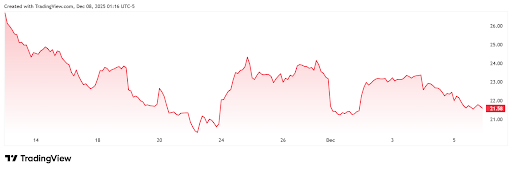
The XRP price has continued to trade within a tight range, just above the psychological $2 level, sparking bearish sentiment among investors. The altcoin is down over 10% in the last month, around the time the first spot XRP ETF, Canary’s fund, launched. This bearish price action has notably contributed to a price crash for Canary’s XRPC fund. 

TradingView data shows that Canary’s XRP ETF is down 20% since its launch on November 13. XRPC also dropped almost 10% last week amid choppy price action. Canary’s fund has also likely crashed due to increased competition from three other spot funds that launched after it. This has led to a slowdown in its inflows since these funds launched. 

XRP

Meanwhile, these funds track the spot XRP price, which also explains Canary’s XRPC crash. XRP has mirrored Bitcoin’s price action amid concerns that the crypto market may already be in a bear market. XRP whales also look to be bearish at the moment, as Santiment data shows a drop in whale transactions from a recent high recorded in November. 

However, despite this bearish sentiment, with the crypto market currently in a state of fear, the XRP ETFs have continued to record daily net inflows. SoSo Value data show that these funds have been on a 16-day net inflow streak since Canary’s XRP fund launched on November 13, and they have yet to record a net outflow day. 

Canary’s XRP ETF, which has suffered a 20% price crash, is currently the largest spot XRP fund with $364 million in assets under management. Grayscale’s GXRP is second with $211 million, while Bitwise and Franklin Templeton are third and fourth. As a group, these XRP funds are about to hit $1 billion in assets under management, with $861 million in total net assets. 

Some Positives For The Altcoin

Santiment data show that XRP exchange outflows have outweighed inflows in recent times. This is a positive as it indicates that more investors are accumulating than selling. Exchange outflows typically represent moves for long-term holding, especially in anticipation of higher prices. 

In an X post, Santiment mentioned that the XRP Ledger is seeing a fascinating trend of whale and shark wallets shrinking in number but continuing to grow in coins held. The on-chain analytics platform noted that there are 20.6% fewer 100 million XRP wallets, but that these wallets, as a group, still own a 7-year high 48 billion coins. As such, the existing 100 million XRP wallets are doubling down on their accumulation efforts and making up for the shrinking number of wallets. 

At the time of writing, the altcoin’s price is trading at around $2.07, up in the last 24 hours, according to data from CoinMarketCap.


XRP
Disclaimer: The articles reposted on this site are sourced from public platforms and are provided for informational purposes only. They do not necessarily reflect the views of MEXC. All rights remain with the original authors. If you believe any content infringes on third-party rights, please contact [email protected] for removal. MEXC makes no guarantees regarding the accuracy, completeness, or timeliness of the content and is not responsible for any actions taken based on the information provided. The content does not constitute financial, legal, or other professional advice, nor should it be considered a recommendation or endorsement by MEXC.

You May Also Like

Tokenization Key to Modernizing US Markets

Tokenization Key to Modernizing US Markets

The post Tokenization Key to Modernizing US Markets appeared on BitcoinEthereumNews.com. The Strategy: SEC Chair Paul Atkins designates “tokenization” as the industrial strategy to modernize US capital markets, launching the “Project Crypto” initiative. The Rules: A new “Token Taxonomy” will legally separate Digital Commodities, Collectibles, and Tools from Securities, ending the “regulation by enforcement” era. The Privacy: The SEC’s Dec 15 roundtable will feature Zcash founder Zooko Wilcox, signaling a potential policy thaw on privacy-preserving infrastructure. Securities and Exchange Commission (SEC) Chair Paul Atkins has formally aligned the agency’s mission with the digital asset revolution, declaring “tokenization” as the critical alpha required to modernize America’s aging capital markets infrastructure.  In a definitive signal to Wall Street, Atkins outlined the next phase of “Project Crypto,” a comprehensive regulatory overhaul designed to integrate blockchain rails into the federal securities system. Related: U.S. SEC Signals Privacy Enhancement in Tokenization of Securities U.S. SEC Chair Touts Tokenization as the Needed Element for Modernizing Capital Markets According to Chair Atkins, tokenization is the alpha needed to modernize the capital markets in the United States. As such, Chair Atkins noted that the SEC’s Project Crypto will focus on issuing clarity under the existing rules as Congress awaits passing the CLARITY  Act. Moreover, the SEC Chair believes that major global banks and brokers will adopt tokenization of real-world assets (RWA) in less than 10 years. Currently, the SEC is working closely with the sister agency Commodity Futures Trading Commission (CFTC) to catalyze the mainstream adoption of tokenized assets. Chair Atkins stated that tokenization of capital markets provides certainty and transparency in the securities industry. From a regulatory perspective, Chair Atkins stated that tokenized securities are still securities and thus bound by the existing securities laws. However, Chair Atkins stated that digital collectibles, commodities, and tools are not securities, thus not bound by the 1940s Howey test. As such,…
Share
BitcoinEthereumNews2025/12/08 18:35





