ETH supply on centralized exchanges has fallen to 8.7 percent, the lowest level since Ethereum’s launch. Vitalik Buterin’s gas futures idea and Tom Lee’s $20,000 target highlight shifting supply, fee, and price dynamics for Ethereum. Ethereum held on centralized exchanges has dropped to its lowest level since the network launched in 2015, tightening the pool [...]]]>ETH supply on centralized exchanges has fallen to 8.7 percent, the lowest level since Ethereum’s launch. Vitalik Buterin’s gas futures idea and Tom Lee’s $20,000 target highlight shifting supply, fee, and price dynamics for Ethereum. Ethereum held on centralized exchanges has dropped to its lowest level since the network launched in 2015, tightening the pool [...]]]>

Ethereum Exchange Balances Hit 10-Year Low as Supply Dries Up

2025/12/08 19:55
  • ETH supply on centralized exchanges has fallen to 8.7 percent, the lowest level since Ethereum’s launch.
  • Vitalik Buterin’s gas futures idea and Tom Lee’s $20,000 target highlight shifting supply, fee, and price dynamics for Ethereum.

Ethereum held on centralized exchanges has dropped to its lowest level since the network launched in 2015, tightening the pool of coins available for immediate trading.

Onchain data from Glassnode show that only about 8.7 percent of the total ETH supply now sits on centralized platforms. In earlier cycles, that share climbed above 30 percent, as traders kept more coins on exchanges for active buying and selling.

The chart tracks the exchange share against Ethereum’s dollar price. It shows that, while price has moved through multiple bull and bear markets, the exchange balance has trended steadily lower since 2020.
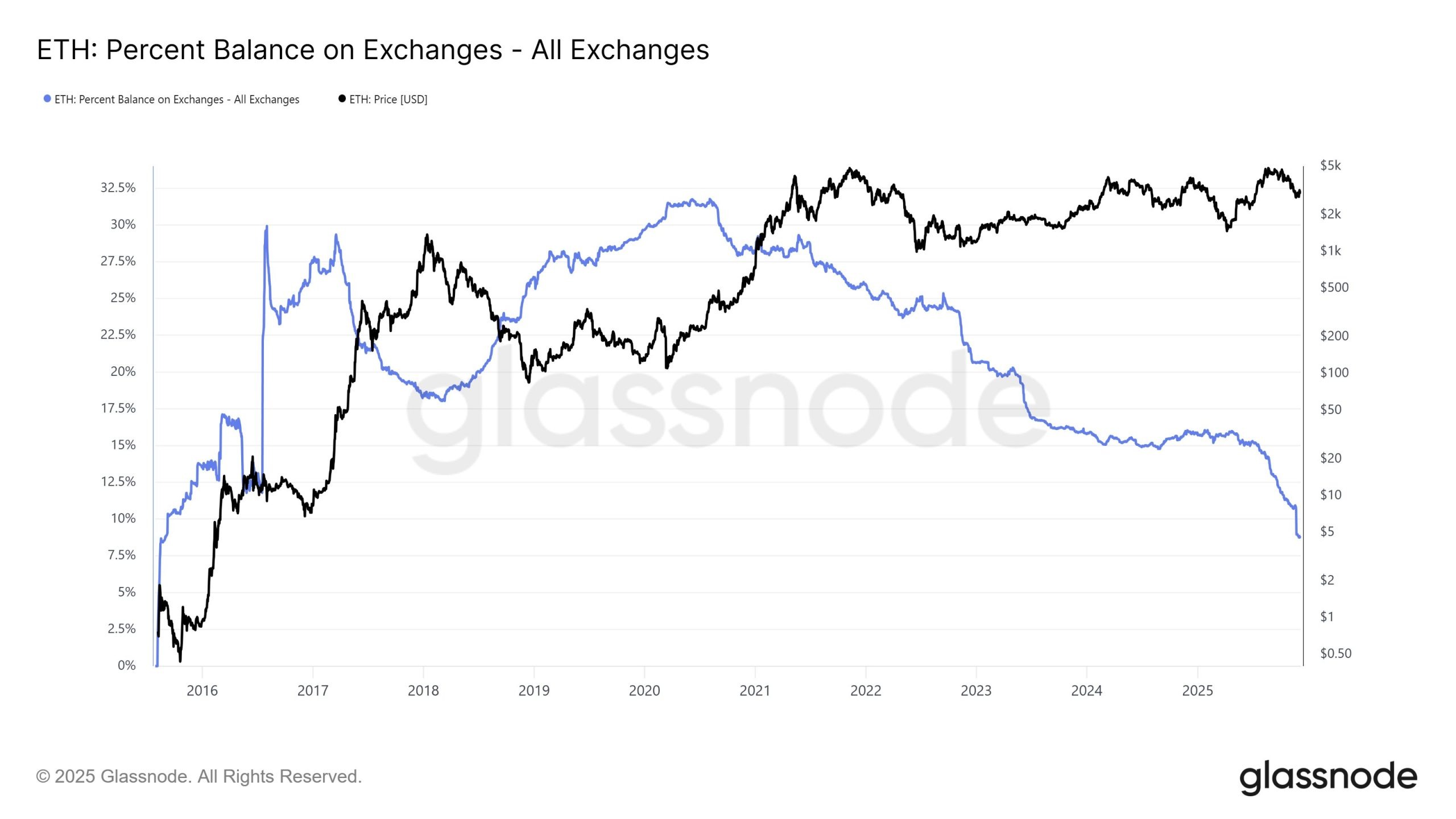
Percent Balance on Exchanges – All ExchangesSource: GlassnodePercent Balance on Exchanges – All Exchanges: Source: Glassnode on X

Analysts say the decline suggests more ETH is moving into long term storage, staking contracts, or self-custody wallets, instead of staying in hot exchange accounts. As a result, the liquid float available to meet new spot demand continues to shrink.

Such structural shifts in supply do not set timing for the next major move. However, market watchers note that when demand increases into a thinner exchange order book, price swings can become sharper in both directions because fewer coins are immediately offered for sale.

Buterin Floats Idea for On-Chain Gas Futures Market on Ethereum

Meanwhile, Ethereum co-founder Vitalik Buterin has proposed a trustless on-chain futures market for gas to give users clearer visibility on transaction fees as network usage grows, as featured in our recent coverage.

Responding to questions about whether Ethereum’s roadmap can guarantee low gas costs, Buterin wrote on X that the ecosystem should explore a market that lets users lock in gas prices for future periods. He said such a system could be built around Ethereum’s base fees, which sit at the core of overall transaction costs and adjust with demand.

Fundstrat’s Tom Lee told Binance Blockchain Week attendees that a stronger Bitcoin cycle could pull Ethereum sharply higher, as mentioned in our previous news brief. He said a better market setup and friendly macro environment could put Ethereum in a strong position for the next rally. If that view proves right, Lee sees ETH trading above 20,000 dollars by early 2026.

]]>


Disclaimer: The articles reposted on this site are sourced from public platforms and are provided for informational purposes only. They do not necessarily reflect the views of MEXC. All rights remain with the original authors. If you believe any content infringes on third-party rights, please contact [email protected] for removal. MEXC makes no guarantees regarding the accuracy, completeness, or timeliness of the content and is not responsible for any actions taken based on the information provided. The content does not constitute financial, legal, or other professional advice, nor should it be considered a recommendation or endorsement by MEXC.

You May Also Like

the $63M White Whale of a tale

the $63M White Whale of a tale

The post the $63M White Whale of a tale appeared on BitcoinEthereumNews.com. This weekend on crypto social media, memecoin traders spun yet another fantastic tale of leveraged trading meltdown.  According to the still-being-written legend, crypto exchange MEXC locked $3 million belonging to famed crypto trader The White Whale. As he continued to amass money from leveraged trading despite the freeze, he claimed that he’d become so wealthy that if MEXC ever unfroze the funds, he’d give away the proceeds to the community.  Then, on October 10, HyperLiquid liquidated $63 million of his then-larger assets amid a contentious pricing print from a data oracle. Though briefly devastated, MEXC eventually agreed to unlock his assets, prompting celebrations over his legendary return and, predictably, the creation of various memecoins. Smelling an opportunity, The White Whale decided to use some of his recently unlocked $3 million, earmarked for “the community,” to overtake one of these eponymous memecoins and add liquidity on its trading pairs. The White Whale of crypto Most crypto traders simply laughed as he attached cringe-worthy images of a white whale engaged in financial transactions to his trading commentary tweets. The laughter was appropriate, given how impossible it is to verify his narrative. So-called decentralized exchanges with limited know your customer requirements like HyperLiquid allow anyone to create an unlimited number of wallets and manipulate the pricing of markets across various wallets that they control.  In other words, no one except the trader knows if someone has sole claim to a single wallet and username, or whether someone is using multiple wallets in order to craft a trading history for one of many usernames. The White Whale, like the titular whale in Herman Melville’s 1851 novel, Moby Dick, has become an obsession to many on social media, thanks to the fantastic sums of money at stake, the clownish images, and the ostensibly philanthropic, Phoneix…
Share
BitcoinEthereumNews2025/12/08 21:19




