

A Cautious Recovery for Cryptos Ahead of Fed Meeting

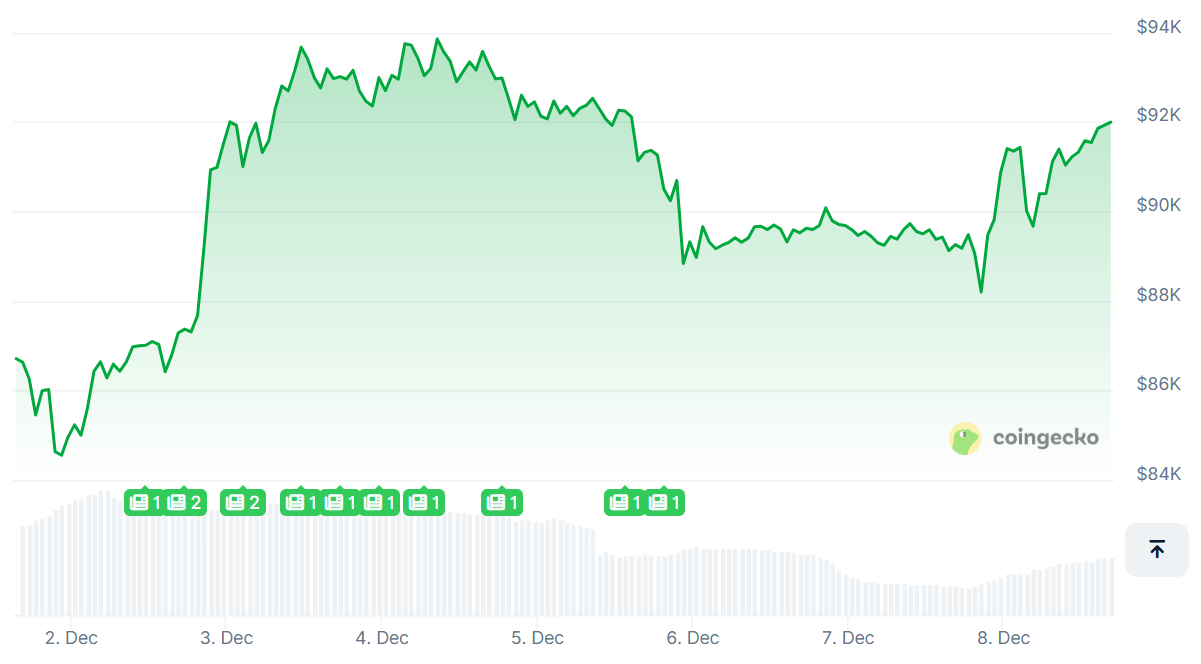
Bitcoin recovered to above $92,000 on Monday after a see-saw week, with the top cryptocurrency token gaining more than 6% over the past week. After falling to a low of below $84,600 last week, Bitcoin climbed to above $93,800 before paring some of those gains.
 Source:CoinGecko
In anticipation of what is almost certainly going to be a interest rate cut at the Federal Reserve's last meeting of the year, cryptos gained ground at the start of the week, with market players watching signals on the interest-rate trajectory for 2026.
Bets for cryptos to take off again in 2026 are doing the rounds on expectations of US fiscal stimulus and monetary easing under a new Fed chief once current boss Jerome Powell's term ends in March.
According to projections from South Korea’s Korbit Research Center, Bitcoin is expected to be valued between $140,000 and $170,000 in 2026. A macro-driven thesis that breaks away from the usual four-year halving cycle narrative was highlighted by Korbit's research team as it delivered its fourth annual market outlook.
Instead of supply-side variables, which the study calls "stronger Reaganomics," productivity driven development in the United States will have a more significant impact on Bitcoin's price movement, according to the analysis.
The forecast highlights three important elements that are changing the distribution of portfolios.
Many people's views on digital assets are changing due to optimistic dollar forecasts, possible shifts in gold prices, and the growing interest of institutions in Bitcoin through exchange-traded funds and digital asset treasuries.
As of the end of November, around 11.7% of the entire Bitcoin supply is held in ETF and digital asset treasury company holdings.
In July 2025, Trump's much-touted "One Big Beautiful Bill" was passed, and its implementation will determine the course for Bitcoin. The bill permits the instant expensing of R&D expenses and restores full bonus depreciation.
These reforms, according to Korbit, will bring effective corporate tax rates down to 10-12%, which will encourage FDI and spur a spike in capital expenditures.
In contrast to the widely held belief on Wall Street, which predicts a decrease, the research asserts that this combination of policies will actually strengthen the dollar. As an asset that does not produce yield, gold may fall behind in a disinflationary environment and a strong currency.
Even while some analysts predict that gold will hit $4,000 per ounce, marking a 5% fall from current levels, Bitcoin is establishing itself as a trustworthy store of wealth alongside the dollar, which could cause adjustments in gold prices.
The relevance of the usual four-year Bitcoin cycle is diminishing. Elevated rates, less liquidity, and more gradual market recoveries define the current situation.
The current consensus among analysts is that prices will stabilise between $100,000 and $120,000 by the end of 2025, with a possible second peak in 2026 if liquidity returns, rather than a dramatic spike.
Despite systemic economic difficulties, institutional adoption is increasing. Bitcoin ETFs have seen massive inflows since their approval, and many businesses are boosting their already sizable digital asset holdings. This provides more consistent pricing and less volatility as compared to previous time periods.
In July 2025, the GENIUS Act formally allowed stablecoins to be used for federal payments.
White House records show that issuers must maintain full reserves in cash or short-term Treasuries as a matter of law. Due to the clear regulations that govern stablecoins, US banks and institutions are quickly adopting them.
On the flip side, Bitcoin is currently positioned at a crucial point that experts suggest may influence the market's ability to maintain its overall upward trajectory or revert to the lows seen recently.
Bitcoin is currently positioned at a significant Fibonacci support level, and a breakdown could lead to a decline towards the April lows around $76,000.
A weekend leverage flush caused BTC to dip below $88,000, followed by a swift recovery.
Market participants are closely monitoring the upcoming Fed meeting and important economic indicators from the United States for trading cues and direction.
One bitcoin trader, Daan Crypto Trades, has stressed the importance of the 0.382 Fibonacci retracement zone for positive momentum and warned that a drop below this level might send Bitcoin's price back to April's levels, about $76,000.
But since the October drop, when Fed Chair Powell emphasized data-driven decisions rather than a steady easing trajectory, the cryptocurrency markets have slowed.
Weakening ETF inflows and falling trading volumes as we head into December indicate limited room for price appreciation. In addition, the volatility compression suggests that short-term declines in BTC price may be more likely.
Recent reports indicate that a significant on-chain metric referred to as “liveliness” is on the rise once more, despite the relatively calm price movements of Bitcoin. Experts indicate that the divergence points to a resurgence in fundamental demand, as inactive coins are being transacted at rates not observed in years, signaling that long-term investors might be coming back into the market.
The consistent upward trend of the indicator suggests a significant shift in capital allocation occurring quietly, even amid a backdrop of careful sentiment.
Liveliness assesses the equilibrium between coins that are actively transacted and those that are retained, taking into account their age. It generally increases during bullish trends as established currencies trade at elevated prices, indicating new investments and stronger confidence.
What Do Technical Analyses Show?
TradingView's overall Bitcoin analysis gauge based on the most popular technical indicators, such as moving averages, oscillators and pivots gave a sell signal, with the other short- and long-term measures showing no significant confidence either.
 Source: TradingView
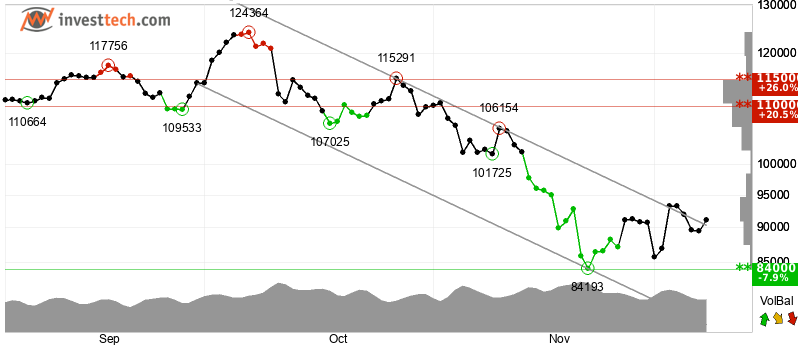
Separately, InvestTech's overall algorithmic analysis pointed to a hold signal, with their recommendation for one to six weeks a weak negative.
 Source: InvestTech
InvestTech said, "Bitcoin has broken through the ceiling of a falling trend channel in the short term. This indicates a slower initial decline or the start of a more horizontal development. The token has support at $84,000 and resistance at $110,000."
The firm added, "Volume has previously been low at price tops and high at price bottoms. This weakens the trend break. The token is overall assessed as technically slightly negative for the short term."
On ETFs, SoSoValue's Daily Total Net Open Interest (Delta) as of December 4 was -$222.57 million.
That reflects the variation in daily changes of open contracts between puts and calls.
The SoSoValue data shows a rise in open contracts for puts, indicating that market makers must sell underlying assets to manage their risk, leading to an increase in ETF sales.
This measure helps in understanding market movements and the strategies that key players employ to mitigate their risks.
Overall, Bitcoin's technical analysis shows a short-term weakness, with the risks tilted more to the downside.
Elsewhere
 Blockhead
Blockhead
Blockhead
Blockhead
Blockhead
 Blockhead
Podcast
Licensed to Shill – Why Central Asia; Why Now? ft. Anthony Howe (GFTN)
This week, the Licensed to Shill panel dives into the dynamic world of Central Asia – a region rapidly emerging as a pivotal hub for trade and innovation. Anthony Howe from the Global Finance Technology Network (GFTN) joins the panel to explore the untapped potential of this region, particularly focusing on Georgia's strategic role in the middle corridor.
Tune in at blockcast.blockhead.co or on Spotify, Apple, Amazon Music, or any major podcast platform.

Blockhead is a media partner for Consensus Hong Kong 2026. Readers can save 20% on tickets using exclusive code BLOCKDESK at this link.


You May Also Like

Cathie Wood’s ARK Invest Buys $13.7M in Circle Shares While Selling Robinhood Stock

The changing face of elder care in Malaysia — Sayed Mohammad Reza Yamani Sayed Umar

Goatseus Maximus (GOAT) Price Prediction 2026, 2027-2030



