This article details a grounded-theory-informed study of a multiscale design environment deployed across five university courses. Through interviews and course observations, researchers examine how instructors use integrated analytics to monitor student progress, shape interventions, and assess creative and technical design work in varied educational contexts.This article details a grounded-theory-informed study of a multiscale design environment deployed across five university courses. Through interviews and course observations, researchers examine how instructors use integrated analytics to monitor student progress, shape interventions, and assess creative and technical design work in varied educational contexts.

How Educators Use Multiscale Design Dashboards to Guide Creative and Technical Coursework

2025/12/09 04:00
7 min read

Abstract and 1. Introduction

  1. Prior Work and 2.1 Educational Objectives of Learning Activities

    2.2 Multiscale Design

    2.3 Assessing Creative Visual Design

    2.4 Learning Analytics and Dashboards

  2. Research Artifact/Probe

    3.1 Multiscale Design Environment

    3.2 Integrating a Design Analytics Dashboard with the Multiscale Design Environment

  3. Methodology and Context

    4.1 Course Contexts

    4.2 Instructor interviews

  4. Findings

    5.1 Gaining Insights and Informing Pedagogical Action

    5.2 Support for Exploration, Understanding, and Validation of Analytics

    5.3 Using Analytics for Assessment and Feedback

    5.4 Analytics as a Potential Source of Self-Reflection for Students

  5. Discussion + Implications: Contextualizing: Analytics to Support Design Education

    6.1 Indexicality: Demonstrating Design Analytics by Linking to Instances

    6.2 Supporting Assessment and Feedback in Design Courses through Multiscale Design Analytics

    6.3 Limitations of Multiscale Design Analytics

  6. Conclusion and References

A. Interview Questions

\

4 METHODOLOGY AND CONTEXT

We present a methodology of deploying the research artifact / probe in situated course contexts, gathering qualitative data through instructor interviews, and performing qualitative analysis with a methodology loosely based on Charmaz’s approach [19] to grounded theory. Grounded theory refers to a family of qualitative “constant comparative” research methods, which involve collecting data, through techniques such as observation and interviews, transcribing the data, unitizing the data, grouping the units based on common interpretations of what they mean, naming the groups (aka ‘coding’), and developing theory from codes and categories that emerge through this iterative process [12].

\ There are various methodological and philosophical approaches to grounded theory. As Birks and Mills articulate, among Charmaz’s contributions to the pool of grounded theory methodologies is “a focus on the place of the author in

\ Table 1. Five design course professors and four teaching assistants in the role of lab instructor interacted with AI-based analytics, presented via the dashboard integrated with multiscale, free-form design environment.
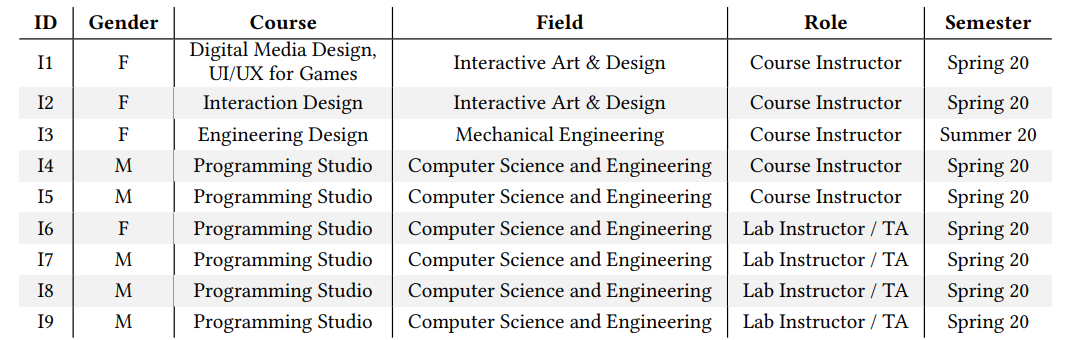
\ the text, their relationship with participants, and the importance of writing…” [12]. We disclose our positionalities in this investigation. The technology developers also played a principal role in the gathering and analysis of data. Further, the developers worked not as detached scientific observers of the courses; rather, we worked in collaboration with instructors. Our collaboration involves the co-creation [66] of pedagogy, technological capability specifications, and interaction design. Both developers / qualitative researchers and instructors are among the authors of this paper.

4.1 Course Contexts

We investigated the research artifact / probe (Section 3.1) in 5 course instances, across three departments, during Spring and Summer 2020 (Table 1). These design course contexts are diverse. We contextualize the design tasks that students perform in these courses. In order to depict the creative work that students in this study are performing, which involves multiscale design, we first present overviews of each project. To detail the design tasks student perform through project phases, we then elaborate on I2’s project deliverables.

\ Instructors’ assessment plays a vital role, as students work through the project phases. Frequent assessment helps students in making continuous progress [57] and fulfilling project and overall course objectives. As project ideas and deliverables are organized within the multiscale design environment, it becomes a one-stop place for instructors to regularly monitor and assess student work. The integration of dashboard with the environment, thus, weaves multiscale design analytics into instructors’ situated contexts, in concert with their teaching and assessment processes.

\ 4.1.1 Assignment Overviews Across Fields. Here are overviews of multi-week assignment sequences in 5 course contexts, across fields (Table 1). The first two assignments are in Interactive Art and Design. The next is in Mechanical Engineering. The last two are in Computer Science and Engineering.

\ I1 (Interactive Art and Design): The students’ task is a team-based, 4-week game interface design project. Students research an assigned game genre and then sketch their own UI while keeping aesthetics in mind. The instructor introduces [the multiscale design environment (Section 3.1)] in the course, through which students organize and present at least 5 game examples, explanations for each on their UI design, mechanics, and any similarities. Alongside their sketches, students need to use text annotations, to explain their ideas and thought processes.

\ I2 (Interactive Art and Design): The students’ task is a team-based, 6-week interactive installation design project to improve people’s experiences of artworks. Students research, conceptualize, develop, evaluate, and present an interactive projection mapping based on physical computing techniques. The instructor introduces [the multiscale design environment] in the course, through which students organize and present inspirational ideas, the project description and plan, concept sketches, storyboards, and visuals of circuitry and interactive functionality.

\ I3 (Mechanical Engineering): The students’ task is a team-based, 2-week analogy formation project. Students identify a topic and then generate solutions by utilizing analogies across a semantic word tree. The instructor introduces [the multiscale design environment] in the course, through which students organize and present their topic, web searches, identified ideas, and analogy formation using the word tree method.

\ I4 and I5 (Computer Science and Engineering): The students’ task is a team-based, 6-week web application project. Students conceptualize, develop, evaluate, and present a mashup website, which needs to utilize at least three diverse web services. The instructors introduce [the multiscale design environment] in the course, through which students organize and present the project description, interface sketches, backlogs, burndown charts, findings from the user study, and videos of the functional product.

\ 4.1.2 I2’s Interactive Art and Design project deliverables. Here we elaborate on one of the projects. This project consists of 4 deliverables, due over 6 weeks, where students develop an interactive installation design project.

\ (1) Students perform technical and concept research, create a detailed project description and plan, and develop concept sketches and storyboards, while focusing on gestures, usability, and user experience. In [the multiscale design environment], they need to include at least three inspirational ideas, two interactive artworks, and types of inputs, outputs, and circuitry they plan to use.

\ (2) Students prepare their circuit connection, with an Android phone, using ProtoPie (a physical computing toolkit). In [the multiscale design environment], they need to include visuals that demonstrate a working connection.

\ (3) Students develop a lo-fidelity prototype for ProtoPie design, which should include color and typography. In [the multiscale design environment], they need to include visuals of the design and functionality.

\ (4) Students work on developing a hi-fidelity prototype, conducting a user study, and presenting their projects. In [the multiscale design environment], they include visuals showcasing users’ experiences with the prototype and the final presentation document.

4.2 Instructor interviews

The research artifact / probe was used by 5 design course instructors and four teaching assistants (TAs). We conducted semi-structured interviews with the professors and teaching assistants regarding their experiences at the end of the respective courses. We asked instructors regarding: whether the analytics dashboard showed them anything new about students’ learning; whether and how they utilized analytics for monitoring, intervening, and assessment and feedback; their thoughts on making analytics available to students on demand; and their understanding of analytics and how seeing analytics’ relationships with the actual design work affected their experiences. The complete set of interview questions can be seen in Appendix A.

\ Invoking Charmaz’s method for grounded theory qualitative data analysis [19], two authors first performed initial coding of three interview transcripts. They met to bring their initial codes into alignment, and formed tentative categories. Then, they performed focused coding of the remaining interview transcripts, revising codes and categories, as needed, to suitably represent the salient phenomena. We present the categories, including participant quotes illustrating the phenomena, in the next section.

\

:::info Authors:

(1) Ajit Jain, Texas A&M University, USA; Current affiliation: Audigent;

(2) Andruid Kerne, Texas A&M University, USA; Current affiliation: University of Illinois Chicago;

(3) Nic Lupfer, Texas A&M University, USA; Current affiliation: Mapware;

(4) Gabriel Britain, Texas A&M University, USA; Current affiliation: Microsoft;

(5) Aaron Perrine, Texas A&M University, USA;

(6) Yoonsuck Choe, Texas A&M University, USA;

(7) John Keyser, Texas A&M University, USA;

(8) Ruihong Huang, Texas A&M University, USA;

(9) Jinsil Seo, Texas A&M University, USA;

(10) Annie Sungkajun, Illinois State University, USA;

(11) Robert Lightfoot, Texas A&M University, USA;

(12) Timothy McGuire, Texas A&M University, USA.

:::


:::info This paper is available on arxiv under CC by 4.0 Deed (Attribution 4.0 International) license.

:::

\

Disclaimer: The articles reposted on this site are sourced from public platforms and are provided for informational purposes only. They do not necessarily reflect the views of MEXC. All rights remain with the original authors. If you believe any content infringes on third-party rights, please contact [email protected] for removal. MEXC makes no guarantees regarding the accuracy, completeness, or timeliness of the content and is not responsible for any actions taken based on the information provided. The content does not constitute financial, legal, or other professional advice, nor should it be considered a recommendation or endorsement by MEXC.

You May Also Like

Why Smart Whales Abandon Cardano And Solana, Choosing Pepeto Presale For 100x Potential

Why Smart Whales Abandon Cardano And Solana, Choosing Pepeto Presale For 100x Potential

But a new player is emerging quickly: Pepeto (PEPETO), still in presale at just $0.000000153, already garnering over $6.7 million. […] The post Why Smart Whales Abandon Cardano And Solana, Choosing Pepeto Presale For 100x Potential appeared first on Coindoo.
Share
Coindoo2025/09/20 01:35
US Crypto Legislation: Unlocking a New Era for the Market Cycle

US Crypto Legislation: Unlocking a New Era for the Market Cycle

BitcoinWorld US Crypto Legislation: Unlocking a New Era for the Market Cycle Get ready for a potentially monumental shift in the crypto world! Galaxy Digital CEO Mike Novogratz has shared a fascinating prediction: significant US crypto legislation could fundamentally reshape the market’s traditional four-year cycle. This isn’t just speculation; it points to a future where crypto’s trajectory might look very different from what we’ve seen before. How is US Crypto Legislation Changing the Game? In a recent interview with Bloomberg, Novogratz highlighted two key pieces of legislation: the Genius Act and the CLARITY Act. These aren’t just bureaucratic terms; they represent a concerted effort to bring clarity and regulation to the cryptocurrency space. The Genius Act, enacted in July, focuses on stablecoin regulation. This is crucial because stablecoins, which are cryptocurrencies pegged to a stable asset like the US dollar, are becoming central to many digital transactions. The CLARITY Act aims to provide a clearer market structure. This means establishing defined rules for how cryptocurrencies are traded and regulated, making the market more transparent and accessible. Novogratz believes these legislative developments will act as a powerful magnet, drawing a massive influx of new investors into the market. Imagine millions of new participants feeling confident enough to engage with digital assets thanks to clear guidelines. Will We See a Different Crypto Market Cycle This Time? One of Novogratz’s most intriguing predictions challenges the historical pattern of crypto. He suggests that this current cycle might not conclude with the kind of large-scale sell-off that characterized previous Bitcoin (BTC) peaks. Historically, after major bull runs, investors often sold off their holdings, leading to significant market corrections. Consider the cycles of 2017 and 2021. Both saw incredible highs followed by substantial downturns as investors took profits. However, Novogratz argues that the investment environment has undergone a significant transformation. The presence of robust US crypto legislation is a key factor here, fostering a more mature market. The Power of Legitimized Stablecoins and Wider Adoption What exactly is different now? A major part of Novogratz’s argument centers on legalized stablecoins. These digital assets are poised to become seamlessly integrated into our daily lives. Think about using them directly within apps on your iPhone or across various social media platforms. This widespread usability has profound implications: Reduced Volatility Concerns: For everyday transactions, stablecoins offer the speed and efficiency of crypto without the wild price swings often associated with assets like Bitcoin or Ethereum. Easier Onboarding for New Users: When stablecoins are integrated into familiar platforms, the barrier to entry for new users dramatically decreases. People can engage with digital assets without needing to navigate complex exchanges immediately. Mainstream Acceptance: This level of integration pushes cryptocurrency further into the mainstream, moving it beyond niche trading circles and into everyday commerce. The clarity provided by US crypto legislation around these assets builds trust and encourages broader adoption. Navigating the Future: Opportunities and Potential Hurdles While the outlook is overwhelmingly positive, it’s also wise to consider the evolving landscape. The introduction of comprehensive US crypto legislation presents both immense opportunities and potential hurdles. Opportunities: A clearer regulatory framework can attract institutional investors, foster innovation within the blockchain space, and provide consumer protection, all contributing to a more robust and sustainable market. Potential Hurdles: Crafting effective legislation is complex. There might be ongoing debates, adjustments, and unforeseen impacts that could influence market dynamics. The industry will need to adapt to new compliance requirements. Ultimately, a regulated environment aims to create a more predictable and secure space for growth, benefiting both seasoned investors and newcomers alike. A New Dawn for Crypto Market Cycles Mike Novogratz’s vision paints an exciting picture for the future of cryptocurrency. The advent of clear US crypto legislation, particularly the Genius and CLARITY Acts, appears set to usher in a new era. This could mean a departure from the dramatic boom-and-bust cycles of the past, paving the way for more sustained growth and widespread adoption. As stablecoins become integral to our digital interactions, the crypto market is evolving into a more mature, integrated, and accessible financial ecosystem. The potential for a less volatile, more inclusive market is truly transformative. Frequently Asked Questions About Crypto Legislation Q1: What is the significance of the Genius Act and CLARITY Act? A1: The Genius Act focuses on regulating stablecoins, providing a clear framework for their issuance and use. The CLARITY Act aims to establish a clear market structure for cryptocurrencies, defining how they are traded and regulated. Together, they bring much-needed legal certainty to the crypto space. Q2: How could new US crypto legislation prevent large-scale sell-offs? A2: Novogratz suggests that with increased regulatory clarity and the widespread integration of stablecoins into daily apps, the market will attract a broader base of long-term investors. This could lead to more stable growth and reduce the likelihood of the rapid, panic-driven sell-offs seen after previous market peaks. Q3: How will legalized stablecoins change everyday use? A3: Legitimized stablecoins are expected to be integrated into common applications on devices like iPhones and social media platforms. This will make them easier to use for everyday transactions, payments, and remittances, much like traditional digital currency, but with the benefits of blockchain technology. Q4: What are the main benefits of clearer US crypto legislation for investors? A4: Clear legislation provides several benefits: it reduces regulatory uncertainty, which can attract more institutional and retail investors; it offers better consumer protection; and it fosters a more predictable and stable environment for innovation and growth within the crypto market. Q5: Are there any potential challenges with new crypto legislation? A5: While largely positive, challenges could include the complexity of implementing and enforcing new regulations, the need for continuous adaptation as technology evolves, and potential disagreements within the industry or among regulators on specific rules. However, these are part of any maturing market. If you found this article insightful, consider sharing it with your network! Help us spread the word about the exciting future of cryptocurrency and how US crypto legislation is shaping it. Your shares help inform and educate others about these pivotal market changes. To learn more about the latest crypto market trends, explore our article on key developments shaping Bitcoin and Ethereum institutional adoption. This post US Crypto Legislation: Unlocking a New Era for the Market Cycle first appeared on BitcoinWorld.
Share
Coinstats2025/09/24 12:25
XRP Price Prediction February 2026: Senator Warren Warns Fed as Pepeto’s 100x Presale Steals the Spotlight From Ripple

XRP Price Prediction February 2026: Senator Warren Warns Fed as Pepeto’s 100x Presale Steals the Spotlight From Ripple

Senator Elizabeth Warren reportedly sent a letter to Fed Chair Jerome Powell and Treasury Secretary Scott Bessent demanding they not […] The post XRP Price Prediction
Share
Coindoo2026/02/22 05:55





