

US Spot BTC ETFs Bleed $60.4M as Altcoin Capital Flows Increase
The US spot Bitcoin exchange-traded funds (ETFs) saw a net outflow of $60.48 million on Monday, despite BlackRock’s IBIT fund contributing to a single-day inflow of $28.76 million.
Per SoSoValue data, Grayscale’s GBTC saw the maximum outflows of $44.03 million, followed by Fidelity’s FBTC fund, which recorded a $39.44 million in outflows.
Meanwhile, the spot Ethereum ETFs logged in a net inflow of $35.5 million yesterday, led by BackRock’s ETHA, which saw $23.7 million inflows.
Altcoin ETFs ‘Boom’ – XRP Leads With $935M Inflow Since Debut
Ripple XRP spot ETFs have attracted more than $900 million in cumulative institutional capital since their launch last month. The move signals capital rotation amid Bitcoin’s turbulence and arbitrage unwind.
Particularly, XRP has the most significant altcoin ETF debut to date, with $38.04 million in a single day inflow from four funds on Monday.
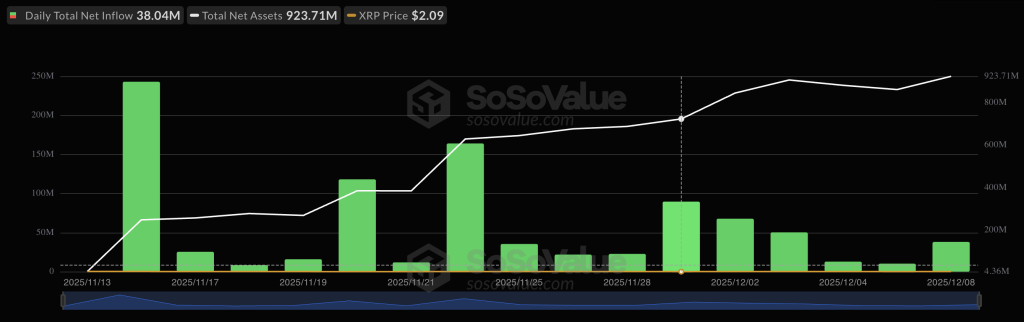 Source: SoSoValue
Besides, spot Solana ETFs posted $1.18M net inflows in a single day, solely from Fidelity’s FSOL fund. The altcoin witnessed a cumulative net inflow of $640.06 million, since its debut on October 28.
Per CoinMarketCap data, XRP showed a significant surge at the start of December, reaching a peak of $2.20. However, the altcoin has dropped 1.54% to $2.05 over the past 24 hours, signalling bearish momentum. XRP is trading at $2.06 at the time of writing.
Meanwhile, Solana has risen to nearly 5% in the past week, trading at $133.16 at press time.
ETF Trajectory for Next Year
Bitwise Asset Management executive Katherine Dowling told DL News that the crypto ETF sector will continue to boom.
“It is a good starter kit for many investors to gain exposure,” said Dowling, adding that altcoin funds such as Solana and XRP “have promising fundamentals,” pushing the prices to go further.
Additionally, Bitfinex analysts view this as a healthy, tactical rebalancing. They told Cryptonews, “the spot ETF channel remains intact.”
Speaking about Bitcoin’s long-term outlook, they said that the structural thesis remains firm.
“As more large allocators use ETF wrappers as entry points, Bitcoin’s path towards a regulated store-of-value role continues, meaning that future inflows can become deeper and more stable.”


You May Also Like

Metaplanet buys 5,075 Bitcoin in Q1 to become 3rd-largest treasury

The changing face of elder care in Malaysia — Sayed Mohammad Reza Yamani Sayed Umar

Not a loophole: Singapore AI export controls let China tap US AI legally



