

Visualizing Data Filtering and Augmentation in Generative Active Learning
Table of Links
Abstract and 1 Introduction
-
Related work
2.1. Generative Data Augmentation
2.2. Active Learning and Data Analysis
-
Preliminary
-
Our method
4.1. Estimation of Contribution in the Ideal Scenario
4.2. Batched Streaming Generative Active Learning
-
Experiments and 5.1. Offline Setting
5.2. Online Setting
-
Conclusion, Broader Impact, and References
\
A. Implementation Details
B. More ablations
C. Discussion
D. Visualization
D. Visualization
D.1. Selected and Discarded Samples
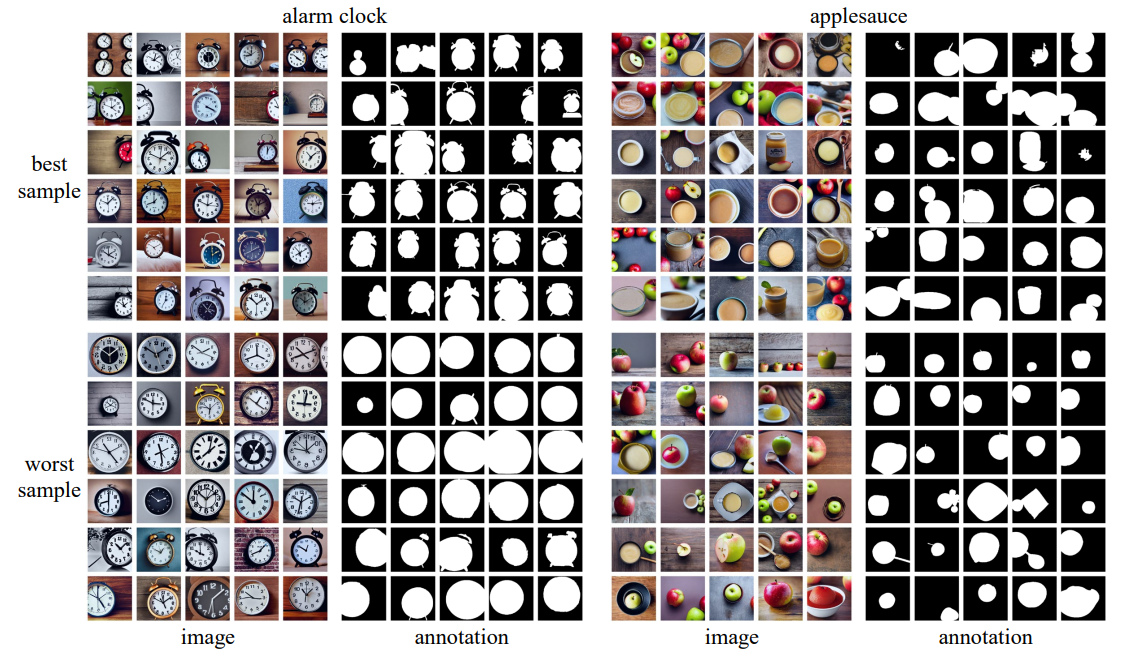
We show some samples selected and discarded by our method in Figure 7. Our proposed method is able to select high-quality samples (best sample) while filtering out low-quality samples (worst sample), which can effectively improve the data learning efficiency of the model. For example, our method is capable of identifying accurately segmented data for applesauce. In cases where applesauce is not present in the generated raw image or is not encompassed within the segmentation mask, our method can discard such samples. For alarm clocks, our method tends to choose images with more complex appearances.
D.2. Instance Augmentation
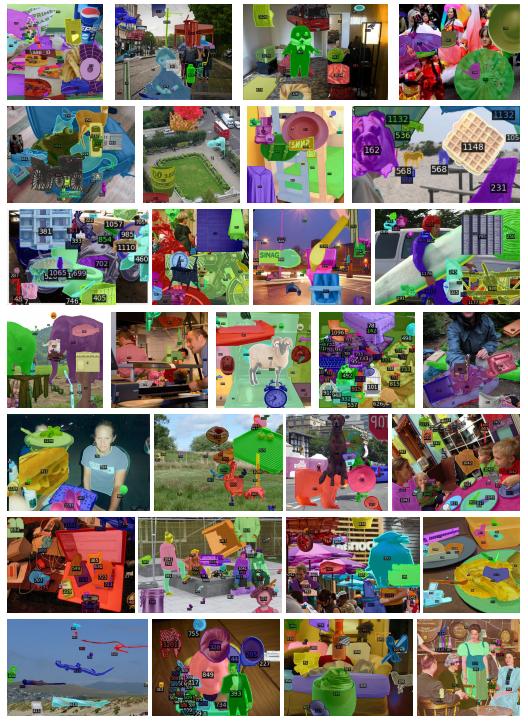
We present some augmented data in Figure 8. By randomly pasting generated samples onto the LVIS training set, we effectively enrich the complexity of the scenes and thus increase the model’s learning efficiency on the generated data.
\ 
\ 
\ 
\
:::info Authors:
(1) Muzhi Zhu, with equal contribution from Zhejiang University, China;
(2) Chengxiang Fan, with equal contribution from Zhejiang University, China;
(3) Hao Chen, Zhejiang University, China ([email protected]);
(4) Yang Liu, Zhejiang University, China;
(5) Weian Mao, Zhejiang University, China and The University of Adelaide, Australia;
(6) Xiaogang Xu, Zhejiang University, China;
(7) Chunhua Shen, Zhejiang University, China ([email protected]).
:::
:::info This paper is available on arxiv under CC BY-NC-ND 4.0 Deed (Attribution-Noncommercial-Noderivs 4.0 International) license.
:::
\
You May Also Like

NZD/USD Plummets: Middle East War and Weak NZ Confidence Crush Kiwi Dollar for Fourth Straight Day

Oil Price at $103 Meets a Bearish Brent Pattern, Is a Ceasefire Being Priced In?


