US District Judge Paul Engelmayer has asked prosecutors and defense lawyers for detailed clarification on a series of unresolved issues ahead of TerraformUS District Judge Paul Engelmayer has asked prosecutors and defense lawyers for detailed clarification on a series of unresolved issues ahead of Terraform

Do Kwon Sentencing: Judge Demands Clarity on Looming 40-Year South Korea Prison Term

US District Judge Paul Engelmayer has asked prosecutors and defense lawyers for detailed clarification on a series of unresolved issues ahead of Terraform Labs co-founder Do Kwon’s sentencing.

This includes the possibility of the crypto entrepreneur facing an additional 40-year prison term in South Korea after serving time in the United States.

The judge issued the order on December 8, laying out multiple questions that he wants answered before the December 11 hearing.
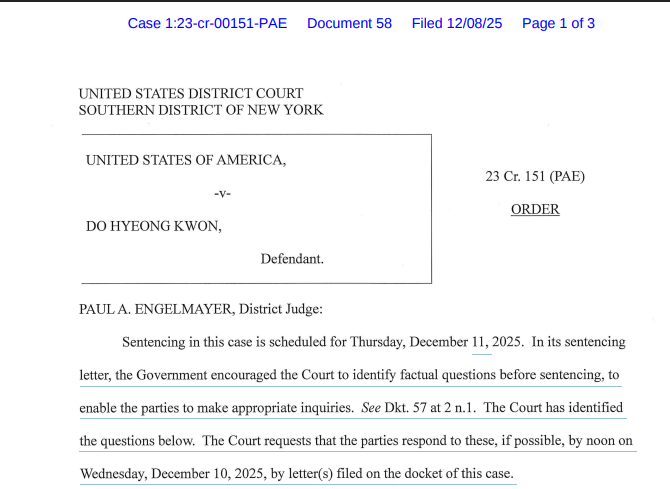
Source: Court Document

The filing shows that the court is weighing how Kwon’s foreign legal exposure, previous detention, and the mechanics of international prisoner transfer programs may affect the punishment imposed in New York.

Court Seeks Clarity on Kwon’s Potential 40-Year Korean Prison Term

The judge’s first set of questions focuses on South Korea’s ongoing criminal case against Kwon.

He asked both parties whether they have any reliable information about the likely outcome of the charges he faces there, whether any agreements have been made with Korean authorities, and what sentencing ranges apply if he is convicted.

South Korean prosecutors previously said they would seek up to 40 years in prison for the same conduct that forms the basis of the US case.

The court also asked whether a Korean sentence could run concurrently or consecutively with a US sentence, a detail that could influence the final terms.

The order also seeks clarification on how to treat the nearly two years Kwon spent in custody in Montenegro. He was arrested in March 2023 while traveling under a false passport and remained detained until extradition.

The judge wants to know whether the Bureau of Prisons will credit any portion of that 21-month period toward his US term and whether the government’s recommendation of a 12-year sentence was based on the assumption that none of that time will count.

Federal prosecutors have already urged the court to impose the full 12 years permitted under Kwon’s plea agreement.

Defense Pushes Back as Prosecutors Call TerraUSD Collapse “Colossal”

They described the TerraUSD collapse as “colossal in scope,” citing the broader market chain reaction that contributed to the downfall of major firms, including Sam Bankman-Fried’s FTX.

Kwon pleaded guilty in August to conspiracy and wire fraud, admitting that he made false statements about TerraUSD’s stability mechanisms and concealed Jump Trading’s role in supporting the stablecoin during a 2021 depeg event.

Kwon’s lawyers have asked for a five-year term instead, arguing that the time he spent in Montenegro was served in “brutal conditions” and should weigh heavily in the court’s decision.

They also point to the likelihood that he will be extradited to South Korea after completing his US sentence, where he faces a much longer potential punishment.

The defense says that imposing the full recommended term would result in an excessively long combined period of imprisonment.

Judge Seeks DOJ Clarification on Victim Compensation and Asset Forfeiture

The judge’s order shows he is taking that possibility seriously. He asked both sides to explain whether supervised release would even matter if Kwon is likely to be removed from the United States.

He also questioned what guarantees the U.S. would have that another country would enforce the rest of Kwon’s sentence if he is transferred overseas.

Prosecutors have already said they will support a transfer request once Kwon serves half of his sentence.

But the judge noted that these transfers usually require detailed recommendations to the Bureau of Prisons before they can move forward.

The filing also points to several administrative problems tied to forfeiture and victim payments.

The judge asked the Justice Department to clarify how its remission process would decide which victims qualify for compensation from the seized assets.

This question is especially important because the losses span multiple countries, and no restitution order was requested in the case.


Disclaimer: The articles reposted on this site are sourced from public platforms and are provided for informational purposes only. They do not necessarily reflect the views of MEXC. All rights remain with the original authors. If you believe any content infringes on third-party rights, please contact [email protected] for removal. MEXC makes no guarantees regarding the accuracy, completeness, or timeliness of the content and is not responsible for any actions taken based on the information provided. The content does not constitute financial, legal, or other professional advice, nor should it be considered a recommendation or endorsement by MEXC.

You May Also Like

Optum Golf Channel Games Debut In Prime Time

Optum Golf Channel Games Debut In Prime Time

The post Optum Golf Channel Games Debut In Prime Time appeared on BitcoinEthereumNews.com. FARMINGDALE, NEW YORK – SEPTEMBER 28: (L-R) Scottie Scheffler of Team
Share
BitcoinEthereumNews2025/12/18 07:21
Google's AP2 protocol has been released. Does encrypted AI still have a chance?

Google's AP2 protocol has been released. Does encrypted AI still have a chance?

Following the MCP and A2A protocols, the AI Agent market has seen another blockbuster arrival: the Agent Payments Protocol (AP2), developed by Google. This will clearly further enhance AI Agents' autonomous multi-tasking capabilities, but the unfortunate reality is that it has little to do with web3AI. Let's take a closer look: What problem does AP2 solve? Simply put, the MCP protocol is like a universal hook, enabling AI agents to connect to various external tools and data sources; A2A is a team collaboration communication protocol that allows multiple AI agents to cooperate with each other to complete complex tasks; AP2 completes the last piece of the puzzle - payment capability. In other words, MCP opens up connectivity, A2A promotes collaboration efficiency, and AP2 achieves value exchange. The arrival of AP2 truly injects "soul" into the autonomous collaboration and task execution of Multi-Agents. Imagine AI Agents connecting Qunar, Meituan, and Didi to complete the booking of flights, hotels, and car rentals, but then getting stuck at the point of "self-payment." What's the point of all that multitasking? So, remember this: AP2 is an extension of MCP+A2A, solving the last mile problem of AI Agent automated execution. What are the technical highlights of AP2? The core innovation of AP2 is the Mandates mechanism, which is divided into real-time authorization mode and delegated authorization mode. Real-time authorization is easy to understand. The AI Agent finds the product and shows it to you. The operation can only be performed after the user signs. Delegated authorization requires the user to set rules in advance, such as only buying the iPhone 17 when the price drops to 5,000. The AI Agent monitors the trigger conditions and executes automatically. The implementation logic is cryptographically signed using Verifiable Credentials (VCs). Users can set complex commission conditions, including price ranges, time limits, and payment method priorities, forming a tamper-proof digital contract. Once signed, the AI Agent executes according to the conditions, with VCs ensuring auditability and security at every step. Of particular note is the "A2A x402" extension, a technical component developed by Google specifically for crypto payments, developed in collaboration with Coinbase and the Ethereum Foundation. This extension enables AI Agents to seamlessly process stablecoins, ETH, and other blockchain assets, supporting native payment scenarios within the Web3 ecosystem. What kind of imagination space can AP2 bring? After analyzing the technical principles, do you think that's it? Yes, in fact, the AP2 is boring when it is disassembled alone. Its real charm lies in connecting and opening up the "MCP+A2A+AP2" technology stack, completely opening up the complete link of AI Agent's autonomous analysis+execution+payment. From now on, AI Agents can open up many application scenarios. For example, AI Agents for stock investment and financial management can help us monitor the market 24/7 and conduct independent transactions. Enterprise procurement AI Agents can automatically replenish and renew without human intervention. AP2's complementary payment capabilities will further expand the penetration of the Agent-to-Agent economy into more scenarios. Google obviously understands that after the technical framework is established, the ecological implementation must be relied upon, so it has brought in more than 60 partners to develop it, almost covering the entire payment and business ecosystem. Interestingly, it also involves major Crypto players such as Ethereum, Coinbase, MetaMask, and Sui. Combined with the current trend of currency and stock integration, the imagination space has been doubled. Is web3 AI really dead? Not entirely. Google's AP2 looks complete, but it only achieves technical compatibility with Crypto payments. It can only be regarded as an extension of the traditional authorization framework and belongs to the category of automated execution. There is a "paradigm" difference between it and the autonomous asset management pursued by pure Crypto native solutions. The Crypto-native solutions under exploration are taking the "decentralized custody + on-chain verification" route, including AI Agent autonomous asset management, AI Agent autonomous transactions (DeFAI), AI Agent digital identity and on-chain reputation system (ERC-8004...), AI Agent on-chain governance DAO framework, AI Agent NPC and digital avatars, and many other interesting and fun directions. Ultimately, once users get used to AI Agent payments in traditional fields, their acceptance of AI Agents autonomously owning digital assets will also increase. And for those scenarios that AP2 cannot reach, such as anonymous transactions, censorship-resistant payments, and decentralized asset management, there will always be a time for crypto-native solutions to show their strength? The two are more likely to be complementary rather than competitive, but to be honest, the key technological advancements behind AI Agents currently all come from web2AI, and web3AI still needs to keep up the good work!
Share
PANews2025/09/18 07:00
Read Trend And Momentum Across Markets

Read Trend And Momentum Across Markets

The post Read Trend And Momentum Across Markets appeared on BitcoinEthereumNews.com. Widely used in technical analysis, the MACD indicator helps traders read trend
Share
BitcoinEthereumNews2025/12/18 07:14





