In the broadening blockchain sector, the Ethereum network remains a dominant force, heavily utilized and constantly selected by crypto players to carry out their on-chain operations. A recent report shows that Ethereum is transitioning from blockchain to the big league, as the network overtakes dollar-denominated transactions across digital payments. A Leader In Dollar Transactions With […]In the broadening blockchain sector, the Ethereum network remains a dominant force, heavily utilized and constantly selected by crypto players to carry out their on-chain operations. A recent report shows that Ethereum is transitioning from blockchain to the big league, as the network overtakes dollar-denominated transactions across digital payments. A Leader In Dollar Transactions With […]

Ethereum Emerges As A Dollar Settlement Powerhouse, Outpacing Traditional Payment Networks – Details

In the broadening blockchain sector, the Ethereum network remains a dominant force, heavily utilized and constantly selected by crypto players to carry out their on-chain operations. A recent report shows that Ethereum is transitioning from blockchain to the big league, as the network overtakes dollar-denominated transactions across digital payments.

A Leader In Dollar Transactions

With a surge in stablecoin transfer volume, Ethereum is no longer only a rival in the cryptocurrency space. In a post on the X platform, Leon Waidmann, a market expert and head of research at On-Chain Foundation, reported that ETH is currently surpassing some of the largest traditional payment networks in the world in terms of raw transaction volume.

Data from the post reveals a surge in dollar-denominated transactions on Ethereum, which has triggered new conversations about its increasing prominence as a layer of global settlement. This spike shows that the blockchain’s changing role in finance is becoming more difficult for institutions to ignore as volumes surge past expectations.

With one month remaining in the year, the amount of ETH stablecoin transfers in Q4 has already exceeded that of Q3. According to the data, the leading network has recorded nearly $6 trillion in stablecoin volume in the fourth quarter of this year alone, reflecting its growing demand for payment settlement.
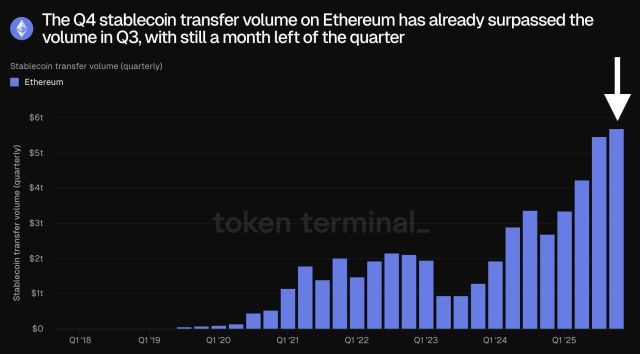
Ethereum

When it comes to dollar-dominated transaction volume, the blockchain has already outpaced both Visa and Mastercard transaction volumes in the current quarter. Given the surge in stablecoin transfer volume, Ethereum is gradually becoming the major settlement layer for digital dollars.

Waidmann stated that the size makes early Decentralized Finance (DeFi) activity appear insignificant by comparison. In the meantime, the conventional financial infrastructure is being surpassed by the on-chain economy.

Ethereum Network’s Throughput Exhibiting Robust Growth

As demand for Ethereum as the main settlement layer grows, the network is also quietly entering a new phase of its evolution. This change is one that is characterized by accessibility, efficiency, and quickness rather than traffic jams and soaring costs.

Waidmann highlighted that ETH scaling is rising, alongside growing throughput and declining transaction costs. With transaction prices continuously declining and network throughput surging, the blockchain is demonstrating concrete evidence that its long-promised scaling vision is coming to pass.

As a result, Ethereum will be able to handle an increasing amount of activity over time. However, the network’s usage cost continues to decline, drawing close to zero. Currently, Layer 2s take care of the heavy execution while the mainnet settles the valuable transactions. Should these two lines continue to move in opposite directions, ETH is scaling just as planned.

At the time of writing, the price of ETH was still holding above the $3,100 level despite recording a more than 1% decline in the last 24 hours. Its trading volume has also witnessed a bearish action, dropping by over 4% in the past day.


Ethereum
Disclaimer: The articles reposted on this site are sourced from public platforms and are provided for informational purposes only. They do not necessarily reflect the views of MEXC. All rights remain with the original authors. If you believe any content infringes on third-party rights, please contact [email protected] for removal. MEXC makes no guarantees regarding the accuracy, completeness, or timeliness of the content and is not responsible for any actions taken based on the information provided. The content does not constitute financial, legal, or other professional advice, nor should it be considered a recommendation or endorsement by MEXC.

You May Also Like

The Channel Factories We’ve Been Waiting For

The Channel Factories We’ve Been Waiting For

The post The Channel Factories We’ve Been Waiting For appeared on BitcoinEthereumNews.com. Visions of future technology are often prescient about the broad strokes while flubbing the details. The tablets in “2001: A Space Odyssey” do indeed look like iPads, but you never see the astronauts paying for subscriptions or wasting hours on Candy Crush.  Channel factories are one vision that arose early in the history of the Lightning Network to address some challenges that Lightning has faced from the beginning. Despite having grown to become Bitcoin’s most successful layer-2 scaling solution, with instant and low-fee payments, Lightning’s scale is limited by its reliance on payment channels. Although Lightning shifts most transactions off-chain, each payment channel still requires an on-chain transaction to open and (usually) another to close. As adoption grows, pressure on the blockchain grows with it. The need for a more scalable approach to managing channels is clear. Channel factories were supposed to meet this need, but where are they? In 2025, subnetworks are emerging that revive the impetus of channel factories with some new details that vastly increase their potential. They are natively interoperable with Lightning and achieve greater scale by allowing a group of participants to open a shared multisig UTXO and create multiple bilateral channels, which reduces the number of on-chain transactions and improves capital efficiency. Achieving greater scale by reducing complexity, Ark and Spark perform the same function as traditional channel factories with new designs and additional capabilities based on shared UTXOs.  Channel Factories 101 Channel factories have been around since the inception of Lightning. A factory is a multiparty contract where multiple users (not just two, as in a Dryja-Poon channel) cooperatively lock funds in a single multisig UTXO. They can open, close and update channels off-chain without updating the blockchain for each operation. Only when participants leave or the factory dissolves is an on-chain transaction…
Share
BitcoinEthereumNews2025/09/18 00:09
Talent Technology Company Cappfinity accelerates growth plans through Chief Talent Management Officer appointment

Talent Technology Company Cappfinity accelerates growth plans through Chief Talent Management Officer appointment

LONDON, Jan. 20, 2026 /PRNewswire/ — Cappfinity is pleased to announce the promotion of Stephanie Hopper to the role of Chief Talent Management Officer, marking
Share
AI Journal2026/01/20 15:30
TRX Technical Analysis Jan 20

TRX Technical Analysis Jan 20

The post TRX Technical Analysis Jan 20 appeared on BitcoinEthereumNews.com. TRX is consolidating at the $0.31 level while showing a short-term bullish tendency
Share
BitcoinEthereumNews2026/01/20 15:27





