Since Bitcoin’s launch, the number of addresses holding more than 0.1 BTC has climbed steadily through every market cycle, until now. Data shows that addresses in this cohort haven’t grown at all over the past two years, breaking a trend that held for more than a decade.  The stagnation indicates a change in how smaller and mid-sized investors engage with Bitcoin, even as broader institutional activity in the market continues to rise. Small Holder Participation Reaches A Standstill The 0.1 BTC threshold has historically represented an important milestone for retail holders, large enough to signal commitment but small enough to remain widely attainable. For more than a decade, wallets crossing that line grew year after year, even during drawdowns when long-term buyers were accumulating quietly. Related Reading: The $13.5 Billion Liquidity Injection That Could Send Bitcoin And Crypto Prices Flying That pattern is no longer intact. The number of addresses with more than 0.1 BTC has flattened since 2023 and is showing no signs of returning to its previous trajectory. Particularly, data from the on-chain analytics platform Santiment shows that the number of these addresses has stalled at around 4.44 million for the past year. This suggests that fewer new participants are choosing to build self-custodied Bitcoin positions at this level. The stagnation becomes more notable considering Bitcoin’s rising mainstream visibility and repeated pushes toward new all-time highs this year. In earlier cycles, such conditions have led to a surge in retail accumulation. This time, the address count has stayed frozen, and this means retail addresses holding Bitcoin might actually be plateauing.  How Bitcoin’s Holder Base Is Changing Although on-chain data points to a slowdown in the growth of overall Bitcoin addresses holding more than 0.1 BTC, it doesn’t necessarily signal a decline in overall adoption. For many market participants, Bitcoin exposure now happens entirely off-chain. Related Reading: Confirming The Bitcoin Price Direction: Analyst Reveals What You Should Look Out For Larger investor cohorts, from high-net-worth individuals to funds and corporate entities, are buying huge amounts of Bitcoin. For instance, Santiment data shows that large Bitcoin holders controlling more than 100 BTC have increased their balances throughout 2024 and 2025, even as smaller address cohorts have stalled. At the same time, more investors are choosing to access Bitcoin through custodial avenues instead of managing their own wallets. Spot Bitcoin ETFs have become one of the most important gateways for new BTC exposure. In the US alone, Spot Bitcoin ETFs now control almost $120 billion worth of Bitcoin, with BlackRock’s IBIT consistently recording the strongest demand.  Together, these developments point to a new phase in Bitcoin’s development. What was once dominated by individual self-custodied users is now increasingly shaped by institutions, ETFs, funds, and professionally managed capital. Therefore, the numbers from on-chain wallet metrics reflect a smaller portion of the actual user base. Featured image from Pixabay, chart from Tradingview.comSince Bitcoin’s launch, the number of addresses holding more than 0.1 BTC has climbed steadily through every market cycle, until now. Data shows that addresses in this cohort haven’t grown at all over the past two years, breaking a trend that held for more than a decade.  The stagnation indicates a change in how smaller and mid-sized investors engage with Bitcoin, even as broader institutional activity in the market continues to rise. Small Holder Participation Reaches A Standstill The 0.1 BTC threshold has historically represented an important milestone for retail holders, large enough to signal commitment but small enough to remain widely attainable. For more than a decade, wallets crossing that line grew year after year, even during drawdowns when long-term buyers were accumulating quietly. Related Reading: The $13.5 Billion Liquidity Injection That Could Send Bitcoin And Crypto Prices Flying That pattern is no longer intact. The number of addresses with more than 0.1 BTC has flattened since 2023 and is showing no signs of returning to its previous trajectory. Particularly, data from the on-chain analytics platform Santiment shows that the number of these addresses has stalled at around 4.44 million for the past year. This suggests that fewer new participants are choosing to build self-custodied Bitcoin positions at this level. The stagnation becomes more notable considering Bitcoin’s rising mainstream visibility and repeated pushes toward new all-time highs this year. In earlier cycles, such conditions have led to a surge in retail accumulation. This time, the address count has stayed frozen, and this means retail addresses holding Bitcoin might actually be plateauing.  How Bitcoin’s Holder Base Is Changing Although on-chain data points to a slowdown in the growth of overall Bitcoin addresses holding more than 0.1 BTC, it doesn’t necessarily signal a decline in overall adoption. For many market participants, Bitcoin exposure now happens entirely off-chain. Related Reading: Confirming The Bitcoin Price Direction: Analyst Reveals What You Should Look Out For Larger investor cohorts, from high-net-worth individuals to funds and corporate entities, are buying huge amounts of Bitcoin. For instance, Santiment data shows that large Bitcoin holders controlling more than 100 BTC have increased their balances throughout 2024 and 2025, even as smaller address cohorts have stalled. At the same time, more investors are choosing to access Bitcoin through custodial avenues instead of managing their own wallets. Spot Bitcoin ETFs have become one of the most important gateways for new BTC exposure. In the US alone, Spot Bitcoin ETFs now control almost $120 billion worth of Bitcoin, with BlackRock’s IBIT consistently recording the strongest demand.  Together, these developments point to a new phase in Bitcoin’s development. What was once dominated by individual self-custodied users is now increasingly shaped by institutions, ETFs, funds, and professionally managed capital. Therefore, the numbers from on-chain wallet metrics reflect a smaller portion of the actual user base. Featured image from Pixabay, chart from Tradingview.com

Bitcoin Addresses Holding Over 0.1 BTC Haven’t Grown in Two Years, What Does This Mean?

2025/12/10 06:00
3 min read
For feedback or concerns regarding this content, please contact us at [email protected]

Since Bitcoin’s launch, the number of addresses holding more than 0.1 BTC has climbed steadily through every market cycle, until now. Data shows that addresses in this cohort haven’t grown at all over the past two years, breaking a trend that held for more than a decade. 

The stagnation indicates a change in how smaller and mid-sized investors engage with Bitcoin, even as broader institutional activity in the market continues to rise.

Small Holder Participation Reaches A Standstill

The 0.1 BTC threshold has historically represented an important milestone for retail holders, large enough to signal commitment but small enough to remain widely attainable. For more than a decade, wallets crossing that line grew year after year, even during drawdowns when long-term buyers were accumulating quietly.

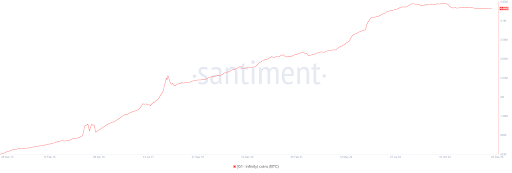
That pattern is no longer intact. The number of addresses with more than 0.1 BTC has flattened since 2023 and is showing no signs of returning to its previous trajectory. Particularly, data from the on-chain analytics platform Santiment shows that the number of these addresses has stalled at around 4.44 million for the past year. This suggests that fewer new participants are choosing to build self-custodied Bitcoin positions at this level.
Bitcoin

The stagnation becomes more notable considering Bitcoin’s rising mainstream visibility and repeated pushes toward new all-time highs this year. In earlier cycles, such conditions have led to a surge in retail accumulation. This time, the address count has stayed frozen, and this means retail addresses holding Bitcoin might actually be plateauing. 

How Bitcoin’s Holder Base Is Changing

Although on-chain data points to a slowdown in the growth of overall Bitcoin addresses holding more than 0.1 BTC, it doesn’t necessarily signal a decline in overall adoption. For many market participants, Bitcoin exposure now happens entirely off-chain.

Larger investor cohorts, from high-net-worth individuals to funds and corporate entities, are buying huge amounts of Bitcoin. For instance, Santiment data shows that large Bitcoin holders controlling more than 100 BTC have increased their balances throughout 2024 and 2025, even as smaller address cohorts have stalled.

At the same time, more investors are choosing to access Bitcoin through custodial avenues instead of managing their own wallets. Spot Bitcoin ETFs have become one of the most important gateways for new BTC exposure. In the US alone, Spot Bitcoin ETFs now control almost $120 billion worth of Bitcoin, with BlackRock’s IBIT consistently recording the strongest demand. 

Together, these developments point to a new phase in Bitcoin’s development. What was once dominated by individual self-custodied users is now increasingly shaped by institutions, ETFs, funds, and professionally managed capital. Therefore, the numbers from on-chain wallet metrics reflect a smaller portion of the actual user base.


Bitcoin
Disclaimer: The articles reposted on this site are sourced from public platforms and are provided for informational purposes only. They do not necessarily reflect the views of MEXC. All rights remain with the original authors. If you believe any content infringes on third-party rights, please contact [email protected] for removal. MEXC makes no guarantees regarding the accuracy, completeness, or timeliness of the content and is not responsible for any actions taken based on the information provided. The content does not constitute financial, legal, or other professional advice, nor should it be considered a recommendation or endorsement by MEXC.

You May Also Like

XRP Price News: Elon Musk Confirms X Money Crypto Plans as Pepeto’s Three Products Approach Launch and the 537x Window Stays Open

XRP Price News: Elon Musk Confirms X Money Crypto Plans as Pepeto’s Three Products Approach Launch and the 537x Window Stays Open

Elon Musk just told the world that X Money is adding crypto. When a platform with hundreds of millions of users integrates cryptocurrency, the market pays attention
Share
Techbullion2026/03/07 08:37
What should investors expect from the Federal Reserve after latest jobs data?

What should investors expect from the Federal Reserve after latest jobs data?

Investors looking at the Federal Reserve after the latest jobs data got a rough answer on Friday. The labor market is getting weaker, inflation is still above the
Share
Cryptopolitan2026/03/07 08:20
BlackRock clients sell $80.2M in Ether

BlackRock clients sell $80.2M in Ether

The post BlackRock clients sell $80.2M in Ether appeared on BitcoinEthereumNews.com. Key Takeaways BlackRock clients sold $80.2 million worth of Ether on Oct. 10, indicating significant outflows from its spot Ethereum ETFs. Ethereum ETFs have experienced both inflows and outflows, with institutions actively rebalancing portfolios. BlackRock clients sold $80.2 million worth of Ether today, marking significant outflow activity from the asset management firm’s spot Ethereum ETF products. Ethereum ETFs have facilitated active trading adjustments as institutions respond to market volatility. The selling activity underscores how traditional finance players are using these products to manage exposure to the blockchain network that supports decentralized finance and layer-2 scaling solutions. Despite periodic sell-offs, institutional players like BlackRock continue to provide Ethereum exposure for clients, highlighting the growing mainstream integration of blockchain assets in traditional finance. Source: https://cryptobriefing.com/blackrock-clients-sell-ether-etf-outflows/
Share
BitcoinEthereumNews2025/10/11 15:30




