Ethereum has spent the past several days consolidating in a tight range between $3,000 and $3,200, signaling a moment of hesitation as the broader market struggles to find direction. Despite attempts to push higher, momentum has flattened, and uncertainty continues to dominate sentiment. Many analysts now warn that Ethereum may be entering a deeper bearish phase, pointing to weakening spot demand, fragile market structure, and fading optimism across major exchanges. Related Reading: Smart Whales Align: Top Performers Go All-In On Ethereum Long Positions With Over $425M in Exposure However, one on-chain development has captured the market’s attention. According to new data from CryptoQuant, December 5, 2025 saw a massive spike in Ethereum Exchange Netflow to Binance, marking one of the largest daily inflows in years. Such a surge typically raises questions about investor intentions: large inflows often signal that holders are moving ETH onto exchanges with the potential to sell, increasing the probability of short-term volatility or downside pressure. Yet the broader context matters. Ethereum’s price remains above key support, suggesting that the market is in a critical decision zone rather than a confirmed breakdown. This combination of consolidation, rising caution, and an unusually large exchange inflow sets the stage for what could become a pivotal moment for ETH as traders prepare for the next major move. Massive Netflow Surge Raises Caution for Ethereum According to data from CryptoOnchain shared on CryptoQuant, Ethereum experienced a striking shift in exchange activity on December 5, 2025. The netflow to Binance reached 162,084 ETH while the price hovered near $3,021, marking the largest daily positive netflow since May 2023. Such an influx is significant, not only because of its size but because of what it typically signals: a rise in the number of investors moving ETH from self-custody to exchanges. Historically, large positive netflows are interpreted as potentially bearish, suggesting that holders may be preparing to sell or rebalance. When deposits drastically outweigh withdrawals, it can precede heightened selling pressure, especially when the market is already in a fragile state. Inflows of this magnitude can act as a temporary supply shock; if even a portion of this ETH hits the order books as market sells, the price could face increased volatility or short-term corrective pressure. Because of this, traders should closely monitor how Binance absorbs this liquidity. Watching order book depth, open interest reactions, and subsequent netflow patterns will reveal whether this was a one-off spike or the beginning of a broader shift in investor behavior. In a market this delicate, even a single inflow event can set the tone for the days ahead. Related Reading: Ethereum Loses Momentum While OI Holds Steady: Binance Data Shows A Market Reset ETH Price Attempts Stabilization Ethereum’s daily chart shows a market in the process of stabilizing, but still weighed down by significant structural resistance. After dipping below $2,800 in late November, ETH has managed to reclaim the $3,100 region, where it has been consolidating for several days. This range-bound behavior signals a pause in the prior downtrend, yet the recovery lacks the strong momentum typically seen in bullish reversals. The 50-day and 100-day moving averages remain positioned above the current price, forming a clear zone of resistance between $3,250 and $3,500. These declining MAs highlight that the broader trend still favors sellers, and ETH will need a decisive breakout above them to shift market sentiment. The 200-day MA, sitting higher, reinforces the idea that Ethereum is still trading below its long-term trend structure. Related Reading: Bitcoin Must Break $97K To Restore Confidence Among Youngest Long-Term Holders – Details Volume has also weakened during this rebound, suggesting that buyers are hesitant to commit aggressively at current levels. The recent spike in exchange netflows adds another layer of caution, raising the possibility of increased near-term selling pressure. ETH is showing early signs of stabilization, but the path forward requires stronger conviction. Until price breaks above the cluster of moving averages, this recovery remains fragile and vulnerable to renewed downside pressure. Featured image from ChatGPT, chart from TradingView.comEthereum has spent the past several days consolidating in a tight range between $3,000 and $3,200, signaling a moment of hesitation as the broader market struggles to find direction. Despite attempts to push higher, momentum has flattened, and uncertainty continues to dominate sentiment. Many analysts now warn that Ethereum may be entering a deeper bearish phase, pointing to weakening spot demand, fragile market structure, and fading optimism across major exchanges. Related Reading: Smart Whales Align: Top Performers Go All-In On Ethereum Long Positions With Over $425M in Exposure However, one on-chain development has captured the market’s attention. According to new data from CryptoQuant, December 5, 2025 saw a massive spike in Ethereum Exchange Netflow to Binance, marking one of the largest daily inflows in years. Such a surge typically raises questions about investor intentions: large inflows often signal that holders are moving ETH onto exchanges with the potential to sell, increasing the probability of short-term volatility or downside pressure. Yet the broader context matters. Ethereum’s price remains above key support, suggesting that the market is in a critical decision zone rather than a confirmed breakdown. This combination of consolidation, rising caution, and an unusually large exchange inflow sets the stage for what could become a pivotal moment for ETH as traders prepare for the next major move. Massive Netflow Surge Raises Caution for Ethereum According to data from CryptoOnchain shared on CryptoQuant, Ethereum experienced a striking shift in exchange activity on December 5, 2025. The netflow to Binance reached 162,084 ETH while the price hovered near $3,021, marking the largest daily positive netflow since May 2023. Such an influx is significant, not only because of its size but because of what it typically signals: a rise in the number of investors moving ETH from self-custody to exchanges. Historically, large positive netflows are interpreted as potentially bearish, suggesting that holders may be preparing to sell or rebalance. When deposits drastically outweigh withdrawals, it can precede heightened selling pressure, especially when the market is already in a fragile state. Inflows of this magnitude can act as a temporary supply shock; if even a portion of this ETH hits the order books as market sells, the price could face increased volatility or short-term corrective pressure. Because of this, traders should closely monitor how Binance absorbs this liquidity. Watching order book depth, open interest reactions, and subsequent netflow patterns will reveal whether this was a one-off spike or the beginning of a broader shift in investor behavior. In a market this delicate, even a single inflow event can set the tone for the days ahead. Related Reading: Ethereum Loses Momentum While OI Holds Steady: Binance Data Shows A Market Reset ETH Price Attempts Stabilization Ethereum’s daily chart shows a market in the process of stabilizing, but still weighed down by significant structural resistance. After dipping below $2,800 in late November, ETH has managed to reclaim the $3,100 region, where it has been consolidating for several days. This range-bound behavior signals a pause in the prior downtrend, yet the recovery lacks the strong momentum typically seen in bullish reversals. The 50-day and 100-day moving averages remain positioned above the current price, forming a clear zone of resistance between $3,250 and $3,500. These declining MAs highlight that the broader trend still favors sellers, and ETH will need a decisive breakout above them to shift market sentiment. The 200-day MA, sitting higher, reinforces the idea that Ethereum is still trading below its long-term trend structure. Related Reading: Bitcoin Must Break $97K To Restore Confidence Among Youngest Long-Term Holders – Details Volume has also weakened during this rebound, suggesting that buyers are hesitant to commit aggressively at current levels. The recent spike in exchange netflows adds another layer of caution, raising the possibility of increased near-term selling pressure. ETH is showing early signs of stabilization, but the path forward requires stronger conviction. Until price breaks above the cluster of moving averages, this recovery remains fragile and vulnerable to renewed downside pressure. Featured image from ChatGPT, chart from TradingView.com

Ethereum Sees Largest Binance Inflow Since 2023 – Warning Sign?

2025/12/10 07:00

Ethereum has spent the past several days consolidating in a tight range between $3,000 and $3,200, signaling a moment of hesitation as the broader market struggles to find direction. Despite attempts to push higher, momentum has flattened, and uncertainty continues to dominate sentiment. Many analysts now warn that Ethereum may be entering a deeper bearish phase, pointing to weakening spot demand, fragile market structure, and fading optimism across major exchanges.

However, one on-chain development has captured the market’s attention. According to new data from CryptoQuant, December 5, 2025 saw a massive spike in Ethereum Exchange Netflow to Binance, marking one of the largest daily inflows in years. Such a surge typically raises questions about investor intentions: large inflows often signal that holders are moving ETH onto exchanges with the potential to sell, increasing the probability of short-term volatility or downside pressure.

Yet the broader context matters. Ethereum’s price remains above key support, suggesting that the market is in a critical decision zone rather than a confirmed breakdown. This combination of consolidation, rising caution, and an unusually large exchange inflow sets the stage for what could become a pivotal moment for ETH as traders prepare for the next major move.

Massive Netflow Surge Raises Caution for Ethereum

According to data from CryptoOnchain shared on CryptoQuant, Ethereum experienced a striking shift in exchange activity on December 5, 2025. The netflow to Binance reached 162,084 ETH while the price hovered near $3,021, marking the largest daily positive netflow since May 2023. Such an influx is significant, not only because of its size but because of what it typically signals: a rise in the number of investors moving ETH from self-custody to exchanges.

Ethereum Exchange Netflow on Binance | Source: CryptoQuant

Historically, large positive netflows are interpreted as potentially bearish, suggesting that holders may be preparing to sell or rebalance. When deposits drastically outweigh withdrawals, it can precede heightened selling pressure, especially when the market is already in a fragile state. Inflows of this magnitude can act as a temporary supply shock; if even a portion of this ETH hits the order books as market sells, the price could face increased volatility or short-term corrective pressure.

Because of this, traders should closely monitor how Binance absorbs this liquidity. Watching order book depth, open interest reactions, and subsequent netflow patterns will reveal whether this was a one-off spike or the beginning of a broader shift in investor behavior. In a market this delicate, even a single inflow event can set the tone for the days ahead.

ETH Price Attempts Stabilization

Ethereum’s daily chart shows a market in the process of stabilizing, but still weighed down by significant structural resistance. After dipping below $2,800 in late November, ETH has managed to reclaim the $3,100 region, where it has been consolidating for several days. This range-bound behavior signals a pause in the prior downtrend, yet the recovery lacks the strong momentum typically seen in bullish reversals.
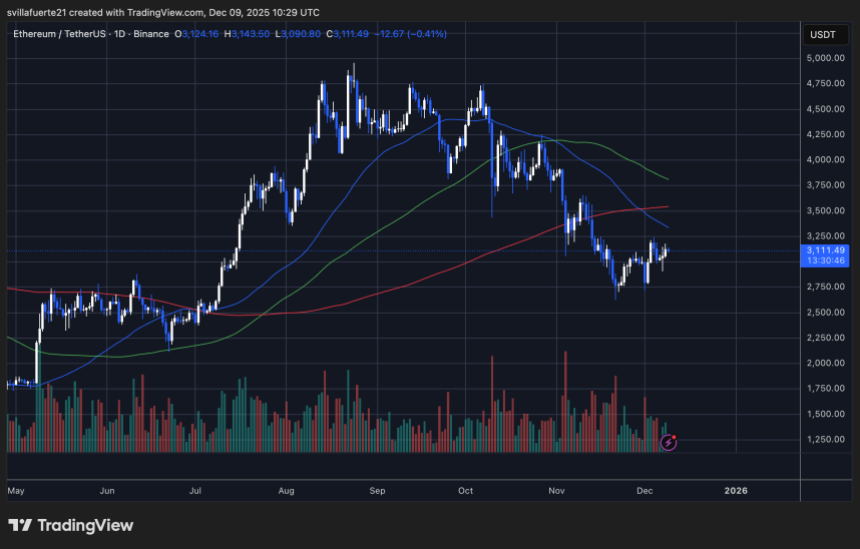
ETH consolidates between key levels | Source: ETHUSDT chart on TradingView

The 50-day and 100-day moving averages remain positioned above the current price, forming a clear zone of resistance between $3,250 and $3,500. These declining MAs highlight that the broader trend still favors sellers, and ETH will need a decisive breakout above them to shift market sentiment. The 200-day MA, sitting higher, reinforces the idea that Ethereum is still trading below its long-term trend structure.

Volume has also weakened during this rebound, suggesting that buyers are hesitant to commit aggressively at current levels. The recent spike in exchange netflows adds another layer of caution, raising the possibility of increased near-term selling pressure.

ETH is showing early signs of stabilization, but the path forward requires stronger conviction. Until price breaks above the cluster of moving averages, this recovery remains fragile and vulnerable to renewed downside pressure.

Featured image from ChatGPT, chart from TradingView.com

Disclaimer: The articles reposted on this site are sourced from public platforms and are provided for informational purposes only. They do not necessarily reflect the views of MEXC. All rights remain with the original authors. If you believe any content infringes on third-party rights, please contact [email protected] for removal. MEXC makes no guarantees regarding the accuracy, completeness, or timeliness of the content and is not responsible for any actions taken based on the information provided. The content does not constitute financial, legal, or other professional advice, nor should it be considered a recommendation or endorsement by MEXC.

You May Also Like

“I Wasted 8 Years in Crypto”: A Builder’s Exit Note Goes Viral Across Asia

“I Wasted 8 Years in Crypto”: A Builder’s Exit Note Goes Viral Across Asia

The post “I Wasted 8 Years in Crypto”: A Builder’s Exit Note Goes Viral Across Asia appeared on BitcoinEthereumNews.com. “I am NOT building a new financial system. I built a casino.”This stark admission from Ken Chan, former co-founder of derivatives protocol Aevo, has been reverberating across Asian crypto communities this week. What began as a post on X has now crossed linguistic borders, been introduced to Chinese communities by local news media, and been widely shared among Korean traders, accumulating millions of views along the way. Sponsored Sponsored From Ayn Rand to Disillusionment: A Libertarian’s Journey Through Crypto Chan’s confession is not merely a critique—it is the unraveling of a personal ideology. He describes himself as a “starry-eyed libertarian” who donated to Gary Johnson’s 2016 presidential campaign after being radicalized by Ayn Rand’s novels. The cypherpunk ethos of Bitcoin spoke directly to this worldview. “Being able to walk across the border with a billion dollars in your head is and always will be a powerful idea to me,” he writes. Yet eight years of industry experience eroded that idealism. Chan recounts how the Layer 1 wars—the flood of capital into Aptos, Sui, Sei, ICP, and countless others—produced no meaningful progress toward a new financial system. Instead, it “literally torched everyone’s money” in pursuit of becoming the next Solana. His verdict is unsparing: “We do not need to build the Casino on Mars.” According to his LinkedIn profile, Chan departed Aevo in May this year. His personal website indicates he is now working on KENSAT, a personal satellite project. It is scheduled to launch aboard a Falcon 9 in June 2026. His confession arrives six months after his departure. It comes as AEVO token trades at roughly $45 million in fully diluted market cap—down approximately 99% from its peak. Chan’s central metaphor—that crypto has become “the biggest, online, multi-player 24/7 casino our generation has ever concocted”—cuts through technical complexity with…
Share
BitcoinEthereumNews2025/12/10 11:04
Bitcoin faces quantum risk: Solana co-founder issues warning

Bitcoin faces quantum risk: Solana co-founder issues warning

The post Bitcoin faces quantum risk: Solana co-founder issues warning appeared on BitcoinEthereumNews.com. Solana co-founder Anatoly Yakovenko has warned that Bitcoin developers must prepare for a potential quantum computing breakthrough that could render the network’s current security measures outdated. Summary At the All-In Summit, Solana co-founder Anatoly Yakovenko reignited debate over Bitcoin’s long-term security. There’s a “50/50” chance that quantum computers could break its cryptographic defenses within five years. Rapid advances in AI show how quickly theory can become reality. The question is not just if Bitcoin must migrate to quantum-safe cryptography—but when. According to Yakovenko, who was speaking at the All-In Summit 2025, there is a “50/50” probability that within five years, quantum computers will be strong enough to crack the cryptographic safeguards protecting Bitcoin wallets. The concern centers on quantum machines running algorithms like Shor’s, which could crack the Elliptic Curve Digital Signature Algorithm currently protecting Bitcoin (BTC) private keys. This would allow attackers to forge transactions and compromise wallets, creating an existential risk for the network. Yakovenko argued that “we should migrate Bitcoin to a quantum-resistant signature scheme” before such technology becomes viable. Skeptics like Blockstream’s Adam Back downplay immediacy of threat The Bitcoin community remains divided on the urgency of quantum threats. Adam Back, CEO of Blockstream, estimated that the technology is still relatively far away and argued that making Bitcoin quantum-ready is “relatively simple.” Bitcoin Core contributor Peter Todd dismissed current quantum computers as non-existent, stating that “demos running toy problems do not count.” Luke Dashjr, another Bitcoin Core contributor, suggested quantum threats pose less immediate danger than spam transactions and developer corruption issues the community currently faces. Bitcoin’s design complicates any quantum upgrade. A migration to post-quantum cryptography would require a hard fork, a highly contentious and technically complex process needing widespread network support. Yakovenko countered skepticism by pointing to quick AI advances as evidence of how…
Share
BitcoinEthereumNews2025/09/22 01:33






