Terra (LUNA), a decentralized payment-focused blockchain, has returned to the spotlight after soaring more than 100% over the past week. This sudden surge has sparked renewed curiosity about what’s actually behind the unexpected rebound. Despite its recent momentum, the project still carries the weight of its past collapse, leaving many early supporters cautious. Its fundamentals […]Terra (LUNA), a decentralized payment-focused blockchain, has returned to the spotlight after soaring more than 100% over the past week. This sudden surge has sparked renewed curiosity about what’s actually behind the unexpected rebound. Despite its recent momentum, the project still carries the weight of its past collapse, leaving many early supporters cautious. Its fundamentals […]

Best Crypto to Buy Now – Terra (LUNA) Price Prediction

2025/12/10 13:16
Best Crypto to Buy Now - Terra (LUNA) Price Prediction

Terra (LUNA), a decentralized payment-focused blockchain, has returned to the spotlight after soaring more than 100% over the past week. This sudden surge has sparked renewed curiosity about what’s actually behind the unexpected rebound.

Despite its recent momentum, the project still carries the weight of its past collapse, leaving many early supporters cautious. Its fundamentals remain weak, with low total value locked and modest trading volumes compared to similar assets.

While recent price action has turned bullish in the short term, the project’s overall ecosystem activity remains weak, prompting analysts to closely watch Terra’s price outlook and question whether it still ranks among the best crypto to buy now.

What’s Powering LUNA’s Rally This Week?

One of the key drivers behind the recent rise of the $LUNA token is the successful rollout of the Terra Chain v2.18 upgrade on December 8, which resolved multiple bugs and improved network performance.

This update also boosted trading activity, pushing overall volume past $200 million as major exchanges, including Binance, temporarily paused deposits and withdrawals to ensure a smooth transition.

Source – Cilinix Crypto YouTube Channel

In a separate development, Adverum Biotechnologies, Inc. shared two-year follow-up data from its LUNA Phase 2 Ixo-vec trial for wet age-related macular degeneration, reporting a nearly 90% reduction in the need for anti-VEGF injections while maintaining stable vision and anatomy.

$LUNA’s price surge, the Terra network upgrade, and promising clinical results from Adverum Biotechnologies have become central factors shaping current market sentiment.

The blockchain update is expected to enhance long-term reliability, while the biotech progress adds an unexpected boost to the $LUNA name beyond the crypto sector.

Legal Tension and Token Reduction Put Terra Back in Focus

Another key element driving Terra’s recent rebound is the heightened attention surrounding Do Kwon’s upcoming December 11 sentencing.

Following his guilty plea related to the $40 billion collapse, U.S. prosecutors are recommending a 12-year sentence, while his defense team is pushing for just five, fueling speculation and renewed activity around Terra-connected assets.

Sentiment has also improved thanks to the surge in Terra Luna Classic (LUNC) token burns, with developers and major platforms like Binance removing nearly 1.57 billion LUNC from circulation in the past week alone.

To date, around 428 billion LUNC have been burned from the 6.47 trillion supply, contributing to a strong price rally that saw LUNC climb nearly 160% before stabilizing near $0.000063.

Terra Price Prediction

In terms of price outlook, Terra is positioned at a critical resistance zone around the $0.15 level. This area represents the lower boundary of a previous trading range, making it a key threshold for determining whether the asset can start a stronger continuation rally.

A sustained break above this level, could open the path toward the next target at approximately $0.19, a move historically followed when the asset manages to reclaim lost ranges with strong momentum.
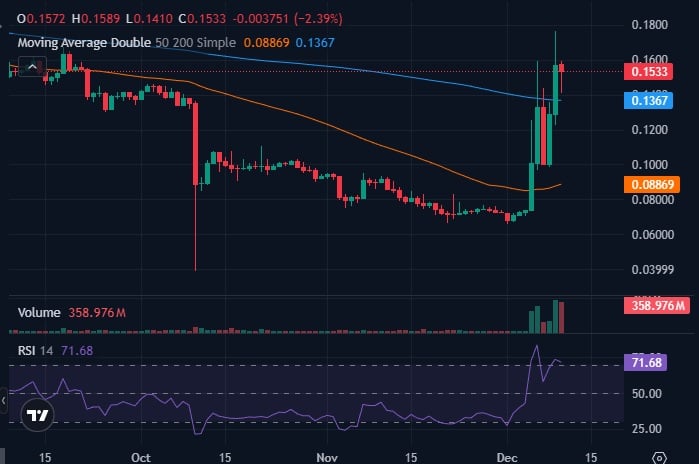
However, several bearish signals remain present, including RSI divergence, weakening volume, and negative market sentiment ahead of broader macroeconomic catalysts. If the price fails to hold above $0.14, a decline toward $0.12–$0.10 becomes more likely as bearish momentum reasserts itself.

Best Crypto Investments Beyond LUNA

For investors exploring opportunities beyond Terra, the wider market offers several emerging alternatives with stronger fundamentals. Crypto presales, in particular, allow early supporters to participate before they reach wider adoption.

Below are two meme coin presales that are both raising millions and have been recognized by experts as among the best crypto to buy now.

Bitcoin Hyper (HYPER)

Bitcoin Hyper is rapidly gaining attention as one of the most ambitious crypto presales of the year. The project, designed as a fast Bitcoin layer-2 chain, allows users to bridge Bitcoin into a new ecosystem where it can be staked, used in DeFi, or even for meme coins before returning to the main chain.

Its presale has already attracted hundreds of buyers, raising nearly $29.3 million, with $30 million considered imminent. The project’s tokenomics allocate substantial funds to treasury, marketing, exchange listings, rewards, and development, providing a strong foundation for growth.

With an expanding ecosystem including a wallet, explorer, and bridge, Bitcoin Hyper is positioning itself for mainstream adoption. Market interest continues to grow as the project demonstrates both innovation and scalability.

Visit Bitcoin Hyper

Pepenode (PEPENODE)

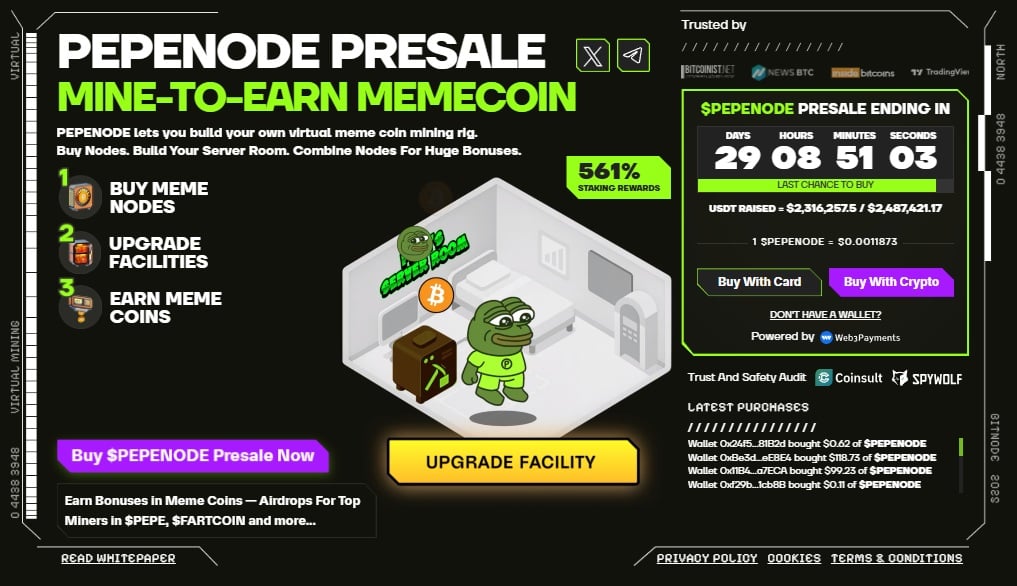
Pepenode is a crypto presale project combining a “mine-to-earn” concept with meme coin culture. Early supporters can purchase $PEPENODE tokens to set up virtual mining nodes, upgrade facilities, and earn meme coins, including Pepe and Fartcoin, with additional bonuses for top miners.

The system rewards strategic combinations and optimized setups, adding a skill-based element to staking. The presale has raised $2.3 million so far, with 29 days remaining to participate, and staking rewards up to 560% APY before gradually decreasing as the sale progresses.
Tokenomics prioritize community growth, protocol development, and marketing, with 35% allocated for engagement and activations. Pepenode aims to build a cult-like community while offering gamified yield opportunities.

Visit Pepenode

This article has been provided by one of our commercial partners and does not reflect Cryptonomist’s opinion. Please be aware our commercial partners may use affiliate programs to generate revenues through the links on this article.


Disclaimer: The articles reposted on this site are sourced from public platforms and are provided for informational purposes only. They do not necessarily reflect the views of MEXC. All rights remain with the original authors. If you believe any content infringes on third-party rights, please contact [email protected] for removal. MEXC makes no guarantees regarding the accuracy, completeness, or timeliness of the content and is not responsible for any actions taken based on the information provided. The content does not constitute financial, legal, or other professional advice, nor should it be considered a recommendation or endorsement by MEXC.

You May Also Like

Bitcoin devs cheer block reconstruction stats, ignore security budget concerns

Bitcoin devs cheer block reconstruction stats, ignore security budget concerns

The post Bitcoin devs cheer block reconstruction stats, ignore security budget concerns appeared on BitcoinEthereumNews.com. This morning, Bitcoin Core developers celebrated improved block reconstruction statistics for node operators while conveniently ignoring the reason for these statistics — the downward trend in fees for Bitcoin’s security budget. Reacting with heart emojis and thumbs up to a green chart showing over 80% “successful compact block reconstructions without any requested transactions,” they conveniently omitted red trend lines of the fees that Bitcoin users pay for mining security which powered those green statistics. Block reconstructions occur when a node requests additional information about transactions within a compact block. Although compact blocks allow nodes to quickly relay valid bundles of transactions across the internet, the more frequently that nodes can reconstruct without extra, cumbersome transaction requests from their peers is a positive trend. Because so many nodes switched over in August to relay transactions bidding 0.1 sat/vB across their mempools, nodes now have to request less transaction data to reconstruct blocks containing sub-1 sat/vB transactions. After nodes switched over in August to accept and relay pending transactions bidding less than 1 sat/vB, disparate mempools became harmonized as most nodes had a better view of which transactions would likely join upcoming blocks. As a result, block reconstruction times improved, as nodes needed less information about these sub-1 sat/vB transactions. In July, several miners admitted that user demand for Bitcoin blockspace had persisted at such a low that they were willing to accept transaction fees of just 0.1 satoshi per virtual byte — 90% lower than their prior 1 sat/vB minimum. With so many blocks partially empty, they succumbed to the temptation to accept at least something — even 1 billionth of one bitcoin (BTC) — rather than $0 to fill up some of the excess blockspace. Read more: Bitcoin’s transaction fees have fallen to a multi-year low Green stats for block reconstruction after transaction fees crash After…
Share
BitcoinEthereumNews2025/09/18 04:07
OpenAI and Partners Launch the Agentic AI Foundation for Open-Source AI Development

OpenAI and Partners Launch the Agentic AI Foundation for Open-Source AI Development

The post OpenAI and Partners Launch the Agentic AI Foundation for Open-Source AI Development appeared on BitcoinEthereumNews.com. Peter Zhang Dec 09, 2025 17:56 OpenAI, Anthropic, and Block, supported by tech giants, establish the Agentic AI Foundation under the Linux Foundation to advance open-source agentic AI infrastructure. In a significant move for the artificial intelligence community, OpenAI, in collaboration with Anthropic and Block, has co-founded the Agentic AI Foundation (AAIF) under the auspices of the Linux Foundation. This initiative, supported by industry leaders such as Google, Microsoft, AWS, Bloomberg, and Cloudflare, aims to develop open-source standards for agentic AI systems as they transition from experimental phases to real-world applications, according to OpenAI. The Role of Open Standards The foundation’s mission is to create a neutral ground for developing interoperable infrastructure for AI agents. As AI technology becomes increasingly integrated into business and consumer environments, the need for standardized protocols grows. Open standards are crucial for ensuring that AI systems can operate safely, efficiently, and across various platforms without the risk of fragmentation. OpenAI’s contribution to the AAIF includes the AGENTS.md, a straightforward open format providing agents with project-specific instructions. This effort is designed to facilitate long-term support and widespread adoption across the AI community. Building the Open Ecosystem Over the past year, OpenAI has been instrumental in developing open-source agentic infrastructure. Contributions include the Agents SDK, Apps SDK, and the Agentic Commerce Protocol, alongside open-source initiatives like the gpt-oss models and Codex CLI. These resources have significantly impacted the development community, demonstrated by their adoption in over two million public pull requests on GitHub. OpenAI’s efforts have laid the groundwork for AAIF by showcasing the potential of open, interoperable infrastructure. The foundation is envisioned as a collaborative space where developers and enterprises can build upon shared standards, ensuring technological advancements benefit the broader community. Donating AGENTS.md The AGENTS.md format, initially…
Share
BitcoinEthereumNews2025/12/10 19:30




