Japan Moves to Classify Crypto Under Securities Law

Japan’s financial regulator plans a major legal shift. This move will treat crypto assets like traditional investment products.
The nation’s financial regulators are now preparing a key change. They intend to move crypto asset oversight completely out of the existing payments regime. Instead, they will put it under a stricter framework. This new framework is specifically aimed at investment and securities markets.
FSA Proposes Stricter Disclosures for Crypto Tokens
The Financial Services Agency, or FSA, released a major report. It is from the Working Group of Financial System Council. The detailed document specifies a plan of the regulatory status of cryptocurrencies. This is a plan that requires more than one financial sector.
Specifically, the document proposes a change in the legal basis of crypto regulation. It would be moved from the Payment Services Act (PSA) to the Financial Instruments and Exchange Act (FIEA). The key legislation for regulating securities, trading and disclosures is the FIEA.
Related Reading: Crypto News: Japan FSA Plans Mandatory Reserve Funds for Crypto Exchanges | Live Bitcoin News
The reason for changing is clearly highlighted in the report. It noted that crypto assets are being used as an investment target increasingly. This applies not only to Japan, but also to the world. Therefore, there is a need to protect users, which means they need to be regulated. It must deal with cryptos just like any other financial product.
A number of proposals have been put forward in a steady stream through 2024 and 2025. Together, they illustrate a very definitive change. It is clear how Japan aims to manage the trading and exchange operations and the safety of investors. The focus is now on investor protection.
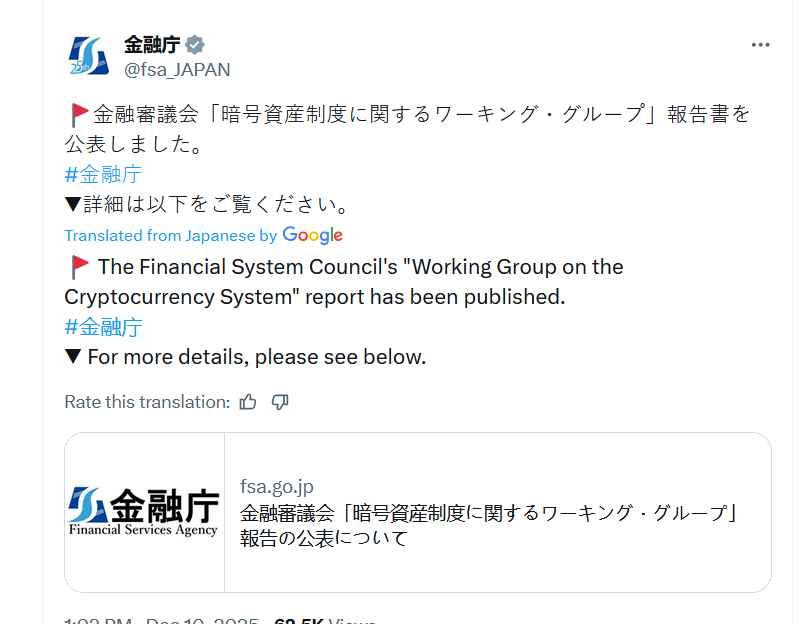 Source: FSA
One fundamental change is to enhance data disclosure rules. Regulators are now scrutinizing initial exchange offerings (IEOs) more closely. Consequently, they require projects to provide key information before any sale. Moreover, they demand a clearer description of how each project maintains control. These steps aim to increase transparency and protect investors throughout the fundraising process.
New Rules on Insider Trading to Enhance Market Integrity
The recommendations also mean calls for explicit insider trading rules. These rules would pertain to critical events. Such occurrences include token listings, major system breaches, and large-scale sales by the issuers. Exchanges will have the responsibility of providing neutral risk assessments. This must have verifiable data as a basis.
The working group contends that IEOs are very similar to securities offerings. This is because new assets are purchased by users or the existing tokens are traded. In it, it mentions that user crypto transactions are akin to security transactions. Timely and full information is very important for buyers.
Moreover, new obligations would fall on the issuers. Completely decentralized projects would be affected. They would be required to disclose the identity of the people or entities behind the token. The goal of the framework is to close gaps. This will avoid anonymous teams that do not properly document raising money.
Moving crypto oversight under the FIEA would bring the FSA greater power. This includes having more enforcement instruments against unregistered trading venues. The scope is overseas platforms that specifically aim at Japanese users. The proposal provides for the restriction of access to unapproved exchanges.
The report includes express prohibitions on market abuse and insider trading. These are areas where Japanese crypto law has been behind. Other standards, such as the EU’s MiCA regime are more advanced. Regulators are interested in ensuring that the employees of the issuer or exchange cannot exploit the non-public information. This move is in line with a major international trend. The shift reflects the fact that much of the sector activity is around investing. The focus is less on simple payments.
The post Japan Moves to Classify Crypto Under Securities Law appeared first on Live Bitcoin News.
You May Also Like

Solana Price Prediction 2026: Mercado Bitcoin Research Says BTC Bottom Is Near as Pepeto Offers What DOGE SHIB and PEPE Never Could

Robinhood’s RVI Stock Plunges 16% After IPO Falls Short of $1B Target