On-chain data shows the Bitcoin Realized Cap Growth indicator has continued to decline recently, a sign new capital inflows lack momentum. Bitcoin Realized Cap Growth Has Been Heading Down Recently As explained by CryptoQuant community analyst Maartunn in a new post on X, the Bitcoin Realized Cap Growth has been trending lower recently. The “Realized Cap” is an on-chain capitalization model for BTC that calculates its total value by assuming the value of each individual token is equal to the spot price at which it was last transacted on the blockchain. Related Reading: Solana Enters Bear Territory: Realized Loss Now Outweighs Profit This is unlike the usual market cap, which simply calculates the total valuation of the asset by multiplying the number of tokens in circulation with the current spot price, considering the latest value of the cryptocurrency to be the one value for all coins. In short, what the Realized Cap represents is the amount of capital that the Bitcoin investors as a whole used to purchase the asset’s supply. On the other hand, the market cap is the value that the investors are carrying in the present. The Realized Cap itself isn’t the indicator of interest in the current discussion, but rather the Realized Cap Growth, measuring the 365-day changes occurring in the Realized Cap. Changes in the indicator naturally reflect the amount of capital exiting or entering the cryptocurrency. In other words, the Realized Cap Growth contains information about the asset’s netflow. Now, here is the chart shared by Maartunn that shows the trend in the 7-day and 59-day moving averages (MAs) of the Bitcoin Realized Cap Growth over the last few years: As displayed in the above graph, the Bitcoin Realized Cap Growth has witnessed both its 7-day and 59-day MAs reverse down recently, with the former line crossing under the latter. The trend indicates that growth in the Realized Cap has been slowing down during the recent market downturn. “This suggests Bitcoin is lacking momentum from new cost basis inflows,” noted the analyst. With the 7-day MA falling below the 59-day MA, the indicator is now flagging the current market to be in a “bear phase.” The last time this signal maintained for an extended duration was alongside BTC’s decline over the first few months of 2025. It now remains to be seen how long momentum from new capital inflows will stay weak for Bitcoin this time around. Related Reading: Bitcoin In An Opportunity Zone? Hash Ribbons Flash New Buy Signal In some other news, the Bitcoin short-term holders are still under a notable amount of stress, as CryptoQuant author IT Tech has pointed out in an X post. Short-term holders (STHs) are defined as the Bitcoin buyers who got into the market during the past 155 days. Despite the rebound BTC has seen since its November low, STHs are still in a loss of 10%. BTC Price At the time of writing, Bitcoin is floating around $92,400, down 1.5% over the last 24 hours. Featured image from Dall-E, CryptoQuant.com, chart from TradingView.comOn-chain data shows the Bitcoin Realized Cap Growth indicator has continued to decline recently, a sign new capital inflows lack momentum. Bitcoin Realized Cap Growth Has Been Heading Down Recently As explained by CryptoQuant community analyst Maartunn in a new post on X, the Bitcoin Realized Cap Growth has been trending lower recently. The “Realized Cap” is an on-chain capitalization model for BTC that calculates its total value by assuming the value of each individual token is equal to the spot price at which it was last transacted on the blockchain. Related Reading: Solana Enters Bear Territory: Realized Loss Now Outweighs Profit This is unlike the usual market cap, which simply calculates the total valuation of the asset by multiplying the number of tokens in circulation with the current spot price, considering the latest value of the cryptocurrency to be the one value for all coins. In short, what the Realized Cap represents is the amount of capital that the Bitcoin investors as a whole used to purchase the asset’s supply. On the other hand, the market cap is the value that the investors are carrying in the present. The Realized Cap itself isn’t the indicator of interest in the current discussion, but rather the Realized Cap Growth, measuring the 365-day changes occurring in the Realized Cap. Changes in the indicator naturally reflect the amount of capital exiting or entering the cryptocurrency. In other words, the Realized Cap Growth contains information about the asset’s netflow. Now, here is the chart shared by Maartunn that shows the trend in the 7-day and 59-day moving averages (MAs) of the Bitcoin Realized Cap Growth over the last few years: As displayed in the above graph, the Bitcoin Realized Cap Growth has witnessed both its 7-day and 59-day MAs reverse down recently, with the former line crossing under the latter. The trend indicates that growth in the Realized Cap has been slowing down during the recent market downturn. “This suggests Bitcoin is lacking momentum from new cost basis inflows,” noted the analyst. With the 7-day MA falling below the 59-day MA, the indicator is now flagging the current market to be in a “bear phase.” The last time this signal maintained for an extended duration was alongside BTC’s decline over the first few months of 2025. It now remains to be seen how long momentum from new capital inflows will stay weak for Bitcoin this time around. Related Reading: Bitcoin In An Opportunity Zone? Hash Ribbons Flash New Buy Signal In some other news, the Bitcoin short-term holders are still under a notable amount of stress, as CryptoQuant author IT Tech has pointed out in an X post. Short-term holders (STHs) are defined as the Bitcoin buyers who got into the market during the past 155 days. Despite the rebound BTC has seen since its November low, STHs are still in a loss of 10%. BTC Price At the time of writing, Bitcoin is floating around $92,400, down 1.5% over the last 24 hours. Featured image from Dall-E, CryptoQuant.com, chart from TradingView.com

Bitcoin Lacks Fresh Momentum As Realized Cap Growth Still Declining

2025/12/11 14:00
3 min read
For feedback or concerns regarding this content, please contact us at [email protected]

On-chain data shows the Bitcoin Realized Cap Growth indicator has continued to decline recently, a sign new capital inflows lack momentum.

Bitcoin Realized Cap Growth Has Been Heading Down Recently

As explained by CryptoQuant community analyst Maartunn in a new post on X, the Bitcoin Realized Cap Growth has been trending lower recently. The “Realized Cap” is an on-chain capitalization model for BTC that calculates its total value by assuming the value of each individual token is equal to the spot price at which it was last transacted on the blockchain.

This is unlike the usual market cap, which simply calculates the total valuation of the asset by multiplying the number of tokens in circulation with the current spot price, considering the latest value of the cryptocurrency to be the one value for all coins.

In short, what the Realized Cap represents is the amount of capital that the Bitcoin investors as a whole used to purchase the asset’s supply. On the other hand, the market cap is the value that the investors are carrying in the present.

The Realized Cap itself isn’t the indicator of interest in the current discussion, but rather the Realized Cap Growth, measuring the 365-day changes occurring in the Realized Cap.

Changes in the indicator naturally reflect the amount of capital exiting or entering the cryptocurrency. In other words, the Realized Cap Growth contains information about the asset’s netflow.

Now, here is the chart shared by Maartunn that shows the trend in the 7-day and 59-day moving averages (MAs) of the Bitcoin Realized Cap Growth over the last few years:
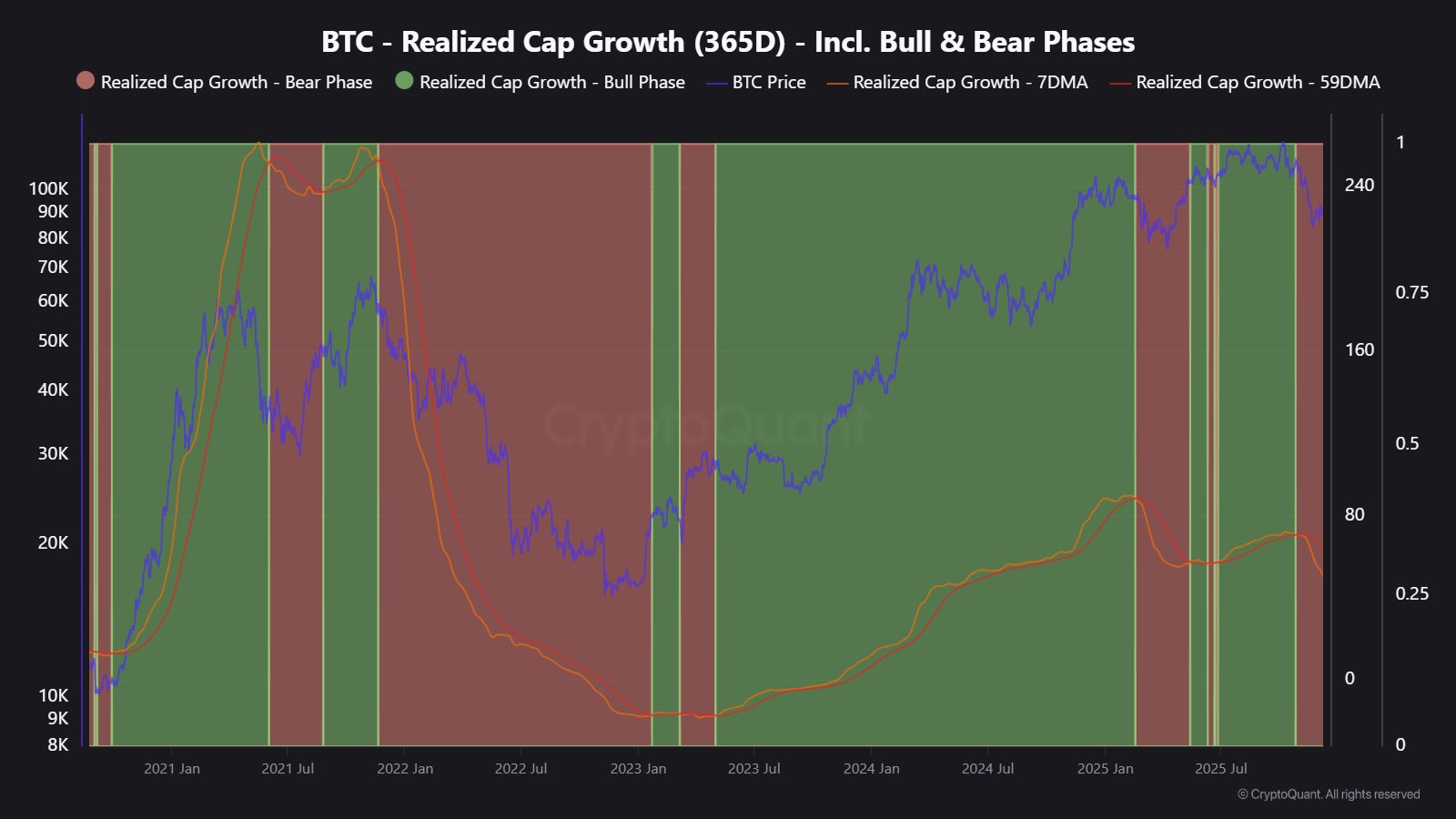
Bitcoin Realized Cap Growth

As displayed in the above graph, the Bitcoin Realized Cap Growth has witnessed both its 7-day and 59-day MAs reverse down recently, with the former line crossing under the latter.

The trend indicates that growth in the Realized Cap has been slowing down during the recent market downturn. “This suggests Bitcoin is lacking momentum from new cost basis inflows,” noted the analyst.

With the 7-day MA falling below the 59-day MA, the indicator is now flagging the current market to be in a “bear phase.” The last time this signal maintained for an extended duration was alongside BTC’s decline over the first few months of 2025. It now remains to be seen how long momentum from new capital inflows will stay weak for Bitcoin this time around.

In some other news, the Bitcoin short-term holders are still under a notable amount of stress, as CryptoQuant author IT Tech has pointed out in an X post.
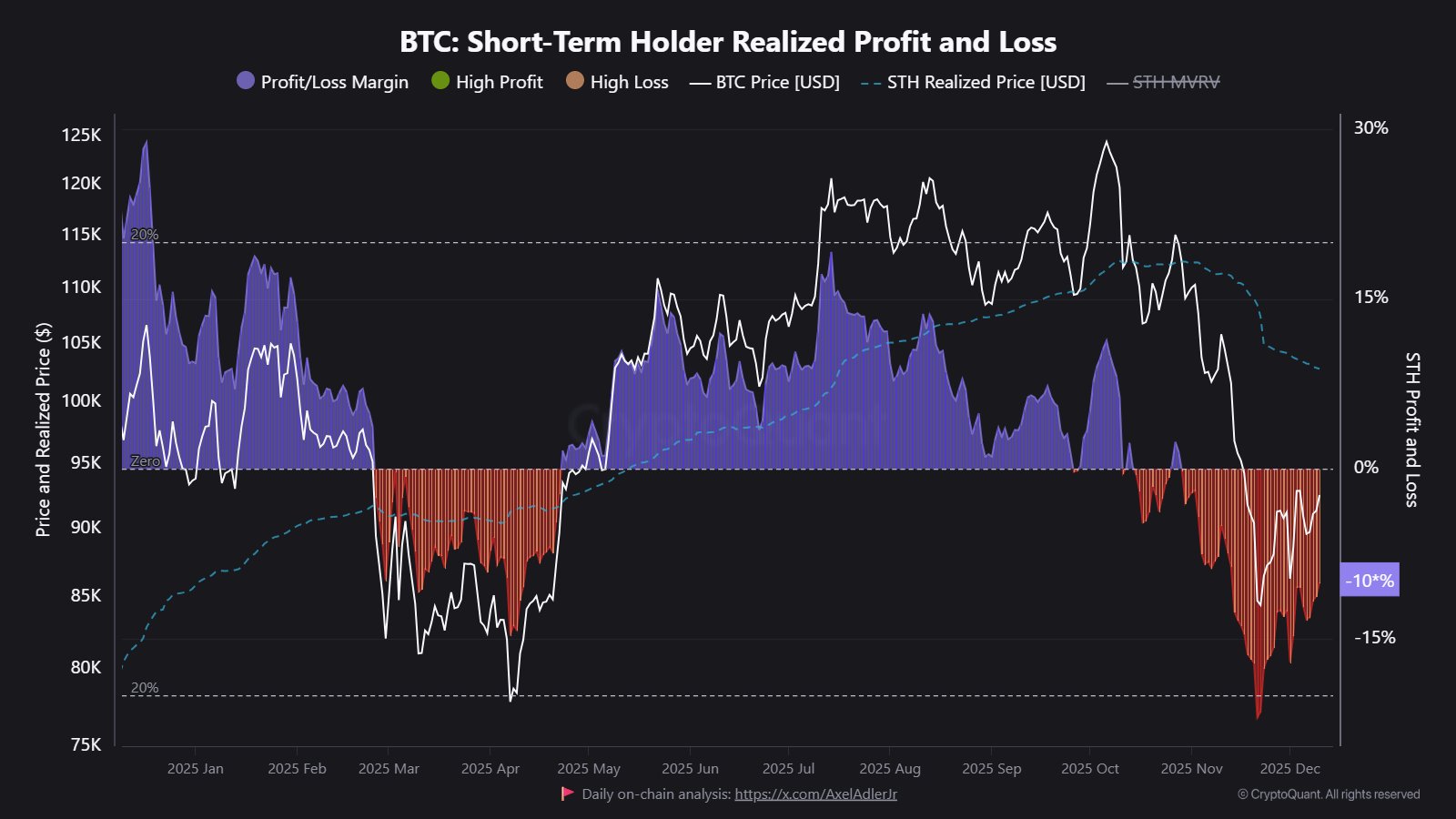
Bitcoin STH Profit/Loss Margin

Short-term holders (STHs) are defined as the Bitcoin buyers who got into the market during the past 155 days. Despite the rebound BTC has seen since its November low, STHs are still in a loss of 10%.

BTC Price

At the time of writing, Bitcoin is floating around $92,400, down 1.5% over the last 24 hours.

Bitcoin Price Chart
Disclaimer: The articles reposted on this site are sourced from public platforms and are provided for informational purposes only. They do not necessarily reflect the views of MEXC. All rights remain with the original authors. If you believe any content infringes on third-party rights, please contact [email protected] for removal. MEXC makes no guarantees regarding the accuracy, completeness, or timeliness of the content and is not responsible for any actions taken based on the information provided. The content does not constitute financial, legal, or other professional advice, nor should it be considered a recommendation or endorsement by MEXC.

You May Also Like

USD/CAD Consolidation Holds with Firm Support – Scotiabank’s Crucial Analysis

USD/CAD Consolidation Holds with Firm Support – Scotiabank’s Crucial Analysis

BitcoinWorld USD/CAD Consolidation Holds with Firm Support – Scotiabank’s Crucial Analysis The USD/CAD currency pair continues to exhibit a phase of consolidation
Share
bitcoinworld2026/03/11 01:55
Shiba Inu Price Forecast: Why This New Trending Meme Coin Is Being Dubbed The New PEPE After Record Presale

Shiba Inu Price Forecast: Why This New Trending Meme Coin Is Being Dubbed The New PEPE After Record Presale

While Shiba Inu (SHIB) continues to build its ecosystem and PEPE holds onto its viral roots, a new contender, Layer […] The post Shiba Inu Price Forecast: Why This New Trending Meme Coin Is Being Dubbed The New PEPE After Record Presale appeared first on Coindoo.
Share
Coindoo2025/09/18 01:13
ASIC Grants Stablecoin Distributors Regulatory Exemption in Australia

ASIC Grants Stablecoin Distributors Regulatory Exemption in Australia

The post ASIC Grants Stablecoin Distributors Regulatory Exemption in Australia appeared on BitcoinEthereumNews.com. Key Points:ASIC grants class relief for stablecoin intermediaries.Streamlines regulatory compliance for industry intermediaries.Potential for increased institutional stablecoin activity. The Australian Securities and Investments Commission (ASIC) granted a regulatory exemption on September 18 for stablecoin intermediaries, allowing distribution without separate financial services licenses within Australia. This exemption provides regulatory clarity, reducing compliance costs, and potentially increasing institutional stablecoin activity under AFS-licensed issuers, signaling upcoming broader reforms in Australia’s digital asset space. ASIC Exempts Stablecoin Providers from Additional Licensing ASIC has provided class exemption for stablecoin intermediaries, allowing them to distribute cryptocurrencies issued by licensed Australian institutions without needing separate financial services licenses. This measure helps address Australia’s regulatory challenges in the stablecoin sector. Intermediaries can now distribute stablecoins through licensed channels without additional AFS licenses, lowering operational barriers. The relief maintains issuer liability while mandating product disclosure to ensure transparency in the market. “The first-of-its-kind relief exempts intermediaries from the requirement to hold separate AFS, Australian market, or clearing and settlement facility licences when providing services related to stablecoins issued by an AFS licensee.” — ASIC Official Statement, Australian Securities and Investments CommissionBlockchain APAC CEO Steve Vallas described this move as a temporary transition toward broader reforms. Official reports emphasize that the exemption does not alter stablecoin classification as financial products. Potential Market Reforms and Global Impact Did you know? Australia’s decision marks its first major regulatory shift to boost stablecoin market efficiency while retaining oversight on financial offerings. Ethereum (ETH) is trading at $4,590.38, with a market cap of formatNumber(554077831078, 2) and 13.53% market dominance. Recent data from CoinMarketCap indicates a 2.25% price increase in 24 hours and an 82.78% rise over the past 90 days. Ethereum(ETH), daily chart, screenshot on CoinMarketCap at 05:36 UTC on September 18, 2025. Source: CoinMarketCap The Coincu research team posits that this exemption may…
Share
BitcoinEthereumNews2025/09/18 14:25