Bitcoin holds steady near 90K as the Fed delivers its third straight rate cut but the market’s reaction is anything but clear.Bitcoin holds steady near 90K as the Fed delivers its third straight rate cut but the market’s reaction is anything but clear.

Will Bitcoin Price Rise or Drop After the Fed’s Third Rate Cut?

2025/12/11 16:10

Bitcoin price has been hovering around the 90,000 USD mark after the Federal Reserve announced its third consecutive rate cut, lowering the key interest rate to the 3.5–3.75% range. While the move was intended to boost hiring amid a slowing job market, the policy split inside the Fed hints at uncertainty that’s spilling into financial markets—including crypto. Traders are now trying to decide whether this cut sets up a new bullish cycle for Bitcoin or if it signals deeper economic stagnation ahead.

Bitcoin Price Prediction: Is Bitcoin Losing Momentum?
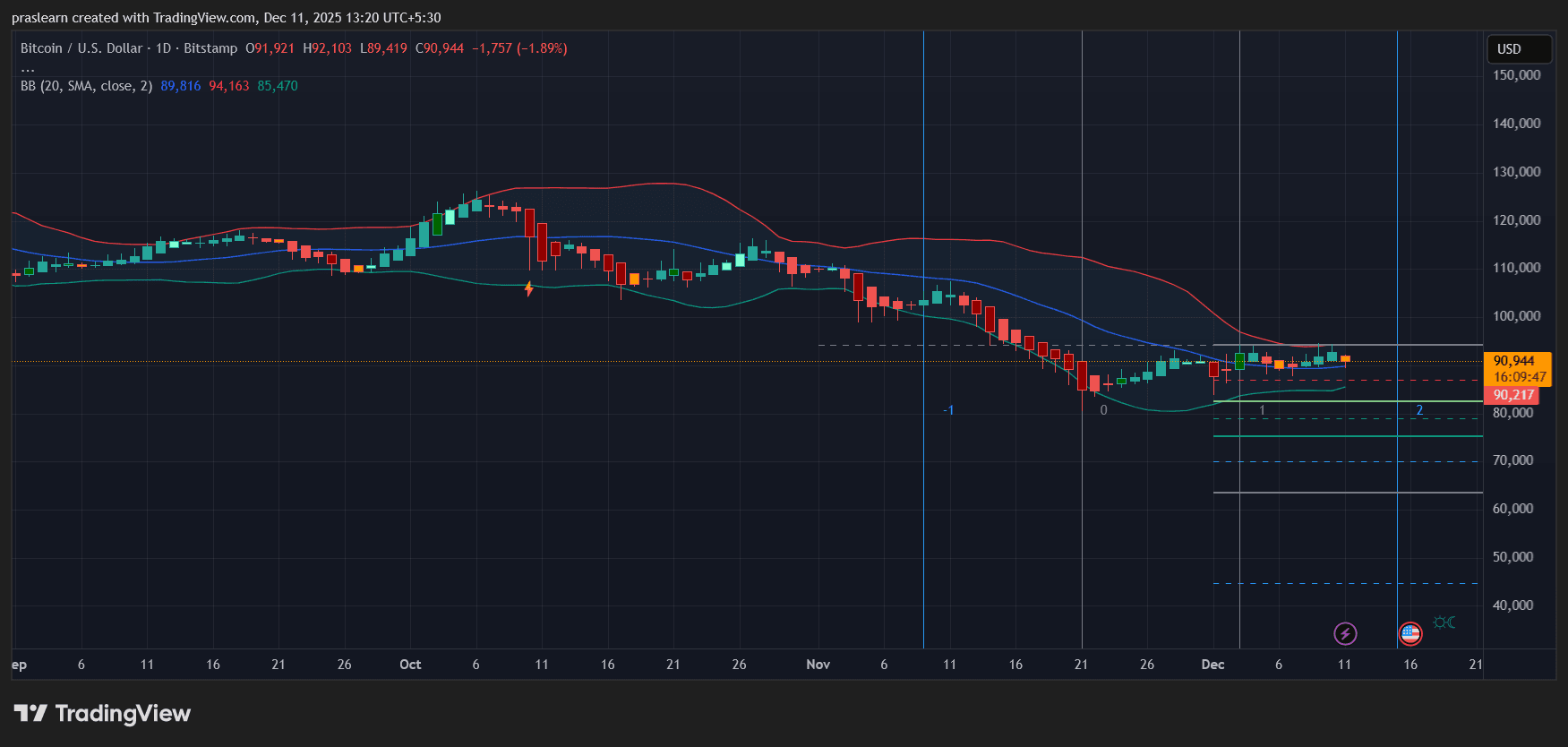
Bitcoin Price PredictionBTC/USD Daily Chart- TradingView

The daily chart shows BTC price trading near 90,944 USD, with the Bollinger Bands starting to tighten—an early sign of a potential volatility breakout. The candles are hovering just below the midline (SMA 20), and price action has repeatedly failed to close above 94,000 USD. This suggests the short-term trend remains mildly bearish unless bulls reclaim the upper band near 94,100 USD.

The 20-day simple moving average is acting as dynamic resistance, and the recent sequence of small-bodied candles shows indecision. Volume has also thinned out, hinting that traders are waiting for macro clarity before committing to new positions.

Fed’s Rate Cut: A Double-Edged Sword for Bitcoin Price Prediction

Typically, lower interest rates weaken the dollar and push investors toward risk assets like Bitcoin price. However, this particular rate cut comes with a warning sign: the Fed is divided, and some policymakers fear “stagflation”—slow growth combined with high inflation. That environment often benefits hard assets in the long term, but in the short run, it can trigger caution in leveraged markets.

If markets interpret this cut as the last one in the cycle, it may dampen speculative appetite and slow down crypto inflows. Bitcoin’s muted reaction so far shows investors are not convinced the easing will translate into sustained liquidity growth.

What the Chart Signals Next

The Bollinger Band base lies around 85,400 USD, forming a critical support zone. A break below that could open the door to 82,000 USD and potentially 78,000 USD if bearish momentum intensifies. On the upside, a daily close above 94,200 USD would mark a bullish breakout from the current compression range, setting up targets near 98,000–100,000 USD.

Momentum indicators suggest mild recovery potential but no strong reversal yet. The structure resembles an accumulation zone—BTC price is building a floor, but the conviction is missing. Historically, similar setups have preceded both sharp rallies and sudden breakdowns, depending on how macro catalysts play out.

Short-Term vs Long-Term Outlook

In the near term, Bitcoin price may remain range-bound between 85,000 and 95,000 USD. Traders should watch for confirmation candles above or below this range to determine the next directional move. Longer term, the macro backdrop—rate cuts, slower growth, and lingering inflation—still supports Bitcoin’s role as a hedge. But without a clear bullish trigger, it might consolidate before attempting any decisive rally toward new highs.

Bitcoin Price Prediction: Consolidation Before a Potential Breakout

If $BTC price manages to hold above 89,500 USD through the week, it could attempt a move back toward 95,000–97,000 USD. Failure to sustain above that level may invite renewed selling, dragging price toward 83,000 USD support. Overall, the structure points to short-term consolidation with a medium-term bullish bias—especially if inflation stabilizes and the Fed hints at more easing early next year.


Disclaimer: The articles reposted on this site are sourced from public platforms and are provided for informational purposes only. They do not necessarily reflect the views of MEXC. All rights remain with the original authors. If you believe any content infringes on third-party rights, please contact [email protected] for removal. MEXC makes no guarantees regarding the accuracy, completeness, or timeliness of the content and is not responsible for any actions taken based on the information provided. The content does not constitute financial, legal, or other professional advice, nor should it be considered a recommendation or endorsement by MEXC.

You May Also Like

South Korea Blockchain Industry: Eric Trump’s Amazing Vision for Asia’s Digital Future

South Korea Blockchain Industry: Eric Trump’s Amazing Vision for Asia’s Digital Future

BitcoinWorld South Korea Blockchain Industry: Eric Trump’s Amazing Vision for Asia’s Digital Future Eric Trump, co-founder of World Liberty Financial (WLFI) and the second son of President Donald Trump, recently made a compelling statement that has resonated throughout the global digital asset community. Speaking via video message to the prestigious Korea Blockchain Week 2025 conference in Seoul, he highlighted the undeniable potential of the South Korea blockchain industry. Trump expressed profound admiration for the nation’s remarkable passion and dynamic energy for blockchain technology, declaring it uniquely positioned to lead Asia’s digital future. What Fuels South Korea’s Blockchain Passion? During his recent travels, which included visits to bustling Hong Kong and technologically advanced Japan, Trump observed a distinct difference. He noted that few countries rival South Korea’s fervent enthusiasm and exceptional proficiency in virtual assets. This isn’t just a casual interest; it’s a deep-seated commitment that permeates various levels of society and business. The nation’s rapid adoption rates, innovative startup ecosystem, and a tech-savvy population create fertile ground for blockchain advancements. This collective drive ensures that the South Korea blockchain industry remains at the forefront of innovation, consistently pushing boundaries and exploring new applications for distributed ledger technology. How is South Korea Building a Robust Blockchain Framework? A critical factor underpinning South Korea’s rise is its proactive approach to regulation and institutional support. Trump specifically emphasized that the country’s rapidly developing institutional and legal framework is unrivaled across Asia. This robust foundation provides much-needed clarity and security for both developers and investors. Key aspects of this evolving framework include: Clearer Regulatory Guidelines: Efforts to establish comprehensive rules for virtual assets, fostering a more stable environment. Government Support: Initiatives and funding programs aimed at boosting blockchain research and development. Industry Collaboration: Strong partnerships between government bodies, academic institutions, and private enterprises to drive innovation. This strategic development is a clear indicator that the South Korea blockchain industry is not only embracing the future but actively shaping it with foresight and meticulous planning. Korea Blockchain Week: A Global Stage for the South Korea Blockchain Industry The Korea Blockchain Week (KBW) conference itself serves as a testament to the nation’s leadership. Trump lauded the event for its consistent success in bringing together diverse blockchain communities for years, evolving into a truly global festival for blockchain and Web3. KBW acts as a vital nexus, facilitating: Knowledge Exchange: Experts share insights on the latest trends and technological breakthroughs. Networking Opportunities: Connecting innovators, investors, and policymakers from around the world. Showcasing Innovation: Providing a platform for emerging projects and established players within the South Korea blockchain industry to demonstrate their advancements. Such high-profile events solidify South Korea’s reputation as a pivotal hub for digital innovation, drawing international attention and investment. What Does South Korea’s Blockchain Leadership Mean for Asia and Beyond? Eric Trump’s confident assertion that South Korea is set to establish itself as a leader in the blockchain industry carries significant weight. This leadership isn’t just about domestic success; it has profound implications for the broader Asian market and the global blockchain landscape. South Korea’s advancements can serve as a blueprint for other nations seeking to harness the power of blockchain. Its regulatory successes, technological innovations, and vibrant community can inspire and guide regional development. The nation’s commitment to fostering a dynamic environment ensures that the South Korea blockchain industry will continue to attract talent and capital, driving forward the evolution of Web3 technologies. Challenges remain, of course, including global regulatory harmonization and scaling solutions. However, South Korea’s proven dedication positions it exceptionally well to navigate these complexities and emerge as a dominant force. In conclusion, Eric Trump’s observations at Korea Blockchain Week 2025 underscore a powerful truth: South Korea is not merely participating in the blockchain revolution; it is actively leading it. With unparalleled passion, a robust legal and institutional framework, and a commitment to fostering global collaboration, the South Korea blockchain industry is undeniably poised for extraordinary growth. Its journey promises to shape the future of digital assets and Web3, not just in Asia, but across the entire world. Frequently Asked Questions (FAQs) Q1: Why is Eric Trump commenting on the South Korea blockchain industry? Eric Trump, as co-founder of World Liberty Financial (WLFI), is involved in the financial sector and has a keen interest in emerging technologies like blockchain. His comments highlight the global recognition of South Korea’s significant advancements in this field. Q2: What makes South Korea’s blockchain framework “unrivaled in Asia”? South Korea has been proactive in developing comprehensive institutional and legal frameworks for virtual assets. This includes clearer regulatory guidelines, government support for R&D, and strong industry collaboration, providing a stable and secure environment for blockchain innovation. Q3: What is Korea Blockchain Week (KBW)? Korea Blockchain Week (KBW) is a major annual conference in Seoul that brings together diverse blockchain communities. It serves as a global festival for blockchain and Web3, facilitating knowledge exchange, networking, and showcasing innovations from the global and local industry. Q4: What does South Korea’s leadership mean for the future of Web3? South Korea’s leadership in the blockchain industry means it can serve as a blueprint for other nations. Its innovations, regulatory successes, and vibrant community will likely inspire and guide regional and global development, driving the evolution and adoption of Web3 technologies worldwide. Q5: Are there any challenges for the South Korea blockchain industry? While poised for leadership, the South Korea blockchain industry still faces challenges such as navigating global regulatory harmonization, ensuring scalability of solutions, and addressing ongoing security concerns common to the broader crypto space. However, its robust framework positions it well to tackle these. If you found this insight into the dynamic South Korea blockchain industry valuable, please consider sharing it with your network! Spread the word about Asia’s potential leader in digital innovation. To learn more about the latest crypto market trends, explore our article on key developments shaping the blockchain industry’s institutional adoption. This post South Korea Blockchain Industry: Eric Trump’s Amazing Vision for Asia’s Digital Future first appeared on BitcoinWorld.
Share
Coinstats2025/09/23 11:05






