Neuron and Hedera are expected to join NATO’s DIANA project as speculations intensify.  A researcher has disclosed that Hedera’s aBFT is the highest level of securityNeuron and Hedera are expected to join NATO’s DIANA project as speculations intensify.  A researcher has disclosed that Hedera’s aBFT is the highest level of security

Hedera Enters the Defense Sector as Neuron Joins NATO’s Project DIANA for Next-Gen Autonomous Systems

For feedback or concerns regarding this content, please contact us at [email protected]
  • Neuron and Hedera are expected to join NATO’s DIANA project as speculations intensify. 
  • A researcher has disclosed that Hedera’s aBFT is the highest level of security in distributed systems. 

A leader in aviation technology and air traffic critical national infrastructure, Neuron, and public distributed ledger Hedera are reported to be making a dramatic entry into the machine economy and the defense sector.

According to reports, they are lined up for a partnership with the intergovernmental military alliance, the North Atlantic Treaty Organization (NATO). Researcher Marco Salzmann has disclosed that a press release will be out soon. Meanwhile, “the signals are already loud.”

All About the NATO and the Hedera Collaboration

On December 10, NATO announced that its flagship project, Defence Innovation Accelerator for the North Atlantic (DIANA), is selecting 150 pioneering companies from 24 NATO countries to participate in the 2026 Challenge program. As part of this, innovators would be tasked with developing dual-use technologies to solve ten critical defense and military challenges.

Shedding more light on this, Salzmann explained that the DIANA program seeks to accelerate autonomous systems, secure communication systems, encourage AI-driven defense innovations, and improve space, aviation, and sensor networks.

According to him, teams selected for the DIANA program would receive up to €400,000 ($468k) in funding. Not just that. They would also have access to NATO’s 10 accelerators and 90 test centers. Additionally, they could have direct collaboration with military end users and also benefit from “long-term adoption pathways into the defense and civilian sectors.”
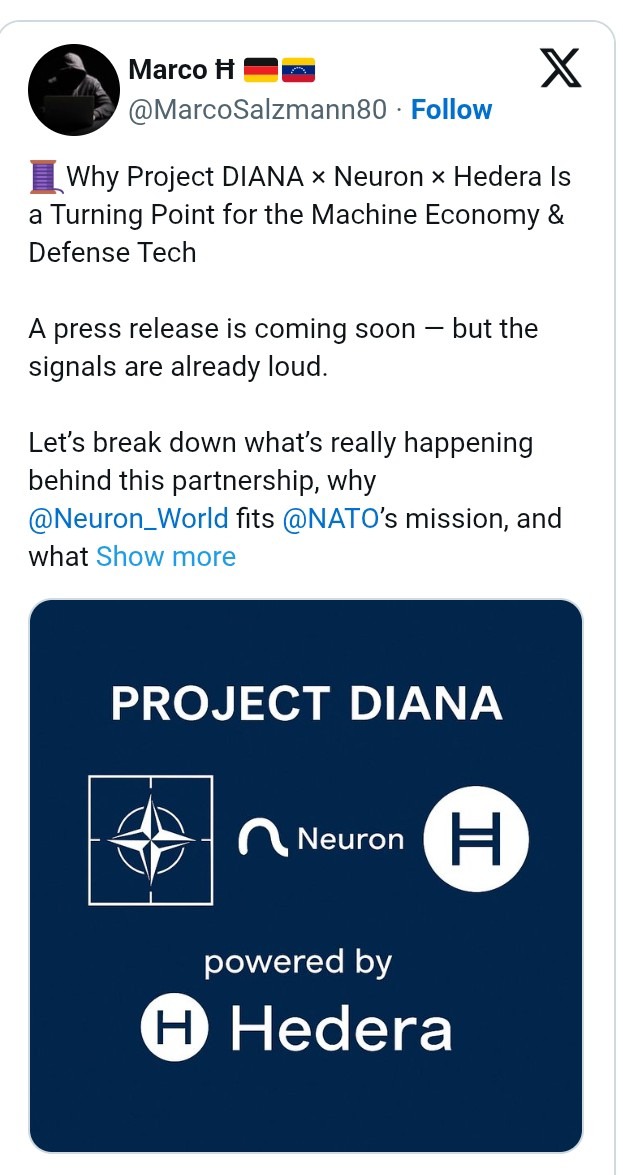
Hedera Enters the Defense Sector as Neuron Joins NATO’s Project DIANA for Next-Gen Autonomous SystemsSource: Marco H on X

Salzmann believes that Neuron is a good fit since it is already used for geospatial intelligence, real-time flight tracking, edge compute telemetry, and autonomous machine coordination. Also, Neuron has an edge since it is built on Hedera.

Explaining this point, he disclosed that defense systems need high throughput, deterministic finality, energy efficiency, and others. According to him, Hedera ticks all of these boxes.

Technically, Hedera’s aBFT is reported to be the highest level of security in distributed systems. Also, it is built for verifiable trust, which is one of the key requirements for defense technology.

Adding to this, Salzmann highlighted that Neuron could be used by DIANA for real-time location data, cross-border defense operations, drone and Unmanned Aerial Vehicle (UAV) coordination networks, as well as secure battlefield communication systems. In a nutshell, the researcher believes that Hedera’s timestamp and Neuron’s data index could be a perfect combination for this initiative.

According to Salzmann, an official confirmation of this could validate Hedera as a trust layer for critical infrastructure and a backend for autonomous systems.

Amidst the backdrop of this, Hashgraph Ventures has secured the first close of $100 million fund, as detailed in our earlier discussion. Also, Georgia has partnered with Hedera to explore blockchain-based upgrades, as noted in our previous post.

]]>


Market Opportunity
PUBLIC Logo
PUBLIC Price(PUBLIC)
$0.01454
$0.01454$0.01454
+2.03%
USD
PUBLIC (PUBLIC) Live Price Chart
Disclaimer: The articles reposted on this site are sourced from public platforms and are provided for informational purposes only. They do not necessarily reflect the views of MEXC. All rights remain with the original authors. If you believe any content infringes on third-party rights, please contact [email protected] for removal. MEXC makes no guarantees regarding the accuracy, completeness, or timeliness of the content and is not responsible for any actions taken based on the information provided. The content does not constitute financial, legal, or other professional advice, nor should it be considered a recommendation or endorsement by MEXC.

You May Also Like

Pi Network Maps 50M Coins Daily as Mainnet Tops 9B

Pi Network Maps 50M Coins Daily as Mainnet Tops 9B

Pi Network news today shows the migration engine appears to be speeding up again. Community posts claim the Pi Core Team is now mapping about 50 million Pi coins
Share
Coinfomania2026/03/03 15:31
FCA, crackdown on crypto

FCA, crackdown on crypto

The post FCA, crackdown on crypto appeared on BitcoinEthereumNews.com. The regulation of cryptocurrencies in the United Kingdom enters a decisive phase. The Financial Conduct Authority (FCA) has initiated a consultation to set minimum standards on transparency, consumer protection, and digital custody, in order to strengthen market confidence and ensure safer operations for exchanges, wallets, and crypto service providers. The consultation was published on May 2, 2025, and opened a public discussion on operational responsibilities and safeguarding requirements for digital assets (CoinDesk). The goal is to make the rules clearer without hindering the sector’s evolution. According to the data collected by our regulatory monitoring team, in the first weeks following the publication, the feedback received from professionals and operators focused mainly on custody, incident reporting, and insurance requirements. Industry analysts note that many responses require technical clarifications on multi-sig, asset segregation, and recovery protocols, as well as proposals to scale obligations based on the size of the operator. FCA Consultation: What’s on the Table The consultation document clarifies how to apply rules inspired by traditional finance to the crypto perimeter, balancing innovation, market integrity, and user protection. In this context, the goal is to introduce minimum standards for all firms under the supervision of the FCA, an essential step for a more transparent and secure sector, with measurable benefits for users. The proposed pillars Obligations towards consumers: assessment on the extension of the Consumer Duty – a requirement that mandates companies to provide “good outcomes” – to crypto services, with outcomes for users that are traceable and verifiable. Operational resilience: introduction of continuity requirements, incident response plans, and periodic testing to ensure the operational stability of platforms even in adverse scenarios. Financial Crime Prevention: strengthening AML/CFT measures through more stringent transaction monitoring and structured counterpart checks. Custody and safeguarding: definition of operational methods for the segregation of client assets, secure…
Share
BitcoinEthereumNews2025/09/18 05:40
Written on the UAE-Oman border: Survival lessons for the crypto natives after navigating through gunfire.

Written on the UAE-Oman border: Survival lessons for the crypto natives after navigating through gunfire.

Author: Brother Bing , co-founder of MegaETH Compiled by: Yuliya, PANews Having personally experienced the Middle East conflict and witnessed the awe-inspiring
Share
PANews2026/03/03 15:28






