

You can put aside up to 18% of your previous year’s income. That said, since you can carry over unused contribution limits, the actual amount you can contribute might be higher.
Your RRSP contribution limit comes from unused deduction room plus 18% of last year’s income. Use our RRSP calculator to find your exact limit for this year. TheYour RRSP contribution limit comes from unused deduction room plus 18% of last year’s income. Use our RRSP calculator to find your exact limit for this year. The
What’s my RRSP contribution limit?
For feedback or concerns regarding this content, please contact us at [email protected]
Your RRSP contribution limit is the maximum amount you can add to your registered retirement savings plan each year without triggering penalties. It’s based on your unused RRSP deduction room plus 18% of your previous year’s earned income, up to the annual CRA limit.
Use our RRSP contribution limit calculator below to find your exact number for this year.
TL;DR RRSP contribution rules, explained
- Every year, the government announces the annual contribution limits for RRSP accounts.
- Your RRSP contribution limit is based on your previous year’s income and past contribution amount.
- If you don’t fully contribute to your RRSP, you can carry over the limit and contribute more than what’s allowed for the following year.
- If you’re part of an employer pension plan, your RRSP contribution room is reduced by a “pension adjustment” (PA). You can find this number on your T4.
What’s an RRSP?
A registered retirement savings account (RRSP) is just one of many ways you can save for retirement. You can open one with a preferred bank or financial institution and fund it with cash, guaranteed investment certificates (GICs), mutual funds, exchange-traded funds (ETFs), bonds, and stocks.
You’ll contribute to either an individual, spousal, or group RRSP.
- The individual account puts you in charge of investments and gives you the ability to claim the tax deduction. You can also contribute to your spouse’s account and claim the tax deduction yourself.
- If your employer offers a group RRSP, you can designate a specific amount of your paycheque to go towards the account, which your employer manages.
One of the most important things to remember about an RRSP is that you’re funding the account with money that hasn’t been taxed yet. This means you’ll pay tax at the time of withdrawal.
Rankings
Compare the best RRSP rates in Canada
read now
RRSP contribution limits by year
Take a look at the annual contribution limit for each year since 2014. Since the money you contribute reduces your taxable income for the year, the government issues contribution limits that are updated annually.
| Tax year | Contribution limit |
|---|---|
| 2026 | $33,810 |
| 2025 | $32,490 |
| 2024 | $31,560 |
| 2023 | $30,780 |
| 2022 | $29,210 |
| 2021 | $27,830 |
| 2020 | $27,230 |
| 2019 | $26,500 |
| 2018 | $26,230 |
| 2017 | $26,010 |
| 2016 | $25,370 |
| 2015 | $24,930 |
| 2014 | $24,270 |
The RRSP deadline this year: March 2, 2026
RRSP deadlines are always 60 days into the following calendar year. Since March 1 falls on a Sunday in 2026, the CRA’s deadline for 2025 contributions will be Monday, March 2, 2026.
Where can you find your RRSP contribution limit?
Our RRSP contribution limit calculator can give you a general idea of how much you can contribute, but you can access the official amount from the Canada Revenue Agency (CRA) by:
- Logging into your CRA account: From your dashboard, you can view your limit, track your refund, make updates to your tax return, and monitor payments.
- Checking your Notice of Assessment: The CRA sends you this form after it processes your tax return. The notice provides your contribution limit for the following year and shows your unused contribution room.
- Calling the Tax Information Phone Systems (TIPS) number: Provide your Social Insurance Number and have your previous tax return ready.
- Checking your RRSP Deduction Limit Statement: Your latest notice of assessment (or reassessment) will show your contribution limit.
What happens if you over-contribute to your RRSP?
If you overcontribute to your RRSP by more than $2,000, you will be subject to a penalty tax. Typically, the penalty is 1% per month on the excess contribution for as long as it remains in your account. You can stop the penalty from growing by withdrawing the excess amount.
What is the age limit to contribute?
Anyone with an income can open and start contributing to an RRSP, but you’re only allowed to contribute until December 31 of the year you turn 71. Then, you’re required to cash out your RRSP, convert it to a registered retirement income fund (RRIF), or purchase an annuity.
If you contribute to your spouse’s RRSP, you can do so until December 31 of the year your spouse or common-law partner turns 71.
The types of investments you can hold in an RRSP
The government allows you to include the following in your RRSP:
- Cash (money): We’re talking money from savings or chequing accounts, but also money-market mutual funds. Since only government-issued cash qualifies, cryptocurrency is not an RRSP-eligible investment.
- Guaranteed investment certificates (GICs): These investment assets pay a guaranteed interest rate for a specified term—typically, longer terms offer higher rates. You can buy an RRSP-eligible GIC with cash inside your RRSP.
- Mutual funds: A mutual fund pools investments from many investors to buy a basket of assets, usually stocks or bonds. Mutual funds can be actively or passively managed, and their fees vary accordingly.
- Exchange-traded funds (ETFs): ETFs track, or mimic, various stock indexes, and their units trade on stock exchanges. You can choose from actively and passively managed ETFs.
- Bonds: Buying a bond is making a loan to a government or a corporation, in exchange for interest payments. Investors can buy individual bonds in an RRSP account, although it is more common to own bonds through a mutual fund or ETF.
- Stocks (also called equities or securities): You can generally include stocks listed on the Toronto Stock Exchange, the New York Stock Exchange, or the NASDAQ, but technically, any stock that trades on a recognized stock exchange qualifies.
- You can open an RRSP with a bank, credit union, or trust company, which can be a good option for those who want the option of speaking with someone face-to-face. In addition, discount online brokers and robo-advisors allow you to set up and manage your own RRSP account in minutes online, from the comfort of your home.
Rankings
The best ETFs in Canada
read now
What else can you use your RRSP money for?
You can withdraw your RRSP money at any time (keeping in mind that it will be taxed at that point), but there are two programs that allow you to withdraw money tax-deferred: the Home Buyers’ Plan (HBP) and the Lifelong Learning Plan (LLP).
The HBP allows you to withdraw up to $60,000 from your RRSP ($120,000 per couple) to put towards the down payment of a first home. You aren’t taxed on the withdrawal, but you’ll have to repay your RRSP over 15 years, starting two years after the withdrawal. There are temporary financial relief options available.
The LLP allows you to withdraw up to $10,000 a year (or up to $20,000 in total) to help you or your spouse/common-law partner cover the costs of post-secondary education. You can’t use it for your children’s education, though. If you withdraw funds, you have to repay your RRSP within 10 years, starting two years after your last eligible withdrawal, or five years after the first withdrawal, depending on which comes first.
Keep in mind: HBP and LLP withdrawals do not reduce your RRSP limit, and do not regenerate contribution room
FAQs
For the most part, it’s wise to max out an RRSP, but you may want to speak with a trusted financial advisor about your specific situation. An RRSP should just be one part of your overall retirement plan.
Technically, you don’t get anything back, but you can deduct $10,000 from your income when you file taxes for the year.
The 4% rule is a general retirement recommendation that you take out 4% of your retirement funds in the first year of retirement. Then, you withdraw that same amount, adjusting for inflation, every year thereafter.
Newsletter
Get free MoneySense financial tips, news & advice in your inbox.
subscribe now
Read more about GICs :
- How do the RRSP contribution carry forward rules work?
- “Help! My RRSPs are all over the place”
- The benefits and flexibility of family RESPs
- How to ladder your GICs in Canada
The post What’s my RRSP contribution limit? appeared first on MoneySense.
Disclaimer: The articles reposted on this site are sourced from public platforms and are provided for informational purposes only. They do not necessarily reflect the views of MEXC. All rights remain with the original authors. If you believe any content infringes on third-party rights, please contact [email protected] for removal. MEXC makes no guarantees regarding the accuracy, completeness, or timeliness of the content and is not responsible for any actions taken based on the information provided. The content does not constitute financial, legal, or other professional advice, nor should it be considered a recommendation or endorsement by MEXC.
You May Also Like

XRP Whale Accumulation Hits 30-Day High: Could Ripple (XRP) Be Gearing Up for a Breakout?
The post XRP Whale Accumulation Hits 30-Day High: Could Ripple (XRP) Be Gearing Up for a Breakout? appeared on BitcoinEthereumNews.com. Key Takeaways On March 26
Share
BitcoinEthereumNews2026/03/29 16:19
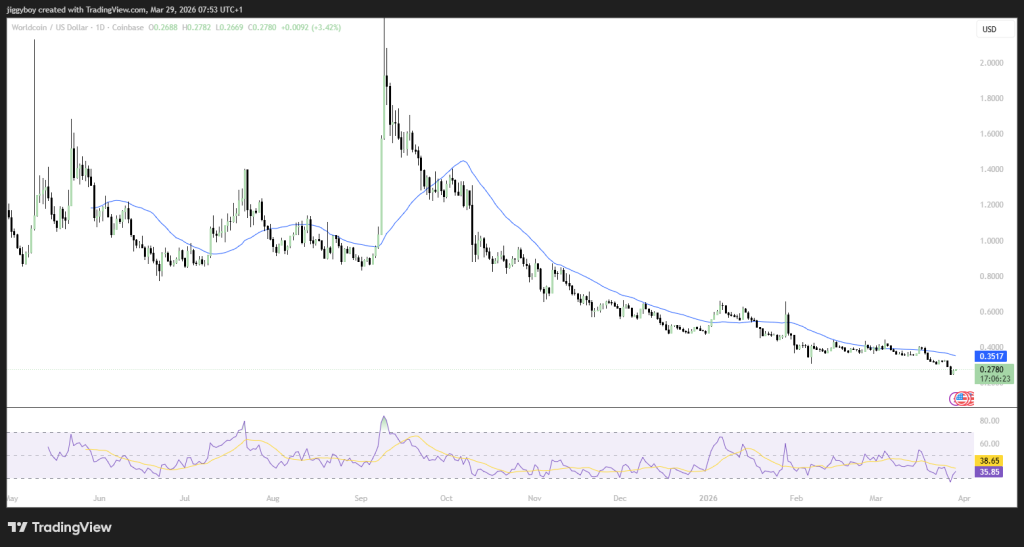
Crypto Price Prediction for Today, March 29: Worldcoin (WLD), XRP, Pi Coin
It’s been a mixed start for crypto today. Some coins are bouncing back, while others are still trying to find their footing. Let’s take a closer look at what’s
Share
Captainaltcoin2026/03/29 16:30
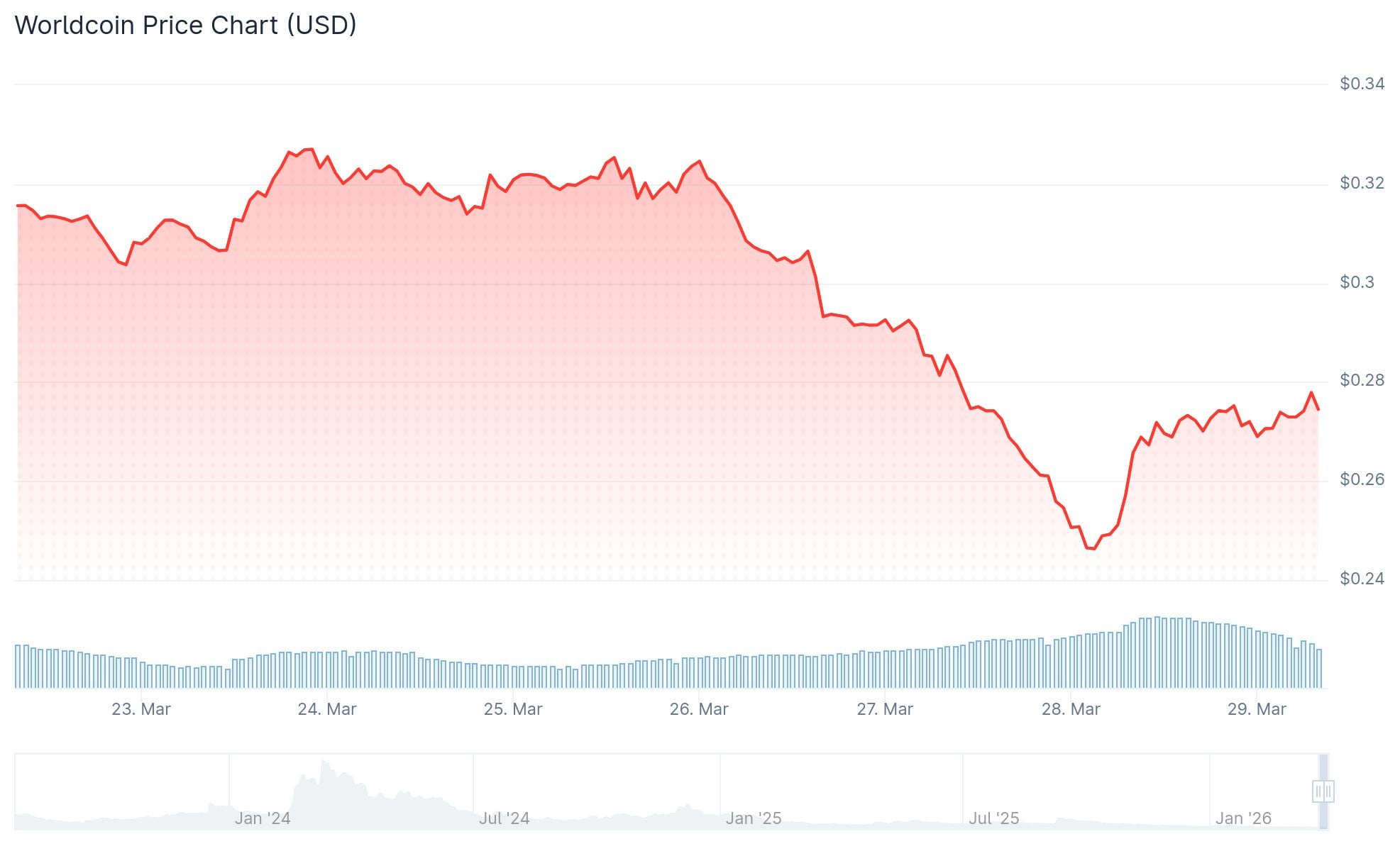
Worldcoin (WLD) Price: World Foundation Sells $65M in Tokens as WLD Hits All-Time Low
TLDR World Assets, a subsidiary of the World Foundation, sold $65M in WLD tokens via OTC deals with four counterparties starting March 20. Tokens were sold at an
Share
Coincentral2026/03/29 15:58

