

JPMorgan Launches Tokenized Yield Fund on Ethereum for Institutional Clients
JPMorgan introduces a tokenized money market fund on Ethereum, targeting qualified investors as regulatory clarity accelerates institutional blockchain adoption.
JPMorgan Chase has launched a tokenized money-market fund on the Ethereum blockchain. The move extends its expansion into blockchain finance. In addition, the fund is aimed at qualified investors who are looking to obtain a regulated digital yield. Therefore, the launch is indicative of increasing institutional demand since clearer U.S. crypto legislation this year.
According to WSJ, the new product is JPMorgan’s first tokenized money-market fund. Importantly, it makes the bank the biggest systemically important institution in the world to offer such a vehicle to the public. The fund is seeded with $100 million of JPMorgan capital, indicating internal confidence in the structure.
JPMorgan Brings Money Market Funds Onto Public Blockchain Rails
JPMorgan Asset Management manages the fund, branded My OnChain Net Yield, or MONY. Investors subscribe via the Morgan Money portal. In return, they get awarded digital tokens representing shares of funds in crypto wallets. This is similar to traditional ownership, but allows blockchain settlement.
Subscriptions and redemptions may be made in cash or USDC. USDC is the dollar-linked stablecoin by Circle. Like traditional money market funds, MONY invests in short-term debt instruments. Income is generated daily, which has familiar characteristics of risk and return.
Related Reading: JPMorgan Issues $50M Galaxy Digital Paper on Solana Blockchain | Live Bitcoin News
There is still limited eligibility. Qualified persons must have a minimum of $5 million in investments. Institutions are asking for a minimum of $25 million. In addition, the minimum investment is $1 million. These thresholds are putting the fund in a strong position for institutional and high-net-worth clients.
The fund is run on JPMorgan’s Kinexys Digital Assets platform. This infrastructure supports token issuance, custody, and transfers. As a result, JPMorgan incorporates existing compliance frameworks with the efficiency of blockchain, without replacing them.
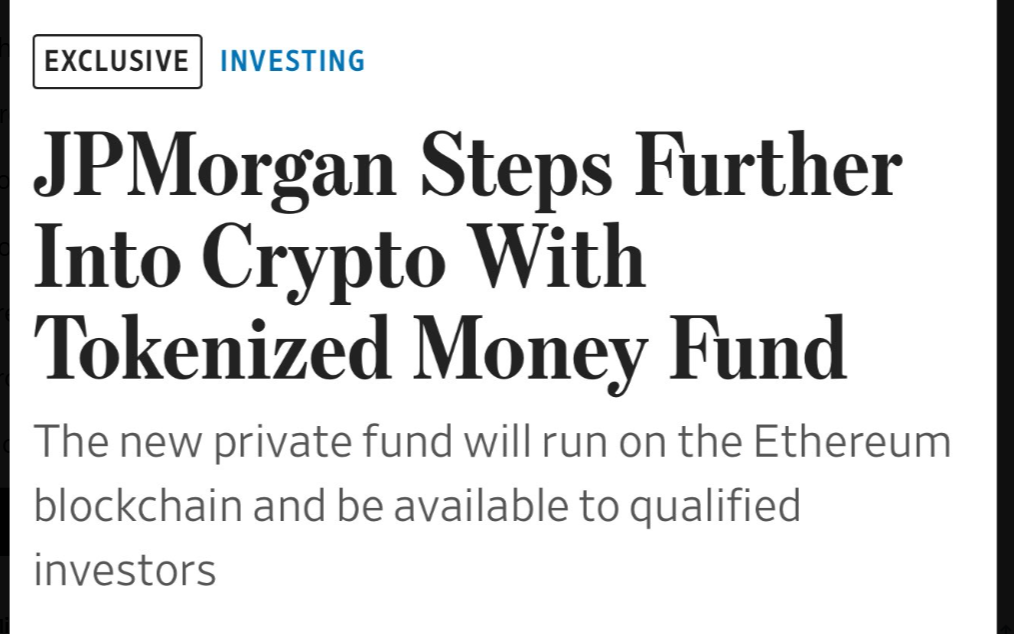 Source: WSJ
Increasing demand has been highlighted by John Donohue, JPMorgan Asset Management’s global head of liquidity. He said interest in tokenization jumped after passage of the Genius Act. That law brought a clearer U.S. framework for stablecoins and tokenized dollars earlier this year.
According to Donohue, clients are interested in blockchain products that are par with traditional fund choices. Therefore, JPMorgan strives to be a leader but offers familiarity. The bank places MONY as an extension of existing tools for liquidity and not as something that is being experimented with.
Regulatory Clarity Fuels Tokenization Across Major Asset Managers
The launch comes after wider regulatory advances in the United States. The Genius Act made it clear for dollar-denominated stablecoins. Meanwhile, debates over the Clarity Act indicated a more constructive regulatory approach. Together, these efforts made the uncertainty for traditional financial firms less.
As a result, large organizations took off tokenization projects. BlackRock and Franklin Templeton have introduced blockchain-based funds in the past. JPMorgan’s move is furthering that trend and putting its scale and payments expertise to work.
Tokenization has some operational benefits. Settlement times can be much reduced. Administrative costs may be reduced. JPMorgan’s tokenized collateral network already demonstrated near-instant repo settlement, which backs up these efficiency claims.
The structure is also beneficial to crypto native investors. Stablecoin holders are often in the position of holding idle balances and not yielding anything. MONY enables those investors to earn returns from low-risk assets without leaving the chain. Therefore, the fund is a bridge between traditional liquidity management and digital asset ecosystems.
Flexibility is at the forefront. Investors are able to transfer without disruption between cash and USDC. This is conducive to treasury operations across traditional finance and blockchain networks. As a result, JPMorgan resolves a longstanding friction point for institutions looking at digital assets.
Overall, the fund marks a sign of normalization of blockchain finance in the global banking world. Regulatory Clarity Allowed for Cautious Innovation JPMorgan’s move hints that tokenized funds may soon become the norm. Consequently, the gap between traditional markets and public blockchains is getting closer and closer.
The post JPMorgan Launches Tokenized Yield Fund on Ethereum for Institutional Clients appeared first on Live Bitcoin News.
You May Also Like

Uphold’s Massive 1.59 Billion XRP Holdings Shocks Community, CEO Reveals The Real Owners

Ethereum unveils roadmap focusing on scaling, interoperability, and security at Japan Dev Conference


