Bitcoin Faces Downward Pressure Amid Whales’ Net Selling and Short-Term Losses Bitcoin has experienced a notable decline, dropping below $86,000 as the market exhibitsBitcoin Faces Downward Pressure Amid Whales’ Net Selling and Short-Term Losses Bitcoin has experienced a notable decline, dropping below $86,000 as the market exhibits

Bitcoin Falls Under $86K as Whales Offload $2.78B in Crypto
2025/12/16 04:55
Bitcoin Falls Under $86k As Whales Offload $2.78b In Crypto

Bitcoin Faces Downward Pressure Amid Whales’ Net Selling and Short-Term Losses

Bitcoin has experienced a notable decline, dropping below $86,000 as the market exhibits contrasting activity between retail traders and large institutional holders. While smaller investors continue to buy the dips, major whales are actively reducing their positions, exerting downward pressure on the cryptocurrency’s price.

Key Takeaways

  • Retail and mid-sized wallets accumulated approximately $474 million in buying volume, while large holders sold $2.78 billion during the same period.
  • Short-term Bitcoin holders are frequently selling at a loss, signaling potential capitulation, but a confirmed reversal remains elusive.
  • The technical structure indicates increased downside risk, with a possible retest of quarterly lows at $80,600.
  • Order flow data reveals a significant divergence: smaller traders bid into the downtrend, whereas whales pose the primary selling force.

Tickers mentioned: None

Sentiment: Bearish

Price impact: Negative. The liquidation of large positions combined with technical breakdowns suggests continued downward momentum.

Whales Drive Market Pressure

Analysis from Hyblock Capital highlights a stark contrast in behavior across different trader segments. Retail wallets holding less than $10,000 have amassed a net volume delta of $169 million, consistently buying into the decline. Similarly, mid-sized traders ($1,000–$100,000) have accumulated a net spot position of $305 million, attempting to anticipate a recovery.

Bitcoin price and volume delta between different wallet sizes. Source: Hyblock

In contrast, whales, holding between $100,000 and $10 million, remain the dominant force on the sell side, with a cumulative volume delta of -$2.78 billion. This disparity indicates that retail and mid-sized traders are unable to absorb the large-scale distribution by institutional holders, perpetuating the liquidity imbalance.

On-chain metrics further underscore bearish sentiment. Axel Adler Jr points out that the short-term holder spent output profit ratio (SOPR), measured over the past week, has dipped below 1—hovering around 0.99—indicating that coins held less than 155 days are being sold at a loss, hinting at local capitulation phases. However, Adler emphasizes that such stress signals alone do not confirm a trend reversal; sustained recovery typically requires the SOPR to recover and remain above 1.
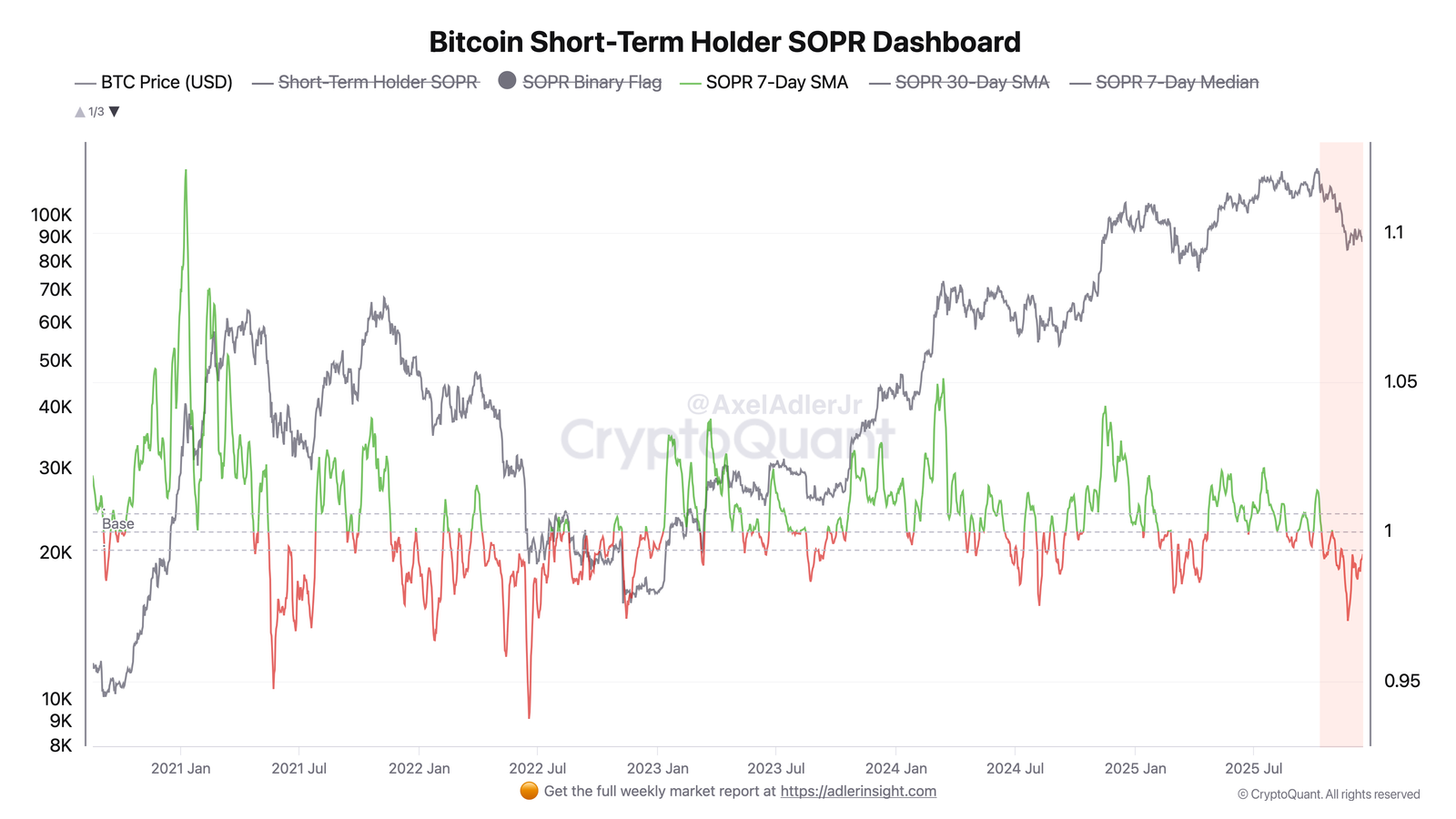
Bitcoin short-term holder SOPRBitcoin short-term holder SOPR. Source: Axel Adler Jr.

Technical Outlook and Potential Support Zones

From a technical perspective, Bitcoin’s recent breakdown of its rising wedge pattern and violation of the monthly VWAP signals increased downside risks. The price has now fallen below $87,600, with key support levels around the previous swing low of $83,800. If sell pressure persists, the market could target the quarterly lows at $80,600, risking further decline.

Both order flow analysis and on-chain signals suggest traders remain cautious, awaiting confirmation of a bottom before expecting a sustained rally. Veteran traders warn that the recent parabola breakdown increases the likelihood of an aggressive correction, potentially up to 80% from recent highs.

For market participants, patience remains essential as the current data indicates that a definitive bottom has yet to form, requiring further declines or consolidation before a credible recovery can be established.

This article was originally published as Bitcoin Falls Under $86K as Whales Offload $2.78B in Crypto on Crypto Breaking News – your trusted source for crypto news, Bitcoin news, and blockchain updates.

Market Opportunity
LayerNet Logo
LayerNet Price(NET)
$0.00000166
$0.00000166$0.00000166
0.00%
USD
LayerNet (NET) Live Price Chart
Disclaimer: The articles reposted on this site are sourced from public platforms and are provided for informational purposes only. They do not necessarily reflect the views of MEXC. All rights remain with the original authors. If you believe any content infringes on third-party rights, please contact [email protected] for removal. MEXC makes no guarantees regarding the accuracy, completeness, or timeliness of the content and is not responsible for any actions taken based on the information provided. The content does not constitute financial, legal, or other professional advice, nor should it be considered a recommendation or endorsement by MEXC.

You May Also Like

The Channel Factories We’ve Been Waiting For

The Channel Factories We’ve Been Waiting For

The post The Channel Factories We’ve Been Waiting For appeared on BitcoinEthereumNews.com. Visions of future technology are often prescient about the broad strokes while flubbing the details. The tablets in “2001: A Space Odyssey” do indeed look like iPads, but you never see the astronauts paying for subscriptions or wasting hours on Candy Crush.  Channel factories are one vision that arose early in the history of the Lightning Network to address some challenges that Lightning has faced from the beginning. Despite having grown to become Bitcoin’s most successful layer-2 scaling solution, with instant and low-fee payments, Lightning’s scale is limited by its reliance on payment channels. Although Lightning shifts most transactions off-chain, each payment channel still requires an on-chain transaction to open and (usually) another to close. As adoption grows, pressure on the blockchain grows with it. The need for a more scalable approach to managing channels is clear. Channel factories were supposed to meet this need, but where are they? In 2025, subnetworks are emerging that revive the impetus of channel factories with some new details that vastly increase their potential. They are natively interoperable with Lightning and achieve greater scale by allowing a group of participants to open a shared multisig UTXO and create multiple bilateral channels, which reduces the number of on-chain transactions and improves capital efficiency. Achieving greater scale by reducing complexity, Ark and Spark perform the same function as traditional channel factories with new designs and additional capabilities based on shared UTXOs.  Channel Factories 101 Channel factories have been around since the inception of Lightning. A factory is a multiparty contract where multiple users (not just two, as in a Dryja-Poon channel) cooperatively lock funds in a single multisig UTXO. They can open, close and update channels off-chain without updating the blockchain for each operation. Only when participants leave or the factory dissolves is an on-chain transaction…
Share
BitcoinEthereumNews2025/09/18 00:09
XRP Price Prediction: Can Ripple Rally Past $2 Before the End of 2025?

XRP Price Prediction: Can Ripple Rally Past $2 Before the End of 2025?

The post XRP Price Prediction: Can Ripple Rally Past $2 Before the End of 2025? appeared first on Coinpedia Fintech News The XRP price has come under enormous pressure
Share
CoinPedia2025/12/16 19:22
BlackRock boosts AI and US equity exposure in $185 billion models

BlackRock boosts AI and US equity exposure in $185 billion models

The post BlackRock boosts AI and US equity exposure in $185 billion models appeared on BitcoinEthereumNews.com. BlackRock is steering $185 billion worth of model portfolios deeper into US stocks and artificial intelligence. The decision came this week as the asset manager adjusted its entire model suite, increasing its equity allocation and dumping exposure to international developed markets. The firm now sits 2% overweight on stocks, after money moved between several of its biggest exchange-traded funds. This wasn’t a slow shuffle. Billions flowed across multiple ETFs on Tuesday as BlackRock executed the realignment. The iShares S&P 100 ETF (OEF) alone brought in $3.4 billion, the largest single-day haul in its history. The iShares Core S&P 500 ETF (IVV) collected $2.3 billion, while the iShares US Equity Factor Rotation Active ETF (DYNF) added nearly $2 billion. The rebalancing triggered swift inflows and outflows that realigned investor exposure on the back of performance data and macroeconomic outlooks. BlackRock raises equities on strong US earnings The model updates come as BlackRock backs the rally in American stocks, fueled by strong earnings and optimism around rate cuts. In an investment letter obtained by Bloomberg, the firm said US companies have delivered 11% earnings growth since the third quarter of 2024. Meanwhile, earnings across other developed markets barely touched 2%. That gap helped push the decision to drop international holdings in favor of American ones. Michael Gates, lead portfolio manager for BlackRock’s Target Allocation ETF model portfolio suite, said the US market is the only one showing consistency in sales growth, profit delivery, and revisions in analyst forecasts. “The US equity market continues to stand alone in terms of earnings delivery, sales growth and sustainable trends in analyst estimates and revisions,” Michael wrote. He added that non-US developed markets lagged far behind, especially when it came to sales. This week’s changes reflect that position. The move was made ahead of the Federal…
Share
BitcoinEthereumNews2025/09/18 01:44