Bitcoin has retraced to the $85,000 level, a critical support zone that bulls must defend to prevent a deeper breakdown. After failing to reclaim higher levels,Bitcoin has retraced to the $85,000 level, a critical support zone that bulls must defend to prevent a deeper breakdown. After failing to reclaim higher levels,

Who Really Sold The Dip? On-Chain Data Exposes Bitcoin’s True Sellers

2025/12/17 05:00
3 min read
For feedback or concerns regarding this content, please contact us at [email protected]

Bitcoin has retraced to the $85,000 level, a critical support zone that bulls must defend to prevent a deeper breakdown. After failing to reclaim higher levels, price action has slowed and volatility has compressed, reinforcing a market environment dominated by apathy and fear.

Sentiment across the crypto space has deteriorated sharply, with a growing number of analysts openly discussing the possibility of a prolonged bear market extending into next year. In this context, understanding who is actually selling becomes far more important than the price move itself.

According to a recent CryptoQuant report, Bitcoin’s pullback from the ~$88.2K region toward ~$85K provides a clean on-chain read of market behavior beneath the surface. Exchange inflow data segmented by Short-Term Holders (STH) and Long-Term Holders (LTH) shows that the decline was not driven by structural distribution from long-term investors.

Historically, bear markets accelerate when long-term holders begin distributing supply. The absence of that behavior suggests the current drawdown reflects positioning adjustments and risk reduction rather than a collapse in long-term conviction. As Bitcoin tests $85K, the market is not only evaluating price support levels.

Short-Term Profit-Taking, Not Structural Distribution

The CryptoQuant report by Crazzyblockk provides a precise breakdown of who actually drove Bitcoin’s recent pullback. On December 15, when BTC traded near the $88.2K level, Short-Term Holders sent approximately 24.7K BTC to exchanges.

Crucially, 86.8% of this supply was realized in profit, while only 13.2% was sold at a loss. In dollar terms, profitable STH inflows exceeded $1.89 billion, vastly outweighing loss-driven selling. This profile clearly indicates that sellers were primarily near-term buyers exiting from strength, rather than panicked participants capitulating under stress.

Bitcoin Long-Term holder P/L Inflow Volume | Source: CryptoQuant

As the price moved lower on December 16 toward the $86K area, total STH inflows dropped sharply to just 3.9K BTC. Although this smaller flow was realized at a loss, its limited size signals exhaustion rather than an acceleration of selling pressure. While the percentage of loss realization increased, the absolute volume did not—an important nuance often overlooked in surface-level market analysis.

Long-Term Holder behavior reinforces this constructive interpretation. Across both days, LTH inflows remained muted, falling from roughly 326 BTC to just 50 BTC. There is no sign of capitulation or meaningful distribution from this cohort. Overall, the data shows a market cooling through short-term profit-taking, not breaking through structural sell pressure.

Bitcoin Weekly Price Structure and Key Support Dynamics

Bitcoin has retraced sharply from its cycle highs and is now consolidating around the $85K–$88K zone. This area is technically significant. Price is currently interacting with the rising 100-week moving average, which has acted as dynamic support throughout the broader uptrend since 2023. So far, buyers are attempting to defend this level, preventing a deeper weekly close below it.
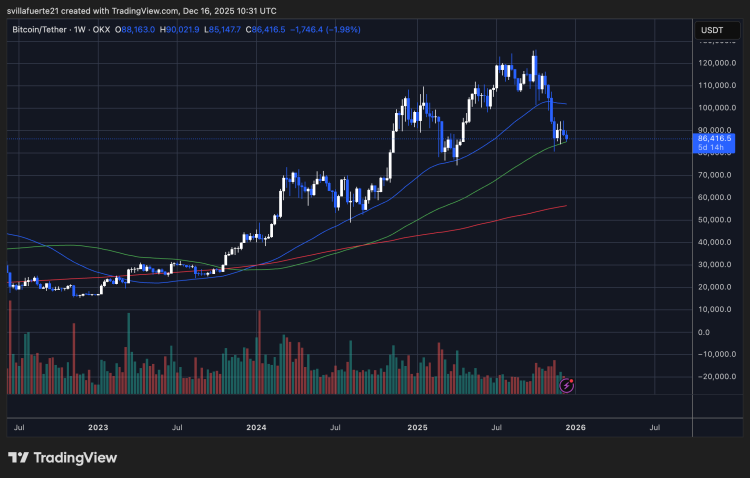
BTC consolidates around key support level | Source: BTCUSDT chart on TradingView

Structurally, the market has shifted from strong impulsive expansion into a corrective phase. The loss of the 50-week moving average earlier in the pullback signaled a transition from momentum-driven price discovery to consolidation and mean reversion. However, the longer-term trend remains intact as long as Bitcoin holds above the 200-week moving average, currently well below the price.

Volume has declined during the retracement, suggesting that selling pressure is not accelerating aggressively. This supports the view that the move is corrective rather than distributive. From a risk perspective, failure to hold the $85K region would open the door to a deeper retrace toward the low-$70K range.

Conversely, reclaiming the $90K–$92K zone would be required to restore bullish structure and momentum on the weekly timeframe.

Featured image from ChatGPT, chart from TradingView.com

Market Opportunity
BULLS Logo
BULLS Price(BULLS)
$323.38
$323.38$323.38
-0.52%
USD
BULLS (BULLS) Live Price Chart
Disclaimer: The articles reposted on this site are sourced from public platforms and are provided for informational purposes only. They do not necessarily reflect the views of MEXC. All rights remain with the original authors. If you believe any content infringes on third-party rights, please contact [email protected] for removal. MEXC makes no guarantees regarding the accuracy, completeness, or timeliness of the content and is not responsible for any actions taken based on the information provided. The content does not constitute financial, legal, or other professional advice, nor should it be considered a recommendation or endorsement by MEXC.

You May Also Like

Warning: npm core package axios version 1.14.1 is under active supply chain attacks.

Warning: npm core package axios version 1.14.1 is under active supply chain attacks.

PANews reported on March 31 that, according to Cointelegraph, Socket detected an active supply chain attack on version 1.14.1 of the npm core package axios. Attackers
Share
PANews2026/03/31 13:03
Won-pegged stablecoin KRW1 launches in South Korea on Avalanche

Won-pegged stablecoin KRW1 launches in South Korea on Avalanche

Stablecoin development in South Korea has advanced with the launch of KRW1, a won-pegged token issued on the Avalanche blockchain. Seoul-based digital asset firm BDACS announced the launch of KRW1 on September 17, a stablecoin fully backed by South Korean…
Share
Crypto.news2025/09/18 15:48
First Multi-Asset Crypto ETP Opens Door to Institutional Adoption

First Multi-Asset Crypto ETP Opens Door to Institutional Adoption

The post First Multi-Asset Crypto ETP Opens Door to Institutional Adoption appeared on BitcoinEthereumNews.com. The US Securities and Exchange Commission (SEC) has officially approved the Grayscale Digital Large Cap Fund (GDLC) for trading on the stock exchange. The decision comes as the SEC also relaxes ETF listing standards. This approval provides easier access for traditional investors and signals a major regulatory shift, paving the way for institutional capital to flow into the crypto market. Grayscale Races to Launch the First Multi-Asset Crypto ETP According to Grayscale CEO Peter Mintzberg, the Grayscale Digital Large Cap Fund ($GDLC) and the Generic Listing Standards have just been approved for trading. Sponsored Sponsored Grayscale Digital Large Cap Fund $GDLC was just approved for trading along with the Generic Listing Standards. The Grayscale team is working expeditiously to bring the FIRST multi #crypto asset ETP to market with Bitcoin, Ethereum, XRP, Solana, and Cardano#BTC #ETH $XRP $SOL… — Peter Mintzberg (@PeterMintzberg) September 17, 2025 The Grayscale Digital Large Cap Fund (GDLC) is the first multi-asset crypto Exchange-Traded Product (ETP). It includes Bitcoin (BTC), Ethereum (ETH), XRP, Solana (SOL), and Cardano (ADA). As of September, the portfolio allocation was 72.23%, 12.17%, 5.62%, 4.03%, and 1% respectively. Grayscale Digital Large Cap Fund (GDLC) Portfolio Allocation. Source: Grayscale Grayscale Investments launched GDLC in 2018. The fund’s primary goal is to expose investors to the most significant digital assets in the market without requiring them to buy, store, or secure the coins directly. In July, the SEC delayed its decision to convert GDLC from an OTC fund into an exchange-listed ETP on NYSE Arca, citing further review. However, the latest developments raise investors’ hopes that a multi-asset crypto ETP from Grayscale will soon become a reality. Approval under the Generic Listing Standards will help “streamline the process,” opening the door for more crypto ETPs. Ethereum, Solana, XRP, and ADA investors are the most…
Share
BitcoinEthereumNews2025/09/18 13:31

