In 2025, approximately 74% of Nigeria’s internet traffic on mobile devices originated from Android devices, while iOS devices…In 2025, approximately 74% of Nigeria’s internet traffic on mobile devices originated from Android devices, while iOS devices…

Android devices fueled 74% of Nigeria’s internet traffic on smartphones in 2025 – report

In 2025, approximately 74% of Nigeria’s internet traffic on mobile devices originated from Android devices, while iOS devices accounted for 26% of the traffic. This is according to a latest report by Cloudflare titled Cloudflare Radar 2025 Year in Review.

As the two leading mobile device operating systems globally are Google’s Android and Apple’s iOS, the report based the tracking of global internet traffic on web requests. In the explanation of its methodology, Cloudflare explained that the trends (from web requests) were used to detect what type of device is accessing a website.

“By analysing information in the User-Agent header included with each Web request, we can calculate the distribution of traffic by client operating system throughout the year,” it said. 

At 74% usage, Nigeria is placed in 87th position of countries where Android devices drive internet usage, while it sits 119th in the iOS device category with 26% usage. 
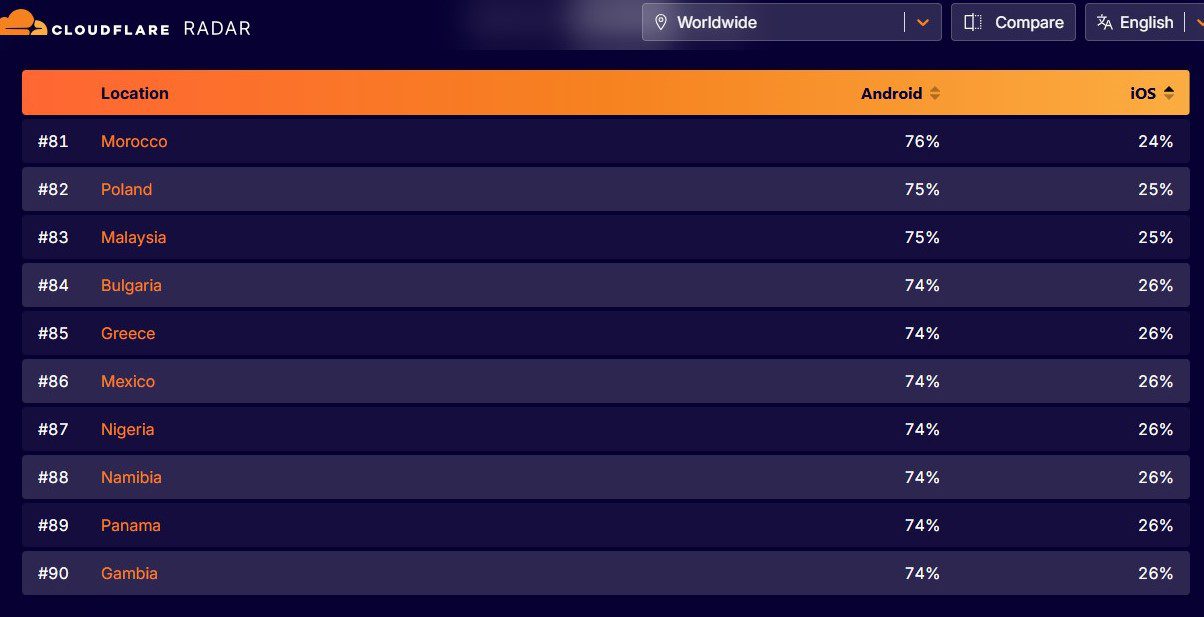
Android: Cloudflare Radar - NigeriaNigeria at 74% internet traffic on Android devices. (Metrics on Cloudflare Radar 2025

Moving up in the ladderboard, 127 countries saw 90% of internet traffic on mobile devices driven by Android in 2025. Papua New Guinea is the highest at 97%. Sudan, Malawi, Bangladesh, and Ethiopia also registered a 95% share or more. Android was responsible for 50% or more of mobile device traffic in 175 countries/regions. The Bahamas’ 51% share placed it at the bottom of that list.

For iOS traffic share, Monaco had the highest share, at 70%. iOS drove 50% or more of mobile device traffic in a total of 30 countries/regions, including Denmark (65%), Japan (57%), and Puerto Rico (52%). Papua New Guinea has the least iOS mobile device traffic at 3.5%. 

Globally, Android devices generated 75% of mobile device traffic while iOS saw 35%, recording a 2% YoY increase. The report explained that the devices continue to generate the majority of mobile device traffic globally due to the “wide distribution of price points, form factors, and capabilities of such devices.”

Also Read: Nigeria’s smartphone shipment grew by 29% in Q3 2025 driven by naira stability.

What’s driving the Android surge

The reasons behind the statistics are not far-fetched. Android smartphones continue to dominate in the global market due to their affordability and adoption in cost-sensitive locations such as Africa, India, Brazil and Eastern Europe. iPhone enjoys a significant market share in markets like the U.S., Japan, Canada, and Australia.

As of November 2025, data on Statcounter reveals that Android dominates the global smartphone market with a significant 71.94% share, while iOS has a 27.64% share. Others, such as Samsung, Linux and KalOS, held on to the remaining. In Nigeria, during the same period, Android held a share of 84.16% while iOS had 12.61%.
Further breakdown on the region reveals that Android dominates Africa at 85% of the market share, with iOS at 13%. In Latin America, it enjoys an 81.45% share in Brazil, driven by affordable devices. It also captured 68% of the Eastern European market share. 

In Asia, the devices dominate 80–95% of the Asian market, with India leading from the front with 95.16%, attributed to brands such as Xiaomi and Oppo.

Market Opportunity
Helium Mobile Logo
Helium Mobile Price(MOBILE)
$0.0002275
$0.0002275$0.0002275
-0.87%
USD
Helium Mobile (MOBILE) Live Price Chart
Disclaimer: The articles reposted on this site are sourced from public platforms and are provided for informational purposes only. They do not necessarily reflect the views of MEXC. All rights remain with the original authors. If you believe any content infringes on third-party rights, please contact [email protected] for removal. MEXC makes no guarantees regarding the accuracy, completeness, or timeliness of the content and is not responsible for any actions taken based on the information provided. The content does not constitute financial, legal, or other professional advice, nor should it be considered a recommendation or endorsement by MEXC.

You May Also Like

What We Know (and Don’t) About Modern Code Reviews

What We Know (and Don’t) About Modern Code Reviews

This article traces the evolution of modern code review from formal inspections to tool-driven workflows, maps key research themes, and highlights a critical gap
Share
Hackernoon2025/12/17 17:00
X claims the right to share your private AI chats with everyone under new rules – no opt out

X claims the right to share your private AI chats with everyone under new rules – no opt out

X says its Terms of Service will change Jan. 15, 2026, expanding how the platform defines user “Content” and adding contract language tied to the operation and
Share
CryptoSlate2025/12/17 19:24
Michael Saylor Pushes Digital Capital Narrative At Bitcoin Treasuries Unconference

Michael Saylor Pushes Digital Capital Narrative At Bitcoin Treasuries Unconference

The post Michael Saylor Pushes Digital Capital Narrative At Bitcoin Treasuries Unconference appeared on BitcoinEthereumNews.com. The suitcoiners are in town.  From a low-key, circular podium in the middle of a lavish New York City event hall, Strategy executive chairman Michael Saylor took the mic and opened the Bitcoin Treasuries Unconference event. He joked awkwardly about the orange ties, dresses, caps and other merch to the (mostly male) audience of who’s-who in the bitcoin treasury company world.  Once he got onto the regular beat, it was much of the same: calm and relaxed, speaking freely and with confidence, his keynote was heavy on the metaphors and larger historical stories. Treasury companies are like Rockefeller’s Standard Oil in its early years, Michael Saylor said: We’ve just discovered crude oil and now we’re making sense of the myriad ways in which we can use it — the automobile revolution and jet fuel is still well ahead of us.  Established, trillion-dollar companies not using AI because of “security concerns” make them slow and stupid — just like companies and individuals rejecting digital assets now make them poor and weak.  “I’d like to think that we understood our business five years ago; we didn’t.”  We went from a defensive investment into bitcoin, Saylor said, to opportunistic, to strategic, and finally transformational; “only then did we realize that we were different.” Michael Saylor: You Come Into My Financial History House?! Jokes aside, Michael Saylor is very welcome to the warm waters of our financial past. He acquitted himself honorably by invoking the British Consol — though mispronouncing it, and misdating it to the 1780s; Pelham’s consolidation of debts happened in the 1750s and perpetual government debt existed well before then — and comparing it to the gold standard and the future of bitcoin. He’s right that Strategy’s STRC product in many ways imitates the consols; irredeemable, perpetual debt, issued at par, with…
Share
BitcoinEthereumNews2025/09/18 02:12